
Buy PDF guide

Buy PDF guide — 8.57 USD

PDF — 8.57 USD

LOWER SAXONY - Harz Goslar Wernigerode Brocken

LOWER SAXONY - Harz Goslar Wernigerode Brocken

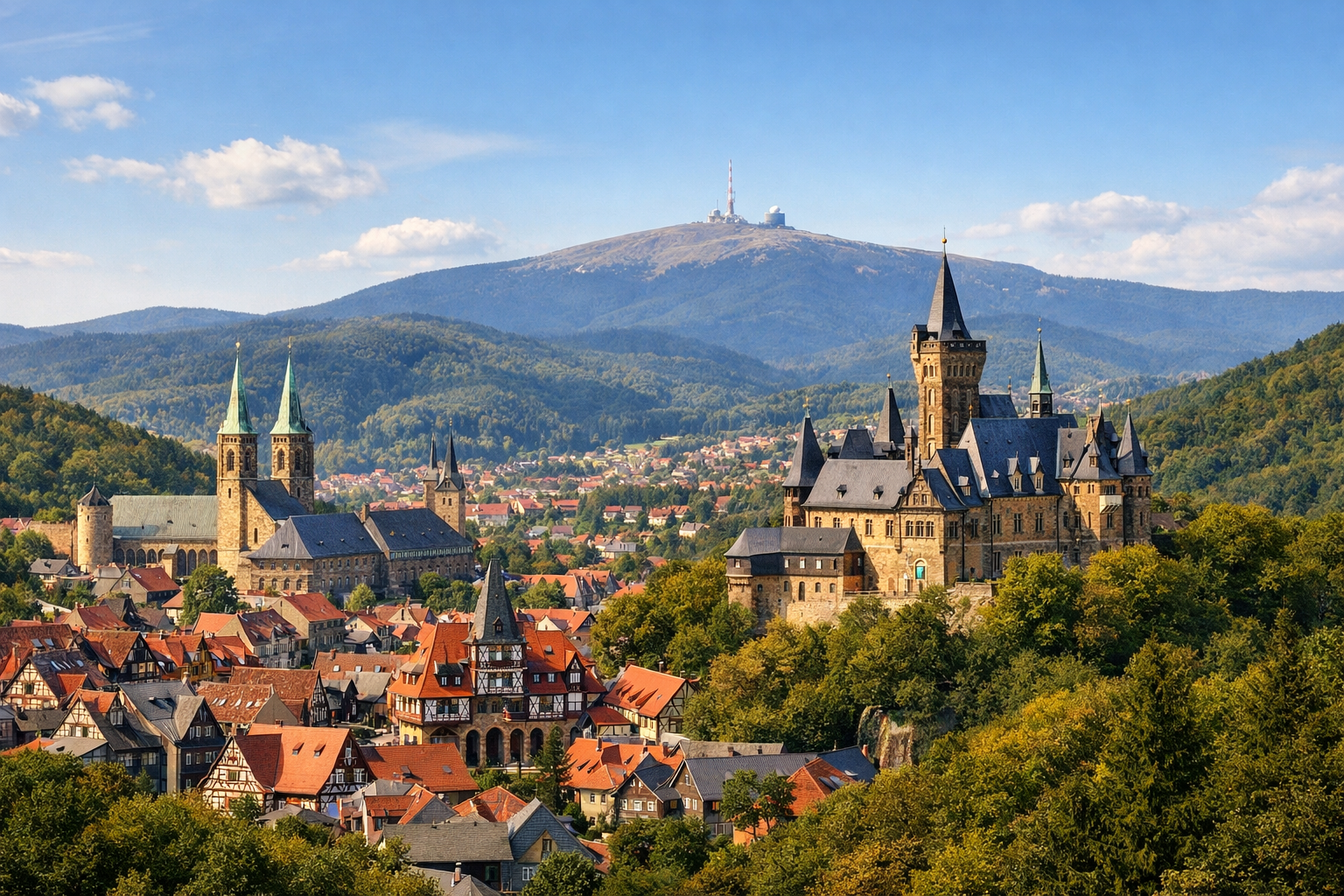
Discover Lower Saxony where medieval Goslar and colorful Wernigerode open the way to the wild beauty of the Harz Mountains. From elegant Hannover to the misty summit of the Brocken, this journey blends half-timbered towns, mountain railways, and dramatic forest landscapes.

🧭 DAY-BY-DAY ROUTE

Ready-made country and city routes with daily plans, sights, transport and accommodation. Buy PDF guides for independent travel.

🧭 DAY-BY-DAY ROUTE


Day 1 — Hannover → Goslar: old town and Imperial Palace

  • 🚆 Arrival at Hannover Airport and transfer to Goslar by train via Hannover Hbf: the journey usually takes about 1 h 45 min – 2 h 15 min depending on the connection. It’s a comfortable start for a short Harz itinerary: no need to rent a car right away, and after arrival you can check in, rest a little, and head out into town already in the second half of the day.

  • 🚶 Goslar is one of the most atmospheric towns in Lower Saxony, where the medieval fabric does not feel like a museum set, but like the living texture of the town itself. Its historic center, included on the UNESCO World Heritage list together with Rammelsberg, makes a strong impression precisely because of its wholeness: there isn’t just one “main postcard view,” but an entire labyrinth of cobbled streets, half-timbered houses, gates, towers, and quiet squares where you’ll want to stop at almost every turn. Start your walk at the Marktplatz and the famous carillon, then slowly wander deeper into the old town, admiring the carved facades, tiled roofs, and old signs. In the evening Goslar is especially beautiful: the tourist noise fades, windows glow with warm light, and the town begins to resemble an illustration from an old Germanic legend.

  • 🏛️ Kaiserpfalz Goslar — the Imperial Palace of Goslar — is one of the key historical highlights of the entire route. It is not just a beautiful Romanesque building, but a place where you can feel the scale of the Holy Roman Empire and the political weight of medieval Goslar. The complex stands a little apart from the commercial center of the old town, which makes the approach especially striking: after intimate little streets, the space suddenly opens up, and before you appears a massive, almost severe structure whose importance lies not in decoration, but in monumentality. Inside and around the palace, the connection of the town with the age of emperors, mines, and power is strongly felt. For the palace quarter itself, the square in front of it, and the adjacent green areas, it makes sense to allow 1.5–2 hours without rushing.

  • 💤 It’s best to spend the night in Goslar: this keeps the first day from being overloaded and gives you time to exhale after the journey. The day here is intentionally designed to be gentle: arrival, check-in, 30–60 minutes of rest, then an easy walk and an early dinner in the old town.


Day 2 — Goslar: Rammelsberg and museums, then transfer to Wernigerode

  • 🚶 Dedicate the morning to Rammelsberg — the former mine and mining museum that gives a Harz trip real depth and historical weight. If old Goslar shows the outward beauty of a wealthy medieval town, Rammelsberg explains where its power, money, and significance came from. It is a rare place where industrial heritage matches palaces and squares in emotional impact: massive buildings, mine structures, traces of hard labor, and underground tour routes create a very dense, almost cinematic impression. Here you understand especially well that the Harz is not only about forests, mist, and fairy tales, but also about a harsh mountain history tied to ore extraction over many centuries. It’s worth allowing at least 2.5–3.5 hours for the visit, especially if you take a mine tour.

  • 🏛️ If you still have energy and interest in urban culture, add Goslarer Museum or Mönchehaus Museum Goslar. The first logically continues the story of the town’s history and the everyday life of its residents; the second offers a pleasant contrast through contemporary art in a historic setting. This transition from imperial architecture and mining heritage to museum halls makes Goslar feel layered and unexpectedly modern.

  • 🚆 In the second half of the day — transfer Goslar → Wernigerode. On regional trains, the journey usually takes about 1 h 20 min – 1 h 45 min, depending on the connection. It is a realistic and not exhausting transfer: after a busy morning, there is still time to check in, take a short rest, and go for an evening walk.

  • 🚶 Wernigerode is often called one of the most beautiful towns in the Harz, and this is one of those rare cases when the tourist cliché is hardly exaggerated. It’s worth leaving the evening free of a strict program: just stroll through the old center, walk to the town hall, wander the half-timbered streets, stop by a pastry shop or wine bar, and feel the town’s lighter, more elegant character compared with the stricter and historically heavier Goslar. If Goslar feels imperial and made of stone, Wernigerode is picturesque, fairy-tale-like, and almost theatrical.

Day 3 — Wernigerode: castle, old town, and parks

  • 🚶 The main location of the day is Schloss Wernigerode. The climb to the castle is already part of the experience: the town gradually remains below, roofs and towers unfold in layers, and above them rises the castle, like a romantic 19th-century stage set. Unlike the severe imperial architecture of Goslar, Wernigerode Castle creates a different feeling — not power and strictness, but aristocratic theatricality, the coziness of old Europe, and a beautiful play of historicism. Inside, the interiors and the story of the life of the 19th-century German high nobility are especially interesting; outside, be sure to linger at the panoramic viewpoints, from where the whole town looks like a scatter of half-timbered blocks against green hills.

  • 🚶 After the castle, spend time in the town itself. The center of Wernigerode is ideal for an unhurried walk: the town hall on the market square, neat colorful facades, decorative half-timbering, narrow streets, and shop windows create an almost festive atmosphere. This is the kind of town where it’s pleasant not to “race through the sights,” but simply to live inside the scenery for a few hours. For a walk through the center, lunch, and a coffee break, it’s worth allowing at least 3–4 hours.

  • 🌿 If you want a calm ending to the day, you can add Bürgerpark Wernigerode or walk through the green areas at the foot of the castle. After museum interiors and the town center, this gives a pleasant balance: space, air, views of the hills, and the feeling that the Harz is not only architecture, but also a very soft, breathing landscape.

  • 💤 Spend the night in Wernigerode again — this is the best option before the trip to Brocken. There’s no need to move early with your luggage, and the day for the summit begins without fuss right from the Harzer Schmalspurbahnen station.

Day 4 — Brocken: steam train and return to Hannover

  • 🚂 In the morning — a ride on the legendary Brockenbahn from Wernigerode to Brocken. According to the summer 2026 timetable, one of the most convenient trains departs from Wernigerode at about 09:00 and arrives at the summit around 10:49; the journey itself takes about 1 h 45 min – 1 h 50 min. This is not just transport, but the central experience of the whole trip: narrow-gauge railway, steam locomotive, and a slow climb through forests and mountain air make the route almost ritualistic. The higher the train climbs, the more the mood of the landscape changes: the cozy town stays behind, the forest becomes harsher, the wind sharper, and the light more northern and transparent.

  • ⛰️ Brocken is the highest peak in Northern Germany and one of the most mythologized places in the country. It is connected with legends of witches, Walpurgis Night, mists, and strange mountain visions, as well as the very real history of the border zone and observation posts from the time of divided Germany. At the summit itself, it’s important not to rush: walk the circular route, stop into the Brockenhaus, look at the harsh vegetation, and feel how quickly the weather and the mood of the place change here. Even in summer, Brocken may greet you with wind, cold, and an almost autumn-like clarity of the air, making the landscape look truly northern, austere, and vast.

  • 🏛️ Brockenhaus complements the ascent very well: after the beautiful journey and panoramas, it pulls the place together into one coherent story — nature, climate, national park, border history, scientific observation, and the cultural image of Brocken in the German imagination. At the summit, it makes sense to plan 2–3 hours so that you don’t just take photos, but truly experience the place.

  • 🚆 After the descent or the return segment to Wernigerode — return to Hannover Airport via Hannover Hbf. For the whole journey from Wernigerode to the airport, it’s best to allow about 2 h 45 min – 3 h 30 min without extra buffer, and if your flight is the same day, it is safer to have at least an additional 2 hours in reserve. For a calmer scenario, you can descend from Brocken during the day, collect your things at the hotel, and head toward the airport without rushing.

Flight tickets

eSIM for travel

Buy PDF guide

Buy PDF guide — 8.57 USD

PDF — 8.57 USD