
Buy PDF guide

Buy PDF guide — 12.85 USD

PDF — 12.85 USD

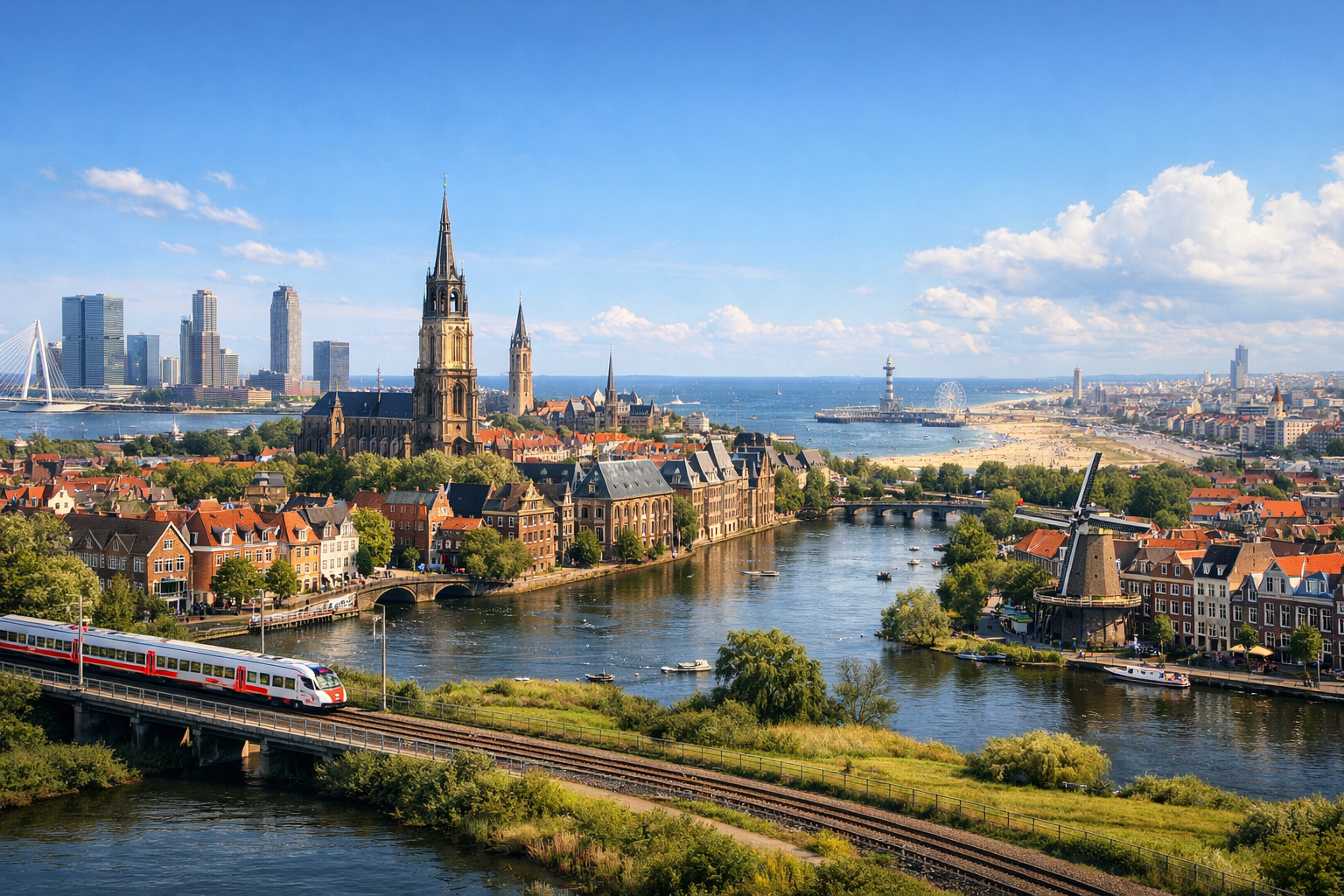
Netherlands, South Holland. Travel between Rotterdam, Delft, The Hague, Scheveningen, and Leiden with convenient train transfers

Netherlands, South Holland. Travel between Rotterdam, Delft, The Hague, Scheveningen, and Leiden with convenient train transfers

Discover the best of South Holland as you hop easily by train from bold, modern Rotterdam to charming Delft, elegant The Hague, breezy Scheveningen, and historic Leiden. In just one trip, you’ll find striking architecture, canal-lined streets, seaside air, and a rich mix of art, culture, and Dutch city life.

🧭 DAY-BY-DAY ROUTE

Ready-made country and city routes with daily plans, sights, transport and accommodation. Buy PDF guides for independent travel.

🧭 DAY-BY-DAY ROUTE


Day 1 — Rotterdam: modern architecture, waterfronts, and a port skyline

  • 🚶 Rotterdam is the best starting point for this route if you want to dive straight into the Netherlands not through postcard canals, but through bold contemporary architecture, broad waterfronts, and the feeling of a major European city that quite literally reinvented itself after the destruction of the 20th century. The day is easy to plan on foot with a few short tram or metro rides: start at Rotterdam Centraal, one of the country’s most striking stations, then head toward the Museumpark district, where important architectural and exhibition venues are concentrated. Het Nieuwe Instituut is especially interesting for anyone who loves urban space, design, and architecture, because here the Netherlands tells its story through buildings, plans, ideas, and experiments, not only through painting. Nearby is Kunsthal, an exhibition space with a very strong temporary program, and the walk through the area itself already feels like an open-air museum: glass, concrete, water, bridges, green zones, and carefully designed public spaces come together to form the image of one of the most modern cities in the Benelux. In the second half of the day, it’s worth walking to Markthal and the Cube Houses: this is a more playful Rotterdam, where architecture becomes almost an attraction without losing its urban daring. The evening naturally ends at Kop van Zuid and around Erasmusbrug — this is where you feel the scale of the city especially well, its bond with the River Maas, and its port history. For lovers of modern cities, this is not just a walk, but a full-scale observation of how an industrial metropolis turns into an aesthetic, comfortable, and lively urban landscape.


Day 2 — Rotterdam and Delft: the contrast of avant-garde and the historic city of masters

  • 🚆 Transfer: Rotterdam Centraal → Delft by NS train usually takes about 13–15 minutes; trains run frequently, and the route is very convenient for a day trip without a car.

  • 🚶 In the morning, you can still devote some time to Rotterdam — for example, for a short walk along the waterfront near Hotel New York or for a boat ride if you want to see the city from another perspective. In the warm season, it is especially pleasant to use water transport as an addition to a walking route, but it’s best to keep the main structure of the day on the rails so the transfer stays easy. After a short train ride, you arrive in Delft — a city with a completely different tone: intimate, historic, with canals, brick facades, towers, and a rhythm that seems made for a slow museum day. Here you can especially feel old Holland, but without museum-like artificiality: Delft is alive, student-filled, refined, and very cohesive in atmosphere. The center is compact, so the day is easy on foot. The main highlights are Vermeer Centrum Delft, where the city is revealed through the figure of Vermeer and the visual culture of the Golden Age, Museum Prinsenhof Delft with its powerful historical context, and Royal Delft Museum if you are interested in the famous Delft pottery and the craft tradition that became part of the country’s cultural code. A special charm of Delft is that between museum stops you don’t need to rush: here you want to walk slowly, look at the bridges, reflections in the water, narrow facades, and quiet squares. After the vertical, glassy, large-scale Rotterdam, Delft feels like a transition to a more intimate, human-scale architecture — and it is exactly this contrast that makes a South Holland route especially strong.

Day 3 — The Hague: royal elegance, world-class museums, and urban ensembles

  • 🚆 Transfer: Delft → Den Haag Centraal or Den Haag HS by NS train usually takes about 10–15 minutes, so the journey is barely tiring and lets you start your museum program in the morning.

  • 🚶 The Hague unfolds differently from Rotterdam and Delft: it is not only the administrative capital and a city of international institutions, but also a remarkably beautiful ensemble of palace streets, museums, ponds, old facades, and a substantial urban scene without capital-city bustle. For lovers of architecture and museums, this is one of the richest days on the route. It’s worth starting around Binnenhof and Hofvijver, where the reflections of historic buildings in the water create an almost ceremonial image of the city, and then moving on to Mauritshuis — small in size, but outstanding in its collection, with Golden Age painting concentrated in nearly ideal interiors. After that, it works well to continue the “art + urban style” line at Escher in Het Paleis or Kunstmuseum Den Haag, depending on your energy and interests: the first offers an intellectual play with optics and graphics, the second a spacious museum building that is important in itself as an architectural object. The Hague is also wonderful because it is simply pleasant to walk between points here: along broad streets, embassy districts, calm squares, and green stretches of the city. This is a more aristocratic, restrained, and composed Holland, where a museum day does not feel overloaded, but instead turns into an elegant urban walk.

Day 4 — Scheveningen: sea, dunes, the pier, and The Hague’s resort side

  • 🚋 Transfer: from central The Hague to Scheveningen, it is convenient to take an HTM tram; from Den Haag Centraal, tram 9 toward the beach is often used, and the region is covered by the unified OV-chipkaart / OVpay payment system and HTM city tickets.

  • 🚶 After several days of urban architecture, it is time for the sea — and Scheveningen is exactly what makes this route truly multi-layered. It is not a separate distant resort, but a natural seaside continuation of The Hague, easy to reach by tram without a car. Here the day is built around air, horizon, and wide beach space. Start with a walk along the promenade and around Kurhaus: this historic resort symbol immediately sets the tone of a place where old European respectability stands alongside modern beach pavilions, surf culture, and relaxed urban life by the sea. Then you can walk to Pier Scheveningen, look out over the North Sea from above, and simply leave time for a long walk along the beach. If you want a calmer and more natural rhythm, head toward the dunes and pedestrian stretches along the coast, where the city recedes and the route becomes almost meditative. This is a light day not in the sense of being empty, but in the sense of being properly unburdened: there is no need to squeeze in ten sights, it is more important to feel the change of landscape, the light, the wind, and the contrast between museum-filled The Hague and the open sea. For sea lovers, this is the climax of the route, and for lovers of modern cities, it is an example of how strong urban planning can naturally connect with a beach and public transport.

Day 5 — Leiden: university town, botany, antiquities, and canals

  • 🚆 Transfer: Den Haag Centraal → Leiden Centraal by NS train usually takes about 12–15 minutes; this is one of the simplest and shortest intercity transfers on the entire route.

  • 🚶 Leiden is a wonderful final urban note before returning: it combines everything people love about the Netherlands, but does so gently and intelligently. It is an old university city with canals, bridges, quiet courtyards, an academic atmosphere, and very strong museums, while remaining compact and easy for walking. The day is worth dedicating to a combination of Naturalis, if you want a modern museum space and a spectacular natural history exhibition, and Rijksmuseum van Oudheden, if archaeology, the ancient world, and a more classical museum calm appeal more to you. Between them, it is pleasant to leave time for a walk through the historic center, along the Rapenburg canals, to the university buildings, and, if the season and your energy allow, into Hortus Botanicus Leiden — one of the oldest botanical gardens in Europe, adding a calm green layer to the route. Leiden is not as theatrical as Amsterdam, nor as experimental as Rotterdam; its strength lies in intellectual beauty and a very human scale. This is a city where you do not want to rush through a must-see list, but rather slow down, sit by the water, visit a museum without crowds, and feel how history, science, and everyday life coexist side by side.

Day 6 — Leiden → Rotterdam: a calm finale, extra time for museums, and departure

  • 🚆 Transfer: Leiden Centraal → Rotterdam Centraal by NS train usually takes about 32–40 minutes, depending on the service; this is a convenient final transfer for a flight via Rotterdam The Hague Airport or for continuing your trip through the Netherlands.

  • 🚶 It’s best not to overload the final day: South Holland is at its best precisely when the route leaves room for a pause, a coffee by the canal, one more exhibition, or a short walk without rushing. If you are leaving in the evening, you can spend the morning in Leiden — for example, taking one more stroll through the historic center or visiting the museum you did not have time for the day before. Then return to Rotterdam by train and use the remaining hours as a flexible urban finale: some will want another walk around Markthal and Oude Haven, others may prefer to go up to a viewpoint or simply spend time by the water near Erasmusbrug. If your flight departs from Rotterdam The Hague Airport, public transport makes it possible to get there without a car: the route is usually built via Rotterdam Centraal or Den Haag Centraal, then metro line E to Meijersplein and a transfer to bus 33, which goes directly to the airport. This buffer final day is especially important on a European trip without a car: it gives resilience in case of rain, delays, schedule changes, or simply a desire not to hurry. As a result, the whole tour remains easy, logical, and genuinely doable by train, tram, and on foot — without forcing it and without dependence on a car.

Flight tickets

eSIM for travel

Buy PDF guide

Buy PDF guide — 12.85 USD

PDF — 12.85 USD