
Buy PDF guide

Buy PDF guide — 10.71 USD

PDF — 10.71 USD

Netherlands, Rotterdam and The Hague. A budget itinerary focused on modern architecture, markets, the seaside, and museums, with hostel accommodation and travel by train.

Netherlands, Rotterdam and The Hague. A budget itinerary focused on modern architecture, markets, the seaside, and museums, with hostel accommodation and travel by train.

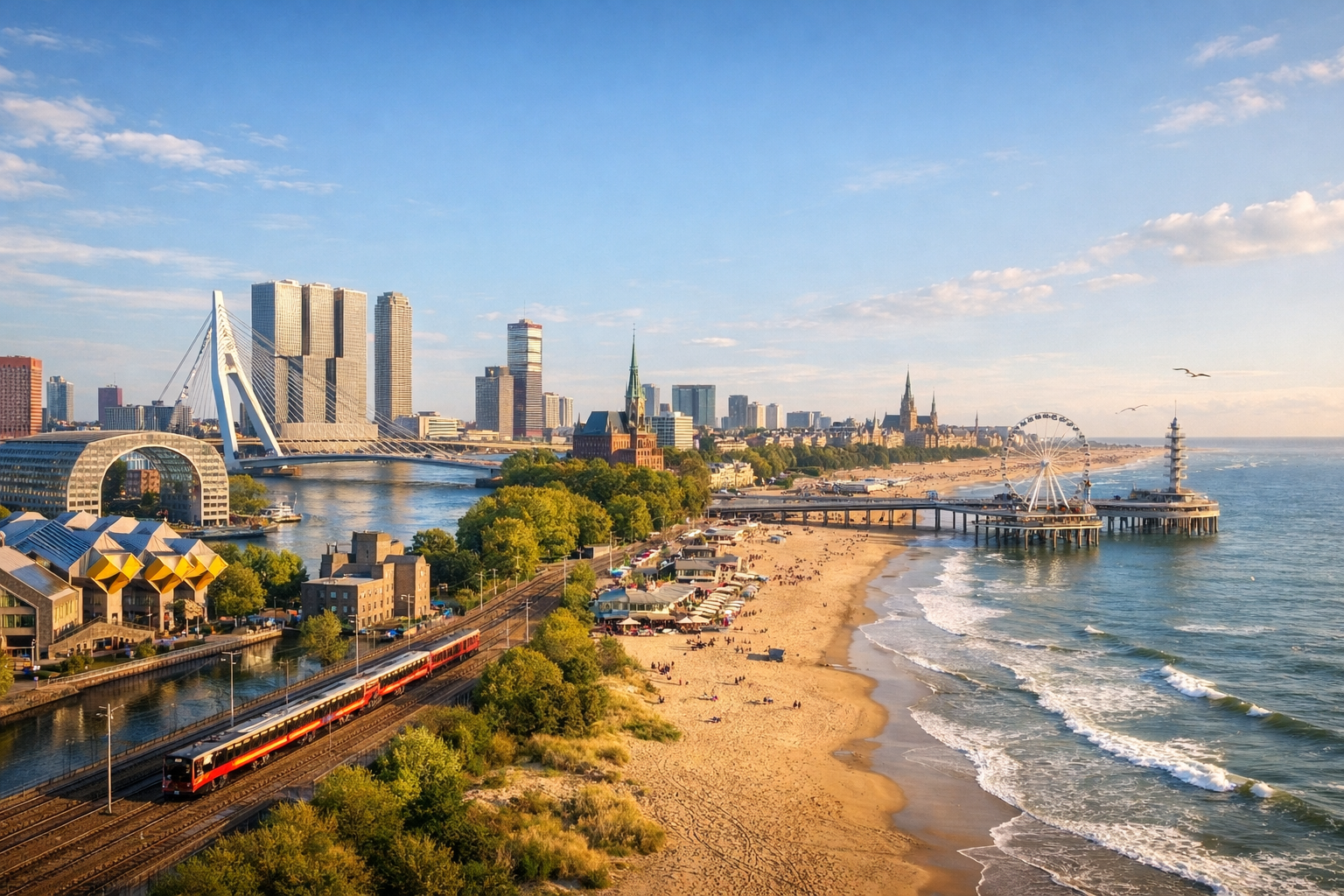
Discover the Netherlands on a budget with a train-friendly route from Rotterdam to The Hague and on to Scheveningen. Explore bold modern architecture, lively markets, and standout museums, then end by the sea with a breezy beach escape—all while staying in hostels and keeping costs low.

🧭 DAY-BY-DAY ITINERARY

Ready-made country and city routes with daily plans, sights, transport and accommodation. Buy PDF guides for independent travel.

🧭 DAY-BY-DAY ITINERARY


Day 1 — Rotterdam: cube houses, Markthal and waterfronts

  • 🚶 Start your budget-friendly introduction to Rotterdam in the Blaak district, where the city immediately reveals its boldest character. Here, experimental architecture, an urban market and a convenient transport hub come together almost in a single frame. Walk around the famous Cube Houses, Kijk-Kubus: they are one of the symbols of postwar Rotterdam, a city that after the destruction of the 20th century chose not to recreate the past but to invent a new future. The tilted cubes set on supports look like an architectural puzzle and are best appreciated on foot, when you can see how living space has been turned into an urban manifesto. Nearby is Markthal — an indoor market and residential complex under a giant arch, where beneath a bright vault with a large-scale fruit-and-flower mural it is easy to combine a walk, an inexpensive lunch and people-watching. To save money, it is convenient to buy food from the market stalls: sandwiches, soups, falafel, Asian street food and fresh pastries usually cost noticeably less than restaurants by the water. After the market, head down to Oude Haven — the old harbor with historic ships, terraces and a pleasant atmosphere without mandatory spending. It is a good area for a gentle adjustment after the journey: everything is close together, with many places for short breaks, toilets, shops and public transport stations.

  • 💤 Staying overnight in Rotterdam at a hostel near the center helps you avoid spending on taxis and reduces travel time. Daily budget guide: hostel €35–70 for a bed, food €18–30, city transport if needed €4–10 depending on actual rides or a day product, and admissions on this day can remain free or very inexpensive.


Day 2 — Rotterdam: modern architecture, Museumpark and panoramas

  • 🚶 Dedicate the second day to a more museum-oriented and architectural side of Rotterdam, while still keeping to a budget logic. In the morning, go to the Museumpark area: the park itself is pleasant for a calm walk and a rest between visits, and around it are concentrated important points of the city’s modern identity. If you want to choose only one paid attraction, a sensible compromise would be Kunsthal Rotterdam — a museum without a permanent collection but with a strong reputation for temporary exhibitions, photography, design and contemporary culture. The building itself by Rem Koolhaas and his OMA office is already part of the experience: it is not a classical museum palace, but a living architectural machine of concrete, glass, ramps and unusual transitions. If your budget is a bit higher, consider Depot Boijmans Van Beuningen — the famous mirrored storage-museum, where the idea itself is especially interesting: not only to look at art, but to understand how a museum stores collections, works with restoration and organizes its holdings. Even if you do not go inside, viewing the building from the outside in Museumpark is essential: the rounded mirrored volume reflects the sky, trees and city in such a way that the architecture literally dissolves into the landscape.

  • 🚶 After the museums, walk to Erasmusbrug or along the Maas waterfronts if the weather allows. Rotterdam is especially appealing because modern architecture here can be “read” almost for free: bridges, towers, business districts, broad views along the water and the constant sense of a world-scale port create the impression of a large avant-garde city without the need to keep buying tickets. For a budget dinner, look for small Asian, Middle Eastern or Surinamese places, as well as Albert Heijn or Jumbo supermarkets for ready-made meals, salads and sandwiches. Daily spending guide: museum €0–20, food €18–30, local transport €4–10. In the evening, it is better to go to bed early: the next day’s transfer to The Hague is short, but it makes sense to keep the program full.

Day 3 — Transfer to The Hague: historic center, Mauritshuis and Lange Voorhout

  • 🚆 Transfer: Rotterdam Centraal → Den Haag Centraal by NS train usually takes about 20–30 minutes depending on the service. This is one of the most convenient and realistic intercity stretches in the country: frequently running trains mean you do not need to build the day around a rare timetable. To minimize expenses, it is worth buying the ticket in advance in the NS app or on the NS website as an e-ticket, or using OVpay/OV-chipkaart when traveling as needed. If you also plan to travel actively by trams and buses in South Holland on the same day, check whether the Tourist Day Ticket is better value, but it is important to remember: it is valid for regional urban transport and water transport in Zuid-Holland, and does not apply to NS trains.

  • 🚶 After Rotterdam, The Hague feels different: less industrial intensity, more formal elegance, broad avenues, government quarters and classic museums. After checking in, start with the area around Plein and Binnenhof, where the historic center is easy to explore on foot. The main museum highlight of the day is the Mauritshuis, one of the best-known art museums in the Netherlands. It fits especially well into this kind of contrast-filled itinerary: after the experimental architecture of Rotterdam, you arrive at an intimate world-class museum with Dutch Golden Age painting, where you can see works by Vermeer, Rembrandt and other masters in an almost palatial atmosphere. The visit does not have to be long: 60–90 minutes is enough not to overload the day and to save energy for a walk.

  • 🚶 After the museum, stroll along Lange Voorhout — one of the most beautiful streets in the city, where trees, embassy buildings and a calm aristocratic setting create a very different rhythm from Rotterdam. It is pleasant here simply to walk without hurrying, looking at façades and choosing an inexpensive café or bakery. For dinner, supermarkets, small Turkish and Indonesian places, as well as take-away options, work well on a budget. Daily spending guide: train €6–12, hostel in The Hague €35–75, museum €13–21 depending on the fare and category, food €18–30.

Day 4 — The Hague: Escher, tram to the sea and the Scheveningen coast

  • 🚶 This day works well as a combination of a museum, public transport and sea air. In the morning, visit Escher in Het Paleis — the M. C. Escher museum in a former palace on Lange Voorhout. It is a very successful stop precisely for a compact itinerary: the museum is not too large, but it makes a vivid impression thanks to optical illusions, graphics, mathematical imagination and the contrast between Escher’s whimsical works and the royal interiors. A visit usually fits well into 1–1.5 hours and is not tiring.

  • 🚋 Then take an HTM tram toward Scheveningen. The ride itself is already part of the experience: in a short time the urban scene changes — from diplomatic quarters and shopping streets to the resort strip, dunes, wind and the broad North Sea horizon. Scheveningen is not only a beach, but also an important part of The Hague’s identity: a place where the official and museum city unexpectedly opens up to the sea. Even in cool weather it is pleasant to walk along the promenade, look at the pier, listen to the cries of seagulls and feel how the city’s pace suddenly slows down. In good weather, you can spend several hours on the beach, walk barefoot along the water, and in windy conditions simply take a long walk in a jacket with coffee stops. To save money, it is better to avoid the most touristy restaurants right on the front line and choose snack bars away from the pier, supermarket snacks, or get takeaway coffee and pastries.

  • 🚶 If you still have energy, on the way back to the center you can take a short walk along the shopping streets or simply end the day calmly around Den Haag Centraal. Budget-wise, this is one of the most pleasant days: museum €11–15, tram/bus pay-as-you-go €4–10 or an HTM day ticket, food €18–30, and the seaside walk is free. It is important to remember that the weather on the coast changes quickly, and the wind by the North Sea is often stronger than it seems from the forecast in the city center.

Day 5 — The Hague: Kunstmuseum Den Haag or a free day in museums and parks

  • 🚶 Make the final day flexible so you can adapt to the weather, fatigue and budget. The best main option is Kunstmuseum Den Haag. This is a major art and design museum in a building worthy of attention in its own right, where the collections of modernism, decorative arts, design and the works of Piet Mondrian are especially interesting. For an itinerary about modern architecture and museums, it is very fitting: there is less tourist noise here than at the most “must-see” sites, and more room for thoughtful viewing. If you want to save money, this day can be made lighter: keep only an exterior look at the museum quarter, a walk through the parks and another outing to the center without a mandatory paid entry. A good free or almost free scenario is to walk around Hofvijver, return again to the government quarter, sit in a park, buy an inexpensive lunch and calmly finish the trip.

  • 🚶 The logic of the whole trip is that in 5 days you are not trying to cover half the country, but getting a dense yet realistic cross-section of two very different cities in South Holland. Rotterdam gives you bold modern architecture, markets and port scale; The Hague offers museums, diplomatic elegance and a seacoast. With this approach, expenses are manageable, transfers are short, and the itinerary remains safer and less tiring than constant long connections. Guide for the last day: museum €0–18, food €18–30, city transport €0–10 depending on the plan. The overall basic budget without international airfare can usually be kept roughly in the range of €260–520 for 5 days with hostel accommodation, moderate food spending and 2–4 paid museums.

Flight tickets

eSIM for travel

Buy PDF guide

Buy PDF guide — 10.71 USD

PDF — 10.71 USD