
Buy PDF guide

Buy PDF guide — 8.57 USD

PDF — 8.57 USD

The Netherlands, the provinces of Zeeland and South Holland. A cycling tour from Middelburg to Rotterdam through islands, sea dikes, dunes, and historic cities. Difficulty: easy or moderate. Season: April - September.

The Netherlands, the provinces of Zeeland and South Holland. A cycling tour from Middelburg to Rotterdam through islands, sea dikes, dunes, and historic cities. Difficulty: easy or moderate. Season: April - September.

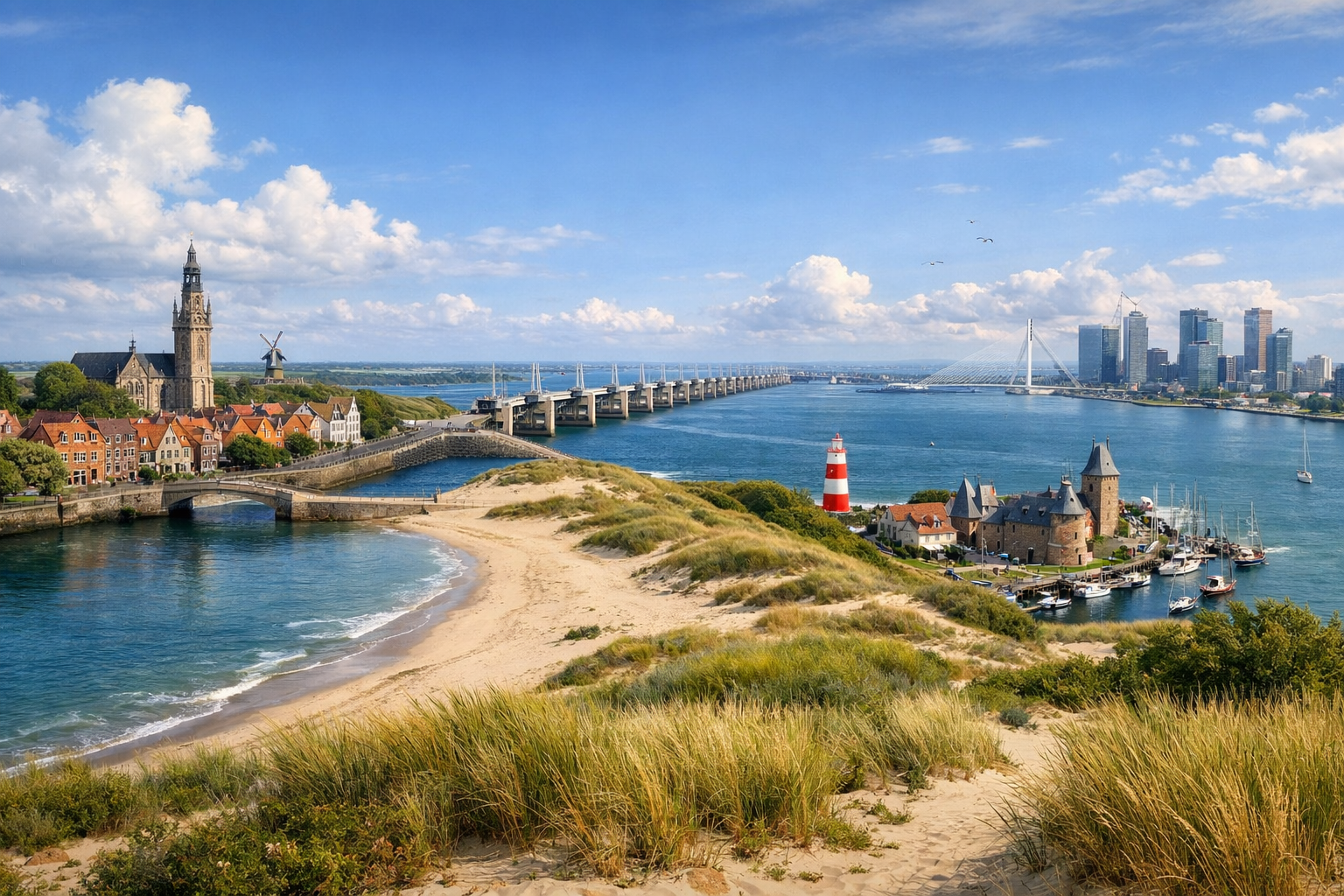
Cycle from the quiet lanes of Zeeland to the bold skyline of Rotterdam on an easy to moderate ride through islands, sea dikes, rolling dunes, and broad coastal views. Along the way, charming towns like Middelburg, Burgh-Haamstede, and Hellevoetsluis blend maritime history with a laid-back Dutch atmosphere, best enjoyed from April to September.

🚲 ROUTE BY DAY

Ready-made country and city routes with daily plans, sights, transport and accommodation. Buy PDF guides for independent travel.

🚲 ROUTE BY DAY


Day 1 — Middelburg → Veere → Neeltje Jans → Burgh-Haamstede

  • 🚲 Start in Middelburg and warm up gently along the flat bike paths of Walcheren toward Veere, one of the most beautiful small port towns in Zeeland. Then the route continues across the Veersedam and along the impressive Delta Works section to the island of Neeltje Jans and the Oosterscheldekering. Finish in the Burgh-Haamstede or Renesse area. About 45 km, pure riding time around 2.5–3 hours, elevation gain is symbolic — up to 60 m for the day, but sea wind can make pedaling noticeably harder. The surface is mostly excellent: separate bike paths, asphalt on the dams, short stretches of quiet local roads, and possible firm dirt-and-gravel sections near the dunes. Main stops: Veere, the viewpoints along the Oosterscheldekering, and Neeltje Jans. Water and food are easy to replenish in Middelburg, Veere, and at tourist points near the Delta Works; in Zeeland, fietscafés are also useful, where you can often refill your bottle and take a short break. It is best to stay overnight in Burgh-Haamstede: it is a logical cycling finish before the dune day. Nuances: on the dams, strong crosswinds can matter more than the mileage, and on the scenic sections you will want to stop more often, so the day should not be overloaded with extra detours. For an average cycle tourist, the day is realistic thanks to the flat profile, good navigation via knooppunten/FIKS, and frequent opportunities to take a break.


Day 2 — Burgh-Haamstede → Westerschouwen → Brouwersdam → Rockanje / Hellevoetsluis

  • 🚲 This is the most panoramic day of the tour: first the dunes and forest edges of Westerschouwen, then the open coast of Schouwen-Duiveland, followed by the crossing of Brouwersdam and the transition into South Holland. It is most convenient to finish in Rockanje or Hellevoetsluis. About 55 km, pure riding time around 3–3.5 hours, elevation gain is small — about 70–100 m due to dune rollers and climbs onto the dams. The surface is mixed but tourist-friendly: asphalt bike paths, promenades, firm dune tracks, and quiet roads in resort areas. Main stops: the dunes of Westerschouwen, Brouwersdam, and the historic harbor of Hellevoetsluis. It is better to take a запас of water and food in the morning, then restock in resort villages and at beach pavilions; on the open dam there are fewer services than the map suggests. Staying overnight in Hellevoetsluis is convenient logistically: in the evening you can walk calmly around the old harbor, and the next day continue easily toward Rotterdam. Nuances: Brouwersdam is open to the wind, so with a strong headwind the day feels moderate rather than easy; it is better to ride in daylight without pushing into dusk. For an average cycle tourist, the day is realistic because the distance fits a comfortable norm, the profile is flat, and almost the entire route follows clear recreational cycling infrastructure.

Day 3 — Hellevoetsluis → Brielle → Maasvlakte views → Rotterdam

  • 🚲 From Hellevoetsluis, the route goes through historic Brielle and then across the island of Voorne-Putten toward the big city. The most logical option for an independent traveler is to ride on safe regional bike paths and enter Rotterdam through the southern districts, without trying to find dubious short car detours. About 65 km, pure riding time around 3.5–4.5 hours, elevation gain about 80–120 m, and the surface is almost entirely asphalt: dedicated cycle paths, promenades, dams, and urban bike lanes on the approach to Rotterdam. Main stops: fortified Brielle, the coastal sections of Voorne, and the first industrial-maritime panoramas on the way into Rotterdam. For water and food, count on Brielle, suburban centers, and supermarkets along the way; wind protection on open sections is minimal, so in summer it is essential to carry at least 1.5–2 liters of water per person. It is best to stay overnight already in Rotterdam so as not to spend the fourth day on a long urban approach. Nuances: the closer you get to the metropolis, the more important discipline becomes at intersections and attention to tram tracks and the many other path users. For an average cycle tourist, the day is realistic thanks to the complete absence of serious climbs and the very developed cycling infrastructure even on the approach to the city.

Day 4 — Rotterdam urban loop: Erasmusbrug → Katendrecht → waterfronts → Waterbus / Kinderdijk option

  • 🚲 It is better to make the last day not a transfer stage, but a beautiful closing loop around Rotterdam with a light radial option. The basic city route: Katendrecht, Erasmusbrug, the Maas waterfronts, Markthal, old harbors, and return to your overnight stay. If you wish, you can add a Waterbus connection with your bike as a short river adventure and ride part of the day toward Alblasserdam / the approaches to Kinderdijk, without trying to squeeze in a full countryside march. The basic distance is 25–35 km, with the river option up to 45–48 km; pure riding time 1.5–3 hours, elevation gain negligible — up to 50 m. The surface is very comfortable: urban bike paths, bridge ramps, waterfronts, and paved sections. Main stops: Erasmusbrug, Katendrecht, and one of the riverside sections with views of port architecture; if extending the day — a boat trip with the bike and windmill landscapes toward Kinderdijk. Water and food are easy to replenish all day: cafés, supermarkets, stations, and city squares are everywhere. Nuances: in central Rotterdam there are many cyclists, scooter riders, and pedestrians, so it is better to keep your speed moderate; on the bridges there can be strong wind, and on the Waterbus during rush hour there may not be enough room for a bike unless you allow extra time. For an average cycle tourist, this is a realistic final day: short, flexible, stress-free, and adaptable to your fatigue after the previous three stages.

Flight tickets

eSIM for travel

Buy PDF guide

Buy PDF guide — 8.57 USD

PDF — 8.57 USD