
Buy PDF guide

Buy PDF guide — 8.57 USD

PDF — 8.57 USD

Nashville - country music, bars and live concerts

Nashville - country music, bars and live concerts

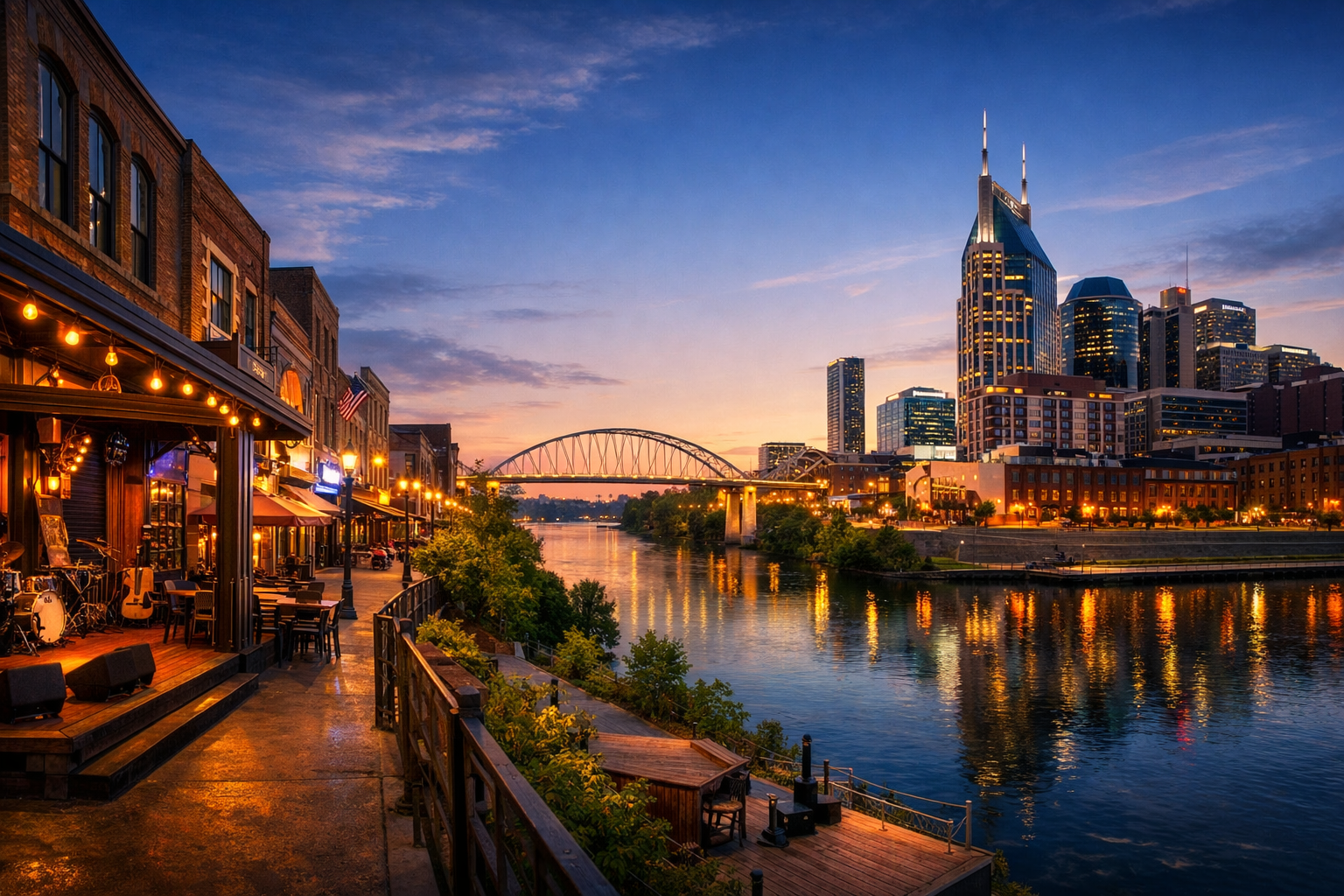
Nashville pulses with country music, neon-lit bars, and live concerts that spill into the streets. Wander from the honky-tonks of Broadway to legendary Music Row and the stylish energy of The Gulch for a city break full of rhythm and Southern charm.

🧭 DAY-BY-DAY ITINERARY

Ready-made country and city routes with daily plans, sights, transport and accommodation. Buy PDF guides for independent travel.

🧭 DAY-BY-DAY ITINERARY


Day 1 — Downtown Nashville: getting to know Music City, Lower Broadway and Ryman

  • ✈️ Arrival at Nashville International Airport (BNA) and transfer to downtown. If your hotel is in Downtown or SoBro, allow about 20–30 minutes for a taxi or rideshare trip without heavy traffic; by public transport the journey is usually longer and requires extra time. After check-in, it’s better not to try to “cram in” too many stops: Nashville opens up best at the pace of a relaxed walk, when you can give yourself an hour for a shower, unpacking, and a short rest before your first musical evening.

  • 🚶 Start your route with Lower Broadway — the very street where Nashville instantly stops being just a city and turns into a living set from American musical mythology. During the day you can already hear guitars, fiddles, drums, and the dense hum of voices, and by evening the space bursts into neon, honky-tonk bar signs, and a constant feeling of celebration. Unlike the “polished” tourist quarters of other cities, Broadway keeps a slightly rough, noisy, authentic character: music pours out from several doorways at once, and tourists, musicians, country fans, and people who simply came for the atmosphere all mix together on the sidewalks. The nicest thing about a first introduction is not to build a strict checklist, but to walk the whole street, going up to the upper floors of bars for views of the downtown lights, peeking into halls with free live music, and gradually catching the rhythm of the city, which here is felt almost physically.

  • 🚶 Then head to Ryman Auditorium — the legendary “Mother Church of Country Music,” a place where Nashville’s musical history feels especially concentrated. This is not just a beautiful concert hall, but a symbolic stage tied to the Grand Ole Opry and to an entire era of American music. Even if you are not planning a full tour inside that day, the building itself and its surroundings deserve special attention: the brick facade, the historical weight of the place, and the crowds who come here not only for concerts but simply to “touch” the cultural heart of the city. The best format for the first day is to stroll around slowly, pause for coffee or an early dinner nearby, and save some energy for the evening, because Nashville is especially good after sunset.

  • 🎶 Dedicate the evening to live music bars on Broadway. It’s better to choose 2–3 venues instead of a chaotic marathon: one for classic honky-tonk with covers and dance energy, a second for a more intimate set, and a third — if you still have energy — for a rooftop view over downtown’s neon waves. Keep in mind that music here often starts during the day and continues until late evening, so it’s wise to take breaks for water and food rather than going nonstop. For a first evening, a comfortable scenario is this: a walk, one long music set, dinner, then one more bar. This lets you feel the city without overexertion and saves energy for the following days.


Day 2 — SoBro and music museums: Country Music Hall of Fame, Johnny Cash Museum, evening concert

  • 🚶 Start the morning in SoBro, where modern Nashville blends with its own musical legend especially naturally. It’s easy to get around on foot here: the blocks are compact, the key stops are usually 10–20 minutes apart, and the urban environment itself seems made for those who want to move without rushing. The main stop of the day is the Country Music Hall of Fame and Museum, one of the most important museums of American musical culture. This place is worth visiting not “at a gallop,” but with at least 2–3 hours to spare, because the exhibitions reveal not only stars, hits, and costumes, but the whole complex journey of country music: from regional roots and radio shows to the huge industry that shaped Nashville’s image as Music City. Even if you don’t consider yourself a fan of the genre, the museum works as a wonderfully assembled story of how music becomes the cultural identity of an entire city.

  • 🚶 After the museum, take time for lunch and an essential rest break of at least 45–60 minutes. This is an important part of the route: rich musical spaces quickly tire your attention, and in the second half of the day it’s better to remain receptive rather than just mechanically ticking off locations. Then head to the Johnny Cash Museum — a more compact place, but one that is emotionally very precise. Unlike a large institutional museum, here you feel the artist’s personal story more strongly, the drama of his image, and Johnny Cash’s influence far beyond country music. What’s good about this museum is that it feels like a concentrate of legend: dark charisma, stage energy, family story, archival value, memorial atmosphere — everything is gathered in a space that is usually convenient to see in an hour to an hour and a half.

  • 🚶 If you still have energy after the museums, walk along the Cumberland River waterfront or return through downtown via 2nd Avenue and neighboring streets. This part of the route works well as an “exhale” between the daytime cultural program and the evening musical one. In central Nashville it’s important not to forget the pace: it’s better to see less but enjoy it than to turn the day into endless running between a bar, a museum, and the next sign. Logistically, the day is realistic: walking distances between key points are short, and museum blocks alternate comfortably with rest.

  • 🎤 It’s best to reserve the evening in advance for a real concert or live set at Ryman Auditorium or in one of the well-known halls downtown. Even if you’ve already been to bars on Broadway, the concert experience in Nashville is a different level of sound, a different attention from the audience, and a completely different depth of immersion. In good venues you can feel that the city lives music not as scenery for tourists, but as a real craft, profession, and almost a religion. Ideally, have dinner 1–1.5 hours before the concert and return to the hotel on foot or by a short taxi ride to end the day without extra fuss.

Day 3 — Music Row, Midtown and Centennial Park: the country industry, a green breather, and an evening in Midtown

  • 🚕 Dedicate the morning to Music Row — a place where the romance of the stage unexpectedly takes on a professional, almost “behind-the-scenes” scale. It’s more convenient to get here by a short taxi or rideshare trip from Downtown, usually about 10–15 minutes depending on traffic. Music Row is not a single museum site, but a mood district, a neighborhood of studios, offices, labels, and music companies where the Nashville sound was created over decades. There isn’t the same neon punch here as on Broadway, but there is another pleasure: understanding that behind the apparent ease of barroom country music stands a huge industry of songwriters, producers, engineers, and performers. A walk through the district is especially good in the morning, when there is less bustle and it is easier to feel its working, not just tourist, character.

  • 🚶 After Music Row, it makes sense to move toward Midtown and Centennial Park. Allow about 10 minutes by car or 25–35 minutes on foot if you want a longer walk and the weather allows. Centennial Park is one of the best stops on the route for a change of pace: after bars, neon, and museum concentration, here you get air, water, greenery, and a calmer urban rhythm. The park is known for its scale and for housing a full-scale replica of the Parthenon, thanks to which Nashville once earned the nickname “Athens of the South.” This place surprises precisely because of the contrast: you come to the capital of country music and find yourself facing an ancient silhouette among trees, lawns, and walking paths.

  • 🏛️ Visit The Parthenon inside and set aside time for the space around it as well. This is not just an unusual photo stop, but at once a city symbol, a museum, and a historical reminder of Nashville’s cultural ambitions. The charm of this stop is that it breaks up a purely musical route with architecture and a park atmosphere, yet does not feel “extra.” If you want another museum note, you can add Frist Art Museum depending on the pace of the day, though it’s not worth overloading the program: it’s better to choose one strong museum accent and leave time for a calm lunch and rest.

  • 🍻 Spend the evening in Midtown or return to the Broadway area more intentionally, choosing a bar or venue to match a specific mood. Midtown appeals because it often feels a bit less touristy and more local, especially if you step away from the most obvious routes. A great scenario for the day is an early dinner, an hour of rest at the hotel, then heading out for live music. After two intense days, this helps you avoid burnout and see the evening not as a mandatory item on the program, but as a pleasure. In Nashville it is very important to leave room for spontaneity: sometimes the best set happens not at a “top” venue, but in a randomly chosen hall you entered simply because the guitar sounded good from there.

Day 4 — The Gulch, Frist Art Museum, final walk and departure

  • 🚶 It’s best to make the last day softer and more aesthetic, without a hard race between locations. Start it in The Gulch — a modern, stylish, slightly more “polished” Nashville, where the industrial past has been reimagined as trendy streets, restaurants, boutiques, and an urban walking environment. From Downtown it is easy to get here on foot in 15–25 minutes or in a few minutes by taxi. The Gulch is a good contrast to noisy Broadway: less chaos, more visual order, contemporary architecture alongside brick and the lines of former warehouse and rail spaces, and the district as a whole creates a feeling of relaxed, upscale, but not cold urban comfort.

  • 🏛️ Then head to Frist Art Museum. This is an excellent final accent for the route because the museum takes you slightly beyond the country genre and shows Nashville as a full-fledged cultural center, not just the capital of live music and bars. In the former historic post office building, art exhibitions feel especially expressive: the space is both monumental and comfortable, and the visit itself gives the trip a beautiful “aftertaste.” It makes sense to allow 1.5–2 hours for the visit, after which it’s nice to have a long lunch or a coffee break, especially if you still have a trip to the airport ahead.

  • 🚶 If time before departure allows, finish the route with a calm walk along the central streets, buy vinyl, merch, or music souvenirs, and leave at least 30–40 minutes unplanned — simply to sit, look at the street, listen to yet another daytime band, and let the city settle in your memory. Nashville is valuable not only for its list of places, but also for its soundscape: here even a random midday set can become the scene you remember more vividly than a museum ticket.

  • 🚖 Plan your departure to BNA airport with extra time. From downtown to the airport, people usually allow about 20–30 minutes by car, but during traffic hours it is wise to give yourself more time. For a domestic flight, it’s better to leave so that you arrive at the airport about 2 hours before departure; if you have luggage, it’s high season, or the roads are busy in the evening — even earlier. This kind of ending makes the route feel not exhausting, but well put together and realistic.

Flight tickets

eSIM for travel

Buy PDF guide

Buy PDF guide — 8.57 USD

PDF — 8.57 USD