
Buy PDF guide

Buy PDF guide — 6.43 USD

PDF — 6.43 USD

Munich city center beer museums and the English Garden

Munich city center beer museums and the English Garden

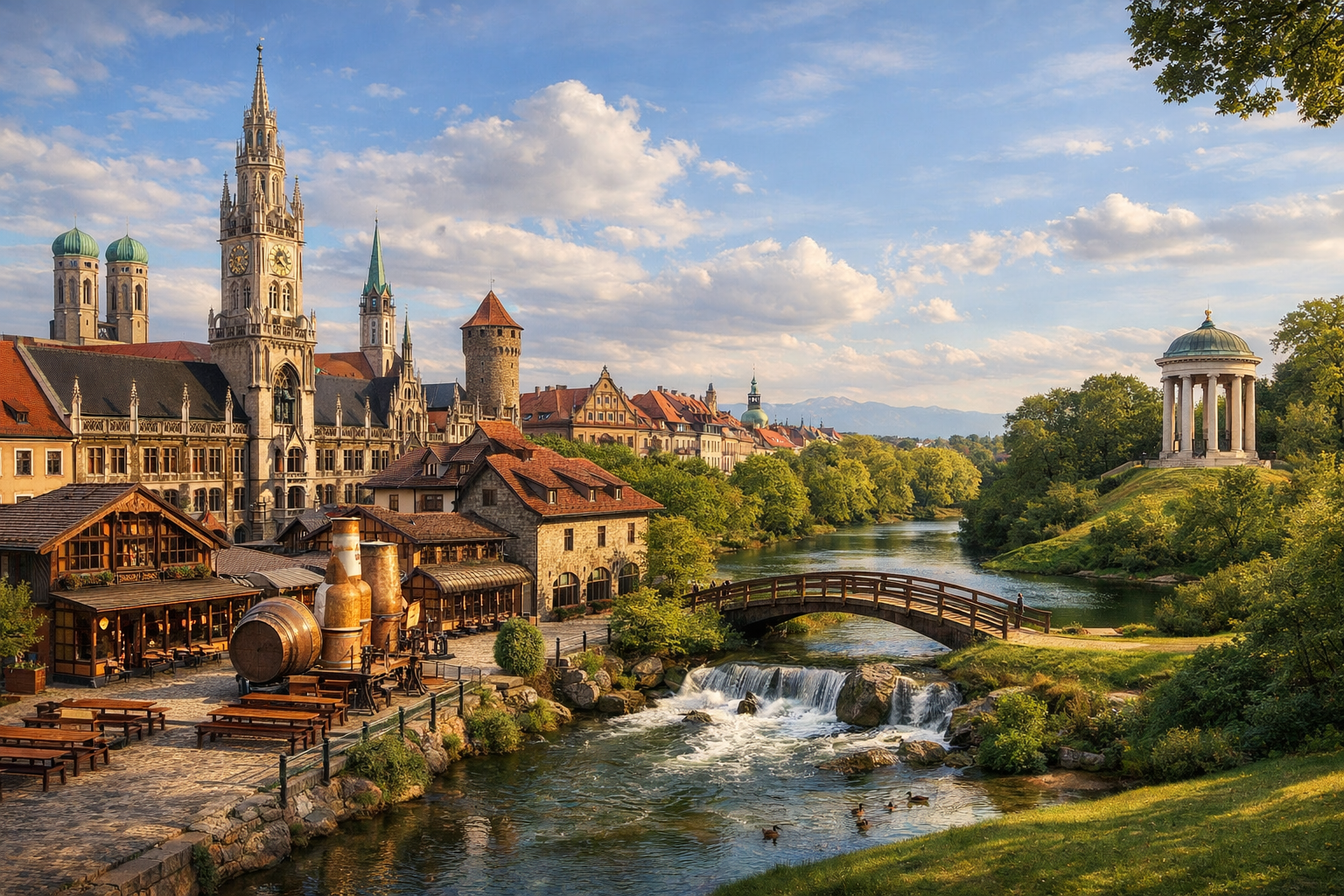
Munich blends grand city-center charm with a deep-rooted beer culture, where historic halls and fascinating museums bring Bavarian traditions to life. Then slow the pace in the English Garden, a vast green escape of shady paths, open meadows, and riverside calm right in the heart of the city.

🧭 DAY-BY-DAY ROUTE

Ready-made country and city routes with daily plans, sights, transport and accommodation. Buy PDF guides for independent travel.

🧭 DAY-BY-DAY ROUTE


Day 1 — Munich: historic center and beer classics

  • 🚆 Arrival from Munich Airport to the center: the most convenient basic option is the S-Bahn S1 or S8 to the city center. The trip to Hauptbahnhof takes about 40 minutes, trains run frequently, and areas like Marienplatz/Isartor are easy to reach without complicated transfers. An alternative is the Lufthansa Express Bus: about 45 minutes to the central station or about 25 minutes to Munich North/Schwabing. After checking into your hotel, allow 45–60 minutes for rest, a shower, and a calm start without rushing.

  • 🚶 Start getting to know Munich from its old heart — the area around Marienplatz, Tal, Platzl, and Viktualienmarkt. This is the very Munich where the city feels not like a backdrop, but like a living stage: Gothic facades, towers, the sound of bells, street musicians, the smell of fresh pastries and grilled sausages, Baroque churches, inner courtyards, and sudden historic passageways between houses. It is especially pleasant to walk slowly here, without the goal of “ticking off sights,” because the whole center is designed like one big postcard walk: from Marienplatz square with the New Town Hall to cozy lanes where the old Bavarian spirit coexists with shop windows, wine bars, and modern boutiques. At Viktualienmarkt, it’s worth pausing for coffee or a light snack: it is one of the most atmospheric city markets, where local gastronomic culture is felt beautifully — not as a museum piece, but as something everyday and very Munich-like.

  • 🚶 Next, it makes sense to move on to the city’s beer legend — Hofbräuhaus München, Platzl 9, 80331 München. This is not just a famous hall with liter mugs, but one of Munich’s most recognizable symbols, where beer culture is part of the city’s history. Huge vaulted ceilings, wooden tables, waiters moving with almost theatrical confidence, live music, a noisy multi-voiced hall, and the feeling that you have arrived in Bavaria in its most concentrated form — all this makes the visit less of a gastronomic stop and more of a cultural experience. It’s best to come either a little before the dinner rush or later in the evening, when after the bustle of the day you want a long pause, hearty food, and that exact feeling of “I’m really in Munich.” For a relaxed visit, dinner, and the atmosphere, it is reasonable to allow 1.5–2 hours.

  • 🏛️ If you still have energy after lunch and want to add context, include the Beer and Oktoberfest Museum, Sterneckerstraße 2, 80331 München. This is an excellent stop specifically on the first day because it helps explain why, for Munich, beer is not just a drink but part of the city’s identity, a social ritual, and historical memory. Here, the connection between monastic brewing traditions, city beer halls, and the phenomenon of Oktoberfest is revealed especially well; for many it seems like just a huge festival, but in fact it grew out of a very specific Bavarian culture. Allow about 45–60 minutes for the museum, after which it is convenient to return to an evening walk through the center.

  • 💤 End the evening with a short walk through the illuminated streets of the Altstadt: at night Munich does not shout, it glows softly. There is no sense of an aggressive metropolis here — rather, it is a noble and very “composed” European city where it is easy to feel the rhythm of rest already on the first day. To avoid overloading yourself, it is better to return to the hotel not too late: two more full days still lie ahead.


Day 2 — Munich: museums, technology, and city panoramas

  • 🚆 Start the morning without rushing and after breakfast head to Deutsches Museum, Museumsinsel 1, 80538 München. From the center, it is easy to get here by public transport or partly on foot if you want a beautiful walk along the city and the water. From the old center, it is usually reasonable to allow about 15–25 minutes depending on your starting point.

  • 🚶 Deutsches Museum is one of those places that can easily turn even a not especially technical traveler into an enthusiastic explorer. This huge science and technology museum on an island in the middle of the Isar does not feel like a dry academic institution; on the contrary, it conveys the scale of human curiosity. What is especially impressive here is the contrast between the grandeur of the topics — from aviation and energy to chemistry, music, medicine, and space — and the very lively, almost adventurous presentation. This is not a museum where you “see two halls and leave,” but a space where you constantly want to turn into new sections, read the labels, examine mechanisms, compare old engineering solutions with modern ones, and now and then catch yourself in childlike delight. Even if you do not aim to see everything, it is better to set aside 2.5–3.5 hours for a comfortable visit and be sure to plan a coffee or lunch break inside or nearby.

  • ☕ After the main museum, take a calm 45–60 minute break. This is an intense day, and it is better not to try to turn it into a marathon. Munich is wonderful because it can be experienced at an unhurried pace: walk a little, sit down, catch your breath, and then move on again.

  • 🚆 In the second half of the day, head to Deutsches Museum Verkehrszentrum, Am Bavariapark 5, 80339 München. From Museumsinsel to this site, it usually takes about 20–30 minutes by transport with a short walking segment. If you want an easier pace, you can choose a taxi and save your energy.

  • 🚶 Verkehrszentrum is a transport museum that is especially good because it shows not abstract technology, but the very history of movement, speed, and urban mobility. Across three large historic pavilions, it brings together bicycles, cars, trains, public transport, and many exhibits through which the history of a whole century of everyday life becomes unexpectedly clear. It feels like a very “European” museum: it does not simply display beautiful machines, but shows how transport changed cities, habits, the rhythm of travel, and ideas about distance. If the main Deutsches Museum is the broad cosmos of science, then Verkehrszentrum offers a more concentrated, highly visual, and strikingly presented story of how people learned to move ever faster, more comfortably, and more boldly. 1.5–2 hours is enough for the visit.

  • 🚶 If you still have energy after the museum part, you can devote the evening to a calm walk around Theresienhöhe or return to the center for dinner. This is a good moment for a quieter evening — without a mandatory program, but with the pleasant feeling of a full day in which Munich has opened up not only as a city of beer and postcards, but also as one of Germany’s most important intellectual and industrial centers.

Day 3 — Munich: BMW, the English Garden, and a beautiful finale

  • 🚆 In the morning, head to the Olympiapark area for BMW Welt and BMW Museum. From the center, the metro ride usually takes about 20–30 minutes, and from the airport, if you build the route directly, you can get here in about 45 minutes by public transport. Plan to leave earlier so the day feels spacious and unhurried.

  • 🚶 BMW Museum is located opposite BMW Welt and is one of the city’s strongest museum highlights for those interested in design, engineering thought, and the history of European industry. Here, the brand is revealed not only as a car manufacturer, but as part of a larger cultural myth about speed, precision, the aesthetics of form, and the German engineering character. The museum space is built so that you seem to move through eras — from early technical solutions and legendary models to futuristic prototypes and new ideas of mobility. Even those far from car culture often enjoy the museum thanks to the strong exhibition architecture, the purity of its lines, the striking presentation, and the feeling that technology is shown here as art and as a symbol of its time. It is reasonable to set aside 1.5–2 hours for BMW Museum. Nearby is BMW Welt — a more open and modern space with bright architecture, new models, and the atmosphere of a showroom of the future; it is convenient to add another 45–60 minutes for it.

  • 🚆 After the museum part, travel to the English Garden. Depending on the chosen park entrance, the journey from the BMW area usually takes about 20–30 minutes by transport. It is better to choose the southern or central part of the park in order to combine a walk, relaxation, and a beautiful end to the trip.

  • 🚶 The English Garden is one of Munich’s main wonders and the ideal place to fall in love with the city completely. It is not just a large park, but an entire green world where the rhythm of a capital suddenly dissolves into meadows, shady alleys, streams, bridges, open lawns, pavilions, and beer gardens. Its special magic is that it does not look “ceremonial”: here it is easy to feel not like a tourist, but like a person who has temporarily been given a very beautiful local life. Some come here for a long walk, some for relaxing on the grass, some for the view of the surfers at Eisbach, and some simply sit in a beer garden overlooking the greenery and realize that this is exactly how a good city route should end. In warm weather, it is an especially powerful place: the air seems wider, the light softer, and Munich calmer and more noble. It is worth allowing at least 2–3 hours for the park, or better yet half a day with a break to rest.

  • 🍺 If you want a final chord in true Bavarian style, end the day in one of the beer gardens near the park or return to the center for an early dinner. It is better not to overload the last evening: this route is good because it leaves a feeling of completeness — you have seen old Munich, its beer soul, its museum depth, its engineering power, and its green heart.

  • ✈️ It is better to plan your transfer to the airport with extra time. From the city center to the airport by S-Bahn, you usually need about 40 minutes; by Lufthansa Express Bus — about 45 minutes from the central station. By taxi, travel time depends on traffic, but people often allow about 30–45 minutes. If your flight is early or predictability matters, it is wise to leave in advance and keep an additional buffer.

Flight tickets

eSIM for travel

Buy PDF guide

Buy PDF guide — 6.43 USD

PDF — 6.43 USD