
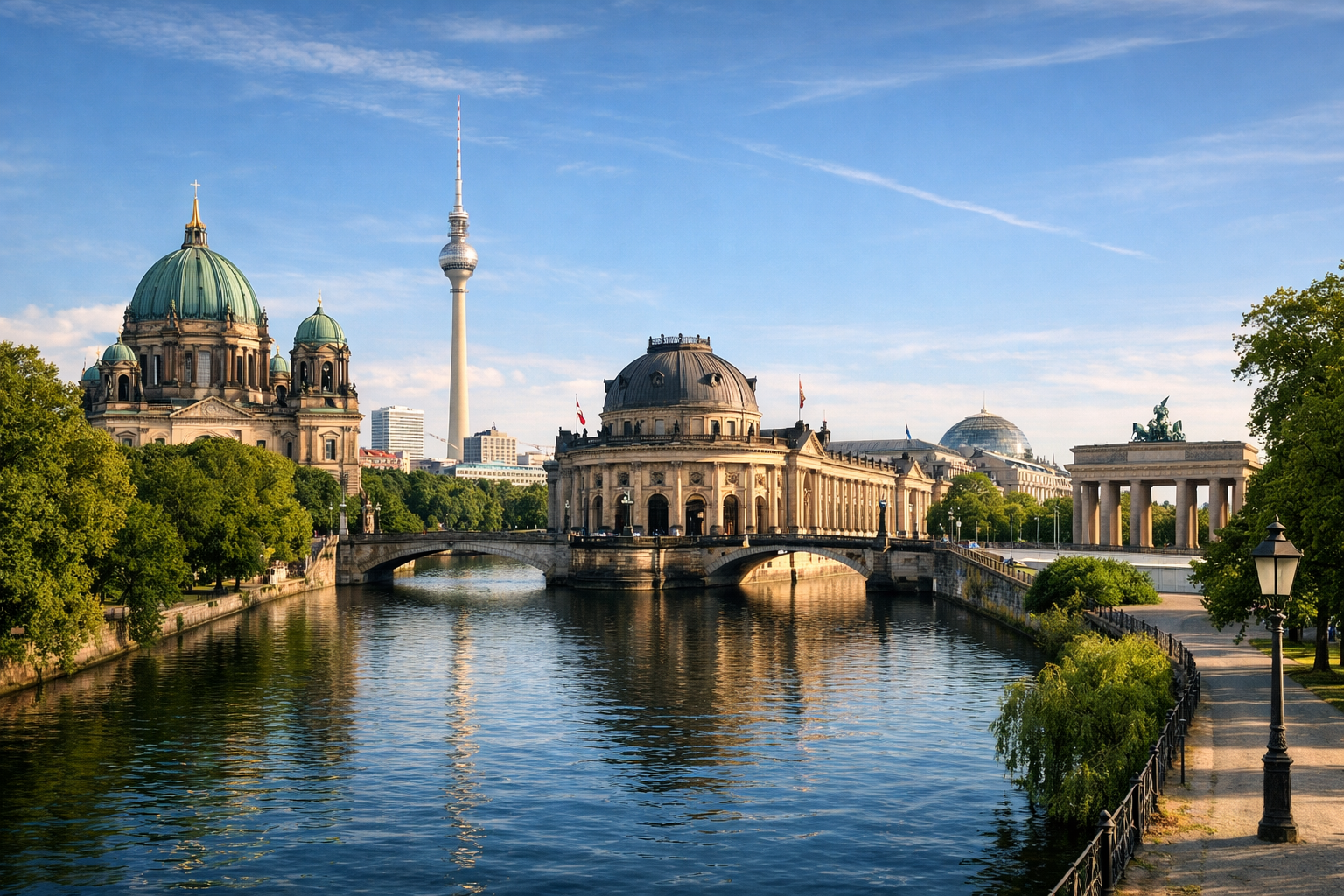
Day 1 — Berlin: Museum Island, Neues Museum, and an evening by the Spree
🚆 Arriving in Berlin is convenient via BER Airport: after leaving the terminal, you go down to the railway station under Terminal 1 and reach the central part of the city in about 30–40 minutes. If you choose to stay around Friedrichstraße, the journey, including waiting for the train, a short transfer, or the final walk, usually takes about 45–60 minutes. This is the most realistic and calmest option without unnecessary transfers, so the first day of the itinerary is designed so that after check-in you do not have to rush, but can ease into the city gradually.
🏨 After check-in and a short 45–60 minute rest, head on foot or with one short U-Bahn/S-Bahn ride to Museum Island — the heart of intellectual and architectural Berlin. It is better not to start too early after the trip: around 11:00–12:00, so the day does not turn into a race. On the way, you can already feel the main charm of Mitte: strict 19th-century facades, stone embankments, the shimmer of water between bridges, university buildings, and the sense that the city is both grand and very much alive.
🏛️ The first major highlight of the day is the Neues Museum, whose entrance is organized through James-Simon-Galerie, Bodestraße, 10178 Berlin. This is one of Berlin’s most impressive museums not only because of its collection, but also because of the space itself: here you feel especially strongly how history can be not preserved in a frozen state, but carefully lived anew. Inside, you will find Egyptian antiquities, the famous bust of Nefertiti, archaeological treasures, and a rare sense of museum depth, when one hall opens into another and each era seems to speak with the next. It is reasonable to allow 2.5–3 hours for your visit without rushing, because this museum is not about “running through a checklist,” but about slowly taking in the details.
☕ After the museum, be sure to take a break of at least 40–60 minutes. The best rhythm for museum-going in Berlin is alternating concentrated contemplation with rest. Once you step out to the water, you can simply sit by the Spree, walk toward the bridges, let your eyes rest from display cases and exhibitions, and look at the Museum Island ensemble from the outside. Here the very idea of Berlin becomes especially clear: the city does not impose an emotion, but gradually draws you in — through scale, air, street perspectives, and the gentle contrast between monumentality and everyday life.
🏛️ Then continue to the Alte Nationalgalerie, Bodestraße, 10178 Berlin. The walk between the two points takes just a few minutes on foot, which makes the route very comfortable even after a flight. From the outside, the building resembles an ancient temple on a high podium and looks almost theatrical, while inside a world of 19th-century European art opens up — Romanticism, Realism, Impressionism, painting that can be both solemn and quietly intimate. It is an ideal continuation of the day after the archaeology of the Neues Museum: if the first museum immerses you in antiquity and civilizations, the National Gallery shifts the conversation toward feelings, light, nature, and the human view of the world.
🚶 Dedicate the evening to a slow walk around the outer ring of Museum Island: Lustgarten, the square in front of Berliner Dom, the embankments by Bode-Museum, and the views toward Unter den Linden. From Alte Nationalgalerie to Berlin Cathedral it is about a very pleasant 10–12 minute walk with stops for photos. The cathedral dome, the water, boats on the Spree, the warm light on the facades, and the wide open spaces make this area especially beautiful closer to sunset. If you still have energy, you can end the day with dinner around Hackescher Markt or Friedrichstraße, and then return to the hotel at an easy pace on foot or with a short public transport ride. This kind of finale leaves a feeling of fullness without exhaustion — exactly what you need for the first day of a two-day museum tour.