
Buy PDF guide

Buy PDF guide — 25.71 USD

PDF — 25.71 USD

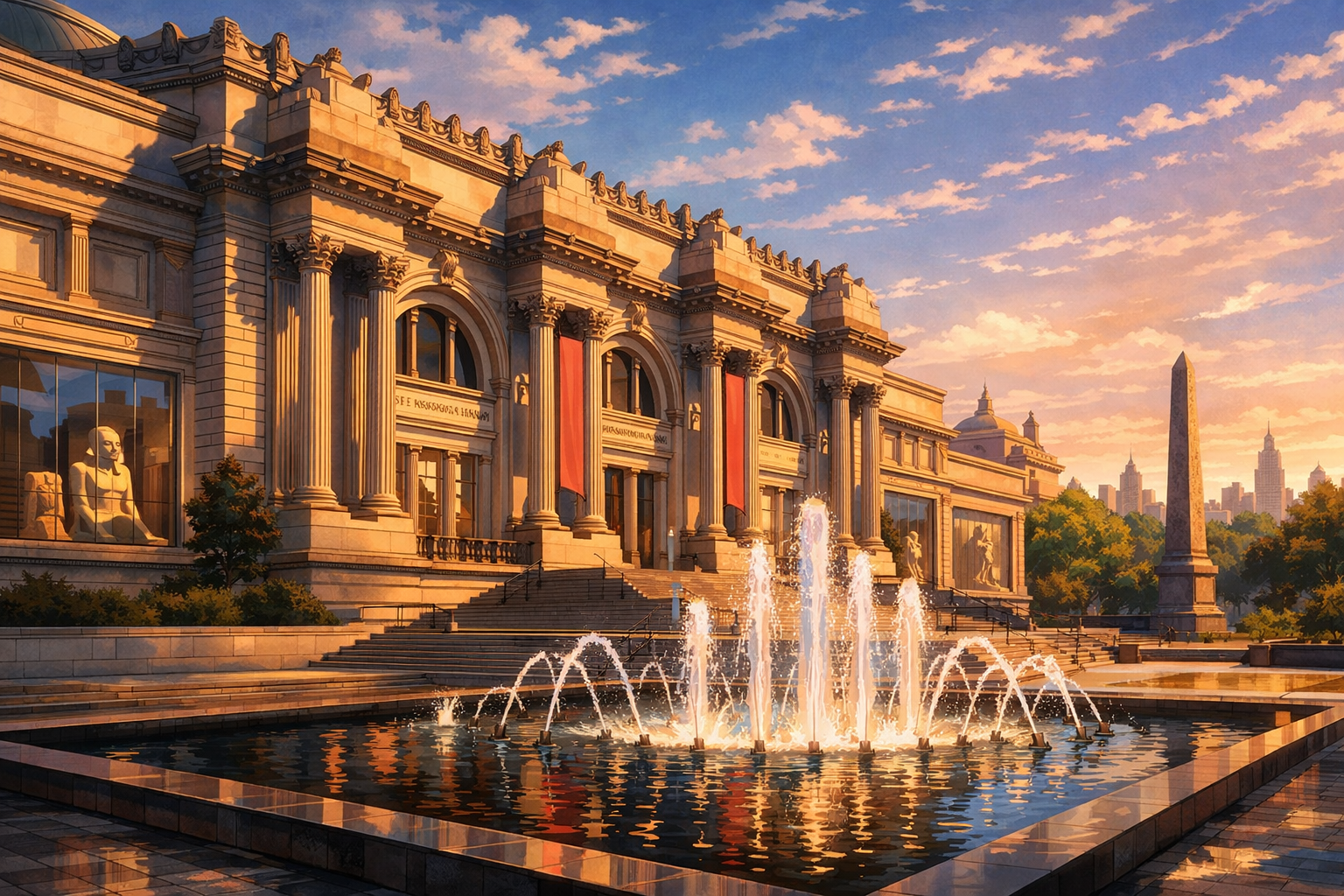
Metropolitan Museum of Art

Metropolitan Museum of Art

Trace a living timeline of art, starting at The Met on Fifth Avenue and drifting up to the Cloisters, across to Brooklyn’s bold galleries, and on to Yale’s storied collection in New Haven. Continue to Philadelphia’s Penn Museum and the Philadelphia Museum of Art before looping back to New York—one elegant arc of masterpieces and eras.

🧭 ROUTE BY DAY

Ready-made country and city routes with daily plans, sights, transport and accommodation. Buy PDF guides for independent travel.

🧭 ROUTE BY DAY


Day 1 — New York: arrival, Museum Mile, and tuning in to the “big collection”

  • 🚶 Settle on the Upper East Side and stroll along Museum Mile on the eastern edge of Central Park. The grand facade of the Metropolitan Museum on Fifth Avenue is a “gate” into five millennia of architecture and art. An evening walk along 5th Avenue and the eastern paths of Central Park helps you “grasp the scale” of the days ahead: from antiquity and the Near East to the Middle Ages and the New World.


Day 2 — The Met Fifth Avenue: Ancient Egypt and the Temple of Dendur

  • 🚶 Start with the Egyptian galleries: a route from statues of pharaohs to the iconic Temple of Dendur composition in the Sackler Wing. It’s a rare experience of a “complete architectural object” inside a museum: spans, proportions, shafts of daylight, and reflected water function as part of an authentic ritual scene. Look at tool marks on the tuff blocks, the difference between sacred spaces (the sanctuary) and transitional areas, and the reliefs where lines of hieroglyphs can be read—a “living stone text” of Roman Egypt.

Day 3 — The Met Fifth Avenue: Greece and Rome — stone sculpture and urban fragments

  • 🚶 The galleries of ancient Greece and Rome are easy to read as a “city in section”: columns and fragments of architraves, sarcophagi and gravestones, marble sculpture as a “language of status” in public spaces. Pay attention to the “architecture of the pedestal”: how the plinth, base, and backdrop (niche) shape the perception of the person and the sculpture.

Day 4 — The Met Fifth Avenue: The Ancient Near East — Assyrian reliefs and empire-cities

  • 🚶 Assyrian reliefs of processions and hunting are a “stone chronicle” of power, where the architectural orders are still silent, but the rhythm of wall and portal is already audible. Compare the scale of royal halls with more intimate household objects: this is how the hierarchy of space becomes legible—from city gates and palace halls to the home and the sanctuary.

Day 5 — The Met Fifth Avenue: Islamic art and interiors — the Damascus Room

  • 🚶 The Damascus Room (1707) is a rare example of a complete interior from a late Ottoman home: wood, inlay, inscriptions, and fountains come together into an “architecture of hospitality.” Here it’s important to look not only at the decor, but also at the plan: how the ataba leads into the raised part of the room, how light works, and where water “lives”—the key to understanding the climatic logic of a home in the Eastern Mediterranean.

Day 6 — The Met Fifth Avenue: Medieval Europe and architectural carving

  • 🚶 The transition from antiquity to the Middle Ages: portal archivolts, tympana, capitals, stained glass, and carved slabs. Look at this “textbook of form”: how stone rethinks classical motifs within a Christian narrative, and how the “architectural dramaturgy” of the portal emerges—from the profile of the jambs to the light of the naves.

Day 7 — The Met Cloisters (Fort Tryon): monasteries, cloisters, and “the garden as part of architecture”

  • 🚇 Travel by subway and bus to northern Manhattan (≈45–60 min).

  • 🚶 Met Cloisters is a medieval museum inside a complex assembled from authentic European fragments. The Bonnefont and Trie cloisters, the herb garden, and the view of the Hudson all show how monastic life organizes space: the courtyard’s quiet, the rhythm of arcades, the functions of the refectory and chapel. The best time is morning or just before sunset, when the relief of the masonry is “read” by the light.

Day 8 — Brooklyn Museum: Egypt and the ancient East + city panoramas

  • 🚇 Subway ride to Brooklyn (≈30–45 min).

  • 🚶 The Brooklyn Museum has one of the strongest Egyptian collections in the US. Look for “architectural plots in miniature”: estate models, sarcophagi, stelae, shrine details. After the museum, stop by Grand Army Plaza and Prospect Park—it’s easy there to “switch scale” from display cases to the urban landscape.

Day 9 — The Morgan Library & Museum: interiors, manuscripts, and “the study as a temple of knowledge”

  • 🚶 Pierpont Morgan’s house-library is a rare “total interior” of American High Eclecticism: halls, paneled finishes, stained glass, manuscripts. Look at the link between space and function: the library as a sacralized archive, where architecture helps focus attention and frames the book as a “sanctuary of knowledge.”

Day 10 — New York → New Haven: Yale University Art Gallery — antiquity, Rome, and Near Eastern collections

  • 🚆 Train transfer: New York (Penn Station or Grand Central) → New Haven Union Station. Options: Amtrak Northeast Regional (≈1h 40m–2h) or Metro-North New Haven Line (≈1h 45m–2h 15m).

  • 🚶 YUAG is an academic “encyclopedic” museum: antiquities, Roman mosaic, ceramics and bronze, as well as Near Eastern artifacts. Look at the typology of Kahn’s museum galleries and neighboring wings: how modernist clarity of plans helps you “read” the object without visual noise.

Day 11 — New Haven → Philadelphia: the Penn Museum and the “text-cities” of the Middle East

  • 🚆 Transfer: New Haven Union Station → Philadelphia 30th Street Station (Amtrak Northeast Regional ≈2h 50m–3h 30m; less often—faster on select runs).

  • 🚶 Penn Museum — strong galleries of Mesopotamia, the Levant, and Egypt. Architecturally it’s a “museum campus”: courtyard spaces, brick, majolica, vaults. If you still have energy—an evening climb to the steps of the Philadelphia Museum of Art: panoramas of Benjamin Franklin Parkway and “neoclassicism as a city symbol.”

Day 12 — Return to New York: finale on Fifth Avenue

  • 🚆 Transfer: Philadelphia (30th Street) → New York (Moynihan Train Hall, Penn Station) on Amtrak Northeast Regional (≈1h 15m–1h 30m).

  • 🚶 Final walk by the Metropolitan Museum’s facade and through Central Park: mentally draw the line “Egypt → Greece/Rome → Middle East → Middle Ages” that you “assembled” in The Met’s galleries, and compare it with how New York’s modernist and Art Deco architecture continues the dialogue with classical forms at megacity scale.

Flight tickets

eSIM for travel

Buy PDF guide

Buy PDF guide — 25.71 USD

PDF — 25.71 USD