
Buy PDF guide

Buy PDF guide — 29.99 USD

PDF — 29.99 USD

MONTAUK AND EAST HAMPTON

MONTAUK AND EAST HAMPTON

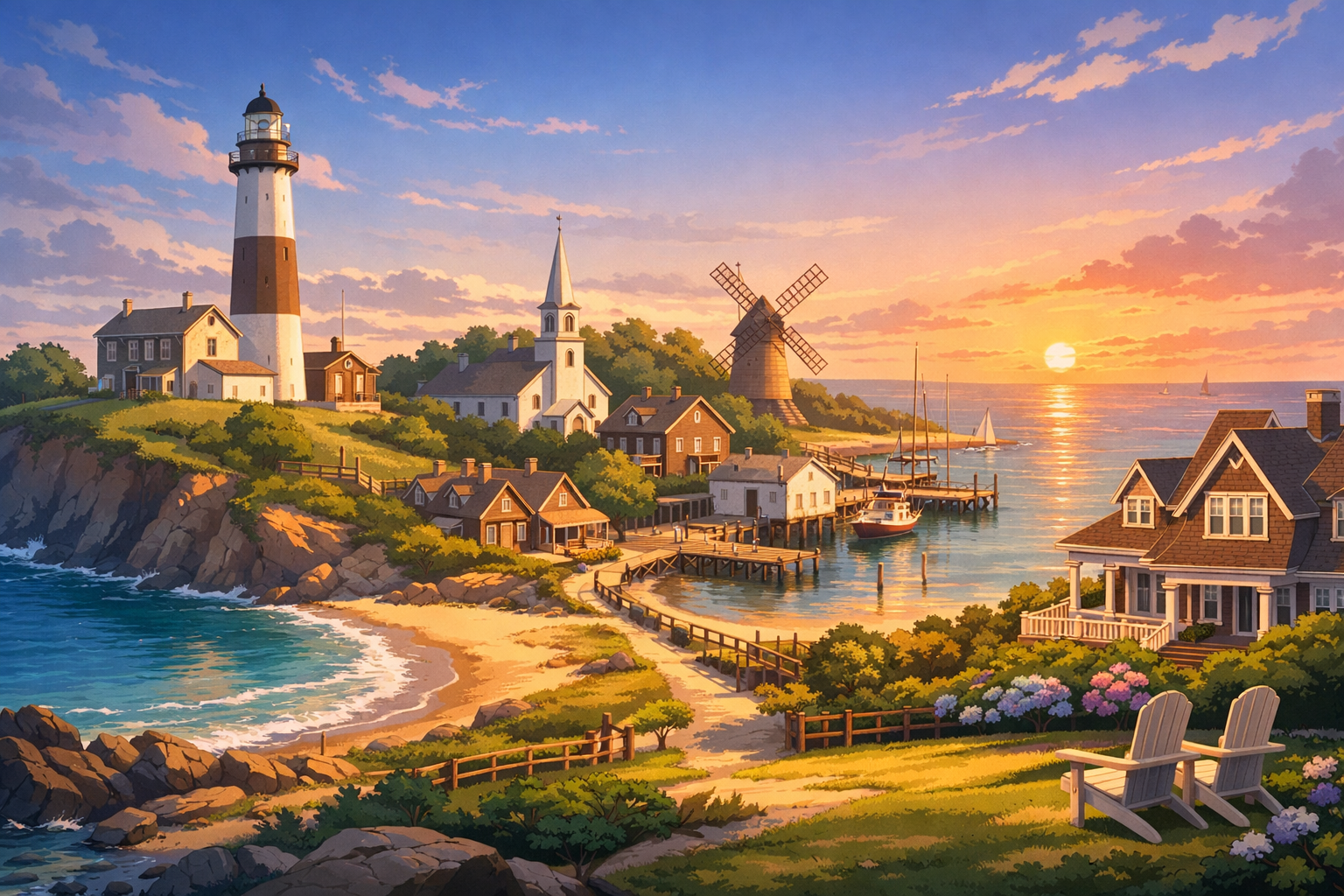
Discover the far eastern edge of Long Island, where East Hampton’s polished charm gives way to the laid-back beauty of Springs, Amagansett, and Napeague. Follow the coast to Montauk Point for windswept beaches, dramatic ocean views, and a true end-of-the-road escape.

🧭 DAY-BY-DAY ITINERARY

Ready-made country and city routes with daily plans, sights, transport and accommodation. Buy PDF guides for independent travel.

🧭 DAY-BY-DAY ITINERARY


Day 1 — East Hampton: gentle arrival and getting to know the village

  • 🚶 Start your trip in East Hampton — one of the most elegant and at the same time surprisingly calm corners of eastern Long Island. After the journey, it’s best not to overload the day: check in, exhale, and take your first walk along Main Street, James Lane, and the nearby quiet blocks. The atmosphere here is built not on a “big city” feeling, but on a combination of old trees, neat white facades, art spaces, and a very well-kept, almost cinematic residential environment. In the evening, it’s lovely to stroll slowly, glancing into gallery windows and tuning into the rhythm of the place: East Hampton opens up not through noise, but through the quality of its details — light in the treetops, old houses, small museums, and the sense that the summer resort here has long grown into a cultural landscape.


Day 2 — East Hampton: historic center, farms, and the colonial thread

  • 🚶 Dedicate the day to East Hampton’s historical layer. Start in the James Lane and Main Street area, where old house museums, colonial buildings, and places important to local memory are gathered compactly together. Mulford Farmstead and Home Sweet Home Museum offer a very grounded and clear look at the early history of the settlement: not a museum abstraction, but the everyday life of an old New England coastal community. Add Clinton Academy, and the route becomes a neat historical loop where you can really feel how the village grew from an agricultural and maritime settlement into one of the most famous addresses in the Hamptons. This day is best experienced slowly: with pauses, reading plaques, short coffee stops, and no urge to tick everything off a list.

Day 3 — East Hampton: art, Guild Hall, and the cultural life of eastern Long Island

  • 🚶 Today, gather the cultural character of East Hampton. Start with Guild Hall — not just a museum address, but an important artistic and civic center that makes it easy to see why the East End has long attracted artists, collectors, and those looking not only for the beach, but for a meaningful summer as well. After the museum, continue your walk through the center, where artistic life almost imperceptibly blends with the resort atmosphere: exhibition posters, small galleries, and spaces where contemporary art feels like a natural part of the local rhythm appear beside respectable homes. If you still have energy, save the evening for a beautiful dinner and a quiet walk in the golden light — East Hampton is especially photogenic at that hour.

Day 4 — Springs: Pollock-Krasner House and the artists’ landscape

  • 🚗 Head to Springs — an area northeast of the village where the landscape becomes looser, less formal, and noticeably more “artistic.” Here it makes sense to focus on the Pollock-Krasner House and Study Center: not just a home connected to famous names, but almost a physical touchpoint with 20th-century American art. In this space, the connection between landscape, solitude, and creative energy feels especially strong. After the museum, don’t rush away right away: Springs is beautiful precisely because of its scattered geography — wooded roads, bay views, sparse development, air scented with salt and pine. This is the day when the Hamptons look not glossy, but deep and genuinely real.

Day 5 — Springs: Leiber Collection and LongHouse Reserve

  • 🚗 Continue discovering Springs through more intimate art and garden architecture. First, stop by The Leiber Collection — a place where fashion, decorative art, and a private collector’s sensibility come together in a very elegant experience. Then move on to LongHouse Reserve: this is one of the most enjoyable days on the route for anyone who loves the combination of sculpture, garden, and an unhurried walk. The key here is not to run from object to object, but simply to move through the grounds, watching how the art “grows into” the greenery, open space, and light. After the urban pace of the previous days, LongHouse works as a reset: quiet, beautiful, slightly meditative, and very much in the Hamptons spirit.

Day 6 — East Hampton → Amagansett and Napeague: a day of ocean and dunes

  • 🚗 This day is best devoted to the road between East Hampton and Montauk — this is where one of the most beautiful coastal transitions of the entire route begins. Travel through Amagansett and onward toward Napeague without turning the drive into a race. The point of the day is to feel how the civilized rhythm of the village gradually gives way to a strip of ocean, dunes, wind, and open sky. If the weather is good, make short stops at beach access points and viewpoints just to look at the water and listen to the surf. This is one of those cases when the road itself is already part of the journey: the long coastal line, shifting light, rare gas stations, and tiny settlement clusters create a very distinctive feeling of moving toward the “edge” of Long Island.

Day 7 — Move to Montauk: village, beach, and a first evening by the ocean

  • 🚗 Move on to Montauk and give yourself time to adjust to the different character of the place. Compared with East Hampton, Montauk feels windier, more open, and less ceremonial: the fishing past, surf culture, closeness to the ocean, and general sense of the edge of the land are stronger here. After checking in, walk through central Montauk and the beachfront near your hotel without overloading the day with long drives. A good format is a late lunch, then the beach, then a long walk at dusk. The first evening in Montauk works best exactly like this: few agenda points, lots of air, the sound of the surf, and the feeling that the trip has moved from its cultural chapter into a much larger natural stage.

Day 8 — Montauk: Shadmoor State Park and ocean trails

  • 🚶 Today, explore Montauk on foot through Shadmoor State Park. It’s an excellent route if you want dramatic terrain without overly difficult hiking: bluffs, trails, viewing platforms, dunes, and a long, highly cinematic horizon. Here you really feel Montauk’s main quality — its natural honesty. The landscape doesn’t try to be a “set piece”: the wind can be strong, the paths are uneven in places, the ocean feels harsh rather than resort-gentle. That’s exactly why the walk leaves such a powerful impression. Bring water, comfortable shoes, and allow extra time for stops: in places like this, the best format is to walk slowly, look far out, and not try to pack everything into a checklist.

Day 9 — Montauk: Camp Hero and the feeling of the edge of the world

  • 🚗 One of the most atmospheric days of the route is a trip to Camp Hero State Park. This place combines natural landscape with traces of military history, which makes the impression especially strong: wooded sections, bluffs over the ocean, expansive views, and at the same time a feeling of abandoned infrastructure and old defensive stories. Even without diving into the historical details, the place works on the level of pure atmosphere — slightly harsh, almost North Atlantic. Plan half a day or more, because Camp Hero is good not only as a point on the map, but as territory for a long unhurried walk. After such a day, it feels especially good to return in the evening to the cozier center of Montauk and end it with a calm dinner.

Day 10 — Montauk Point: lighthouse, cliffs, and the easternmost point of the route

  • 🚗 Today is the region’s main “icon”: Montauk Point and its legendary lighthouse. It’s worth coming here not for the checklist, but for the sense of geography: you really do find yourself at the very end of a long, narrow peninsula where water, wind, stone, and maritime history meet. The lighthouse itself is an important visual anchor, but the coastal views and the line of the rocky shore are just as powerful here. If the weather cooperates, the landscape will feel almost epic; if it doesn’t, the place will still remain expressive — simply in a harsher key. Set aside time not only for the museum part, but also for walking around, photo stops, and simply watching the water.

Day 11 — Montauk: Hither Hills State Park and a gentler nature day

  • 🚗 After the dramatic views of Point and Camp Hero, give yourself a more relaxed day at Hither Hills State Park. It’s a good combination of beach, walks, and open space without too much “plot.” At Hither Hills, it’s pleasant to shift from museum and historical accents to the simple physical joy of travel: walk by the water, sit on the sand, have a picnic, lie down for a bit, then wander a little farther. If your trip is packed with transfers and movement, this kind of day is especially important — it gives both body and mind a chance to catch up with the impressions. Don’t plan too much: Hither Hills is good precisely because here you can allow yourself not to “extract” anything, but simply be by the ocean.

Day 12 — Montauk: Second House Museum, harbor, and the town’s fishing character

  • 🚗 Bring a historical and local note back into the route. Start with Second House Museum — one of Montauk’s key historical addresses, helping you see the town not only as Long Island’s beach finale, but as an old settlement with its own inner memory. Then move toward the harbor and docks to feel another Montauk — not a postcard, but a working coastal town with fishing and maritime life. The contrast between the museum, the modest historical fabric, and the living port environment makes the day especially vivid. This is a good point in the route to understand that Montauk is not only about beautiful views, but also about labor, sea, wind, and a very concrete everyday geography.

Day 13 — Montauk: free day — surf rhythm, beaches, revisiting favorite places

  • 🚶 Leave this day as free as possible. In Montauk, it’s especially important to have room for repetition: return to a favorite beach, drive once more to a viewpoint, have a long breakfast, then a walk, then a pause, then a spontaneous outing. If you liked Shadmoor or Montauk Point — go back. If you want a more relaxed scenario, simply live the day in the town’s rhythm: coffee, beach, short moves, sunset. A day like this is needed not because you “ran out of content,” but because good coastal places reveal themselves through repeated presence. Montauk is especially rewarding to those who do not rush it.

Day 14 — Finale: Montauk → East Hampton or departure for New York

  • 🚗🚆 The final day is best planned gently. If you’re leaving via East Hampton or heading back to New York, don’t cram the morning with a tight program: in eastern Long Island, the road depends on the season, time of day, and traffic, so a calm departure is almost always better than a “last sprint.” Take a short morning walk by the water, have breakfast without rushing, and leave buffer time for the trip to the station or bus. If time allows, you can make a short stop in East Hampton for a farewell coffee and once again feel the difference between the two characters of the trip: the more cultural and polished East Hampton and the harsher, more natural Montauk. It’s a finale that ties the whole route together into one coherent story.

Flight tickets

eSIM for travel

Buy PDF guide

Buy PDF guide — 29.99 USD

PDF — 29.99 USD