Buy PDF guide

Buy PDF guide — 29.99 USD

PDF — 29.99 USD

MILAN

MILAN

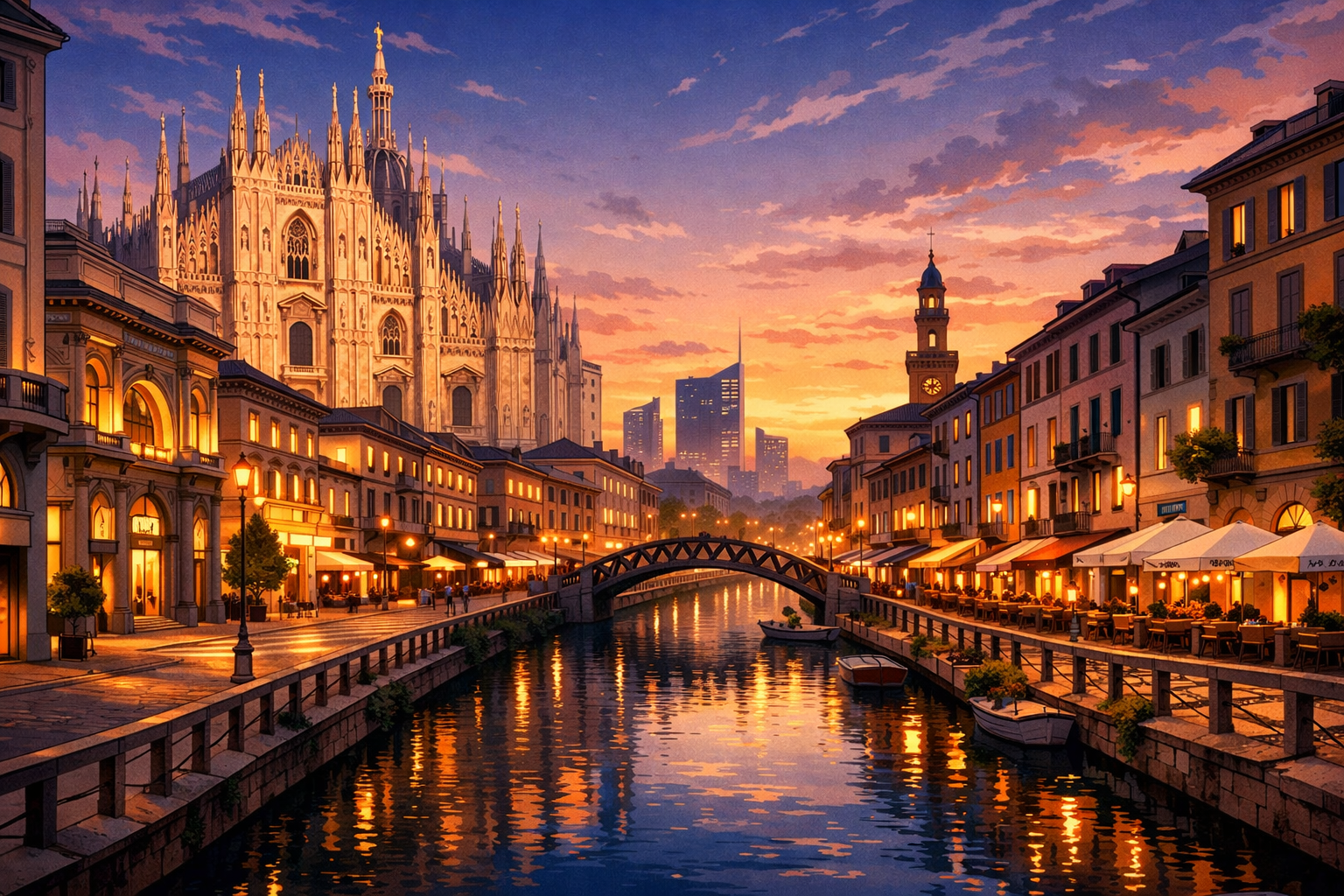
Start at the soaring Duomo and stroll into the glossy boutiques of the Quadrilatero della Moda, then linger over art and aperitivo in bohemian Brera. Watch the skyline shift in sleek Porta Nuova before the day fades into canal-side nights in Navigli.

🧭 DAY-BY-DAY ITINERARY

Ready-made country and city routes with daily plans, sights, transport and accommodation. Buy PDF guides for independent travel.

🧭 DAY-BY-DAY ITINERARY


Day 1 — The Duomo and the historic heart

  • 🚶 Start at Piazza del Duomo: the cathedral’s white-and-pink marble seems to “shimmer” as the light changes, and the rooftop terraces offer a 360° view over the entire center. Walk through the Galleria Vittorio Emanuele II — glass arcades, mosaics, and luxury storefronts create a ceremonial rhythm. Piazza della Scala and the theater’s austere façade are another key “anchor point.” Finish with a gentle stroll along quiet streets toward Brera: low lamps, courtyard shadows, the smell of coffee, and the click of heels set the right “Milanese” mood.


Day 2 — Quadrilatero della Moda (Via Montenapoleone, della Spiga, Manzoni, Corso Venezia)

  • 🚶 This is the fashion “golden square”: palazzo façades, boutique doors, the dense weave of craftsmanship and haute couture. Start on Via Montenapoleone — restrained luxury in the windows and the street’s perfect proportions. Cross to Via della Spiga — quieter, more intimate, with pale portals and neat courtyards. On Via Manzoni and Corso Venezia there’s more air and classic lines. Drop into Palazzo Morando (Via Sant’Andrea, 6): the “Costume. Fashion. Image” museum neatly gathers the fabric of the city’s fashion history. Breaks are short espresso at the counter so you don’t fall out of the rhythm.

Day 3 — Brera: art and neighborhood courtyards

  • 🚶 Brera is picturesque streets, studios, bookshops, and the famous Pinacoteca di Brera (Via Brera, 28): a collection of old masters inside a palace with classical enfilades. Nearby is the tiny Brera Botanical Garden — a green pause amid the stone. Then on to Sforza Castle and Parco Sempione: a sequence of alleys, lawns, and water mirrors with the lines of the Arco della Pace on the horizon. The day comes together like “tuning your gaze”: from museum quiet to a big city park.

Day 4 — Navigli and Darsena: water, brick, and sunset

  • 🚶 Water makes Milan especially expressive. Start at the Darsena — the “city harbor” where Naviglio Grande meets Naviglio Pavese: reflections of façades, boats, and russet brick. Walk along the Ripa di Porta Ticinese embankment and stop by Vicolo dei Lavandai — an old “laundry” alley with stone washbasins. Naviglio Pavese is quieter and more graphic. Along the way: the portico of the Columns of San Lorenzo and Porta Ticinese — ancient lines in modern life. Best time is the golden hour: the canals become a mirror of the sky.

Day 5 — The Tortona design corridor: MUDEC and Armani/Silos

  • 🚶 Southwest of the center, former factories have become a world of design and fashion. MUDEC — Museo delle Culture (Via Tortona, 56) — large exhibition volumes and clear routes. A bit farther: Armani/Silos (Via Bergognone, 40), a large-scale distillation of Armani’s couture language in the строг architecture of a former grain silo. Between them are showrooms and inner courtyards where Milan is especially convincing as a “capital of form.” Finish at Porta Genova: the green M2 line will quickly take you back to any district.

Day 6 — The modern city: Porta Nuova, BAM, and towers

  • 🚶 Piazza Gae Aulenti, the “trees” of Bosco Verticale, and BAM Park — Biblioteca degli Alberi — are Milan at a new height. Here you can hear how the city has learned to speak the language of landscape and glass: crisp tower edges, diagonal paths, a “collection” of trees and grasses right in the center. In the evening, light reflections in the park’s ponds and the high sky create a rare feeling of a “walkable мегacity.”

Day 7 — Leonardo and science: Museo Nazionale Scienza e Tecnologia

  • 🚶 Via San Vittore leads to the Museo Nazionale della Scienza e della Tecnologia “Leonardo da Vinci” (Via San Vittore, 21): reconstructions of machines, railway halls, ships, and space — all assembled with Italy’s love of engineering. Nearby are the Basilica of Sant’Ambrogio and quiet cloisters: slow your pace, then walk to Castello Sforzesco and Parco Sempione — “a lot of air after a rich museum.”

Day 8 — The 20th century: Museo del Novecento and Palazzo Reale

  • 🚶 Back to Piazza del Duomo for the Museo del Novecento (Piazza del Duomo, 8): Italian Futurism, abstraction, Arte Povera, and a view of the cathedral from the upper galleries’ windows. If there’s a major show at Palazzo Reale, add it: palace interiors become a neutral “container” for strong curatorial stories. Finish with an unhurried loop around the cathedral to catch a couple more angles of its marble “lace-like” sculpture.

Day 9 — Private collections: Gallerie d’Italia and Poldi Pezzoli

  • 🚶 On Piazza della Scala: Gallerie d’Italia (Piazza della Scala, 6), elegant 19th–20th-century halls and renovated spaces. Two steps away: Museo Poldi Pezzoli (Via Manzoni, 12), a jewel-box mansion with an armory, tapestries, and paintings. By day, it’s an ideal pairing: from “institutional” beauty to intimate museum quiet.

Day 10 — Naviglio Grande as a long line

  • 🚶 A walking day along Naviglio Grande. Go from the Darsena toward the western neighborhoods: little bridges, workshops, antique shops, unexpected courtyards, graffiti, and fabrics drying on lines. You can rent a bike and go farther along the water beyond the dense center — there the canal becomes a country road, and Milan reads completely differently.

Day 11 — A day of water and bridges: short cruise/walk

  • 🚶 If there’s a seasonal canal boat ride, it’s a gentle way to see the same geometry from a different level. Alternatively, do a “bridge” route: pick 5–6 bridges over Naviglio Grande and Pavese, photographing reflections and the play of perspective. In the evening, an aperitif by the water: it’s not a “tourist ritual,” but a living urban gesture of “stopping and looking.”

Day 12 — Squares and shop windows: from the Duomo to Montenapoleone

  • 🚶 Return to the route Duomo → Galleria → La Scala → Quadrilatero: by day the shop windows reveal themselves differently—without theatrical lighting, but with precise textures of fabrics and leather. At Palazzo Morando you can catch a temporary fashion exhibition. End in one of the inner courtyards—here you can hear how Milan knows how to preserve silence amid its businesslike fullness.

Day 13 — Parks: Sempione and Giardini Indro Montanelli

  • 🚶 In the morning—Parco Sempione: walk to the pond by Piazza del Cannone, drop by the Acquario Civico and catch the line of the Arco della Pace. In the afternoon—Giardini Pubblici Indro Montanelli by Porta Venezia: old trees, lawns, and the museum axes around (GAM, Paleontology, Planetarium). A “no obligations” day before the finish—to straighten your shoulders.

Day 14 — Finale: favorite places and sunset on the canals

  • 🚶 Put together your own “final lap”: a spot where it felt especially good (a Brera alleyway, a little bridge by the Navigli, or the Duomo viewpoint). Choose the shots you want to take with you—marble, water, steel, and glass—and arrange a leisurely dinner nearby. Milan says goodbye best in the evening, when shop windows become screens and the canals become long bands of light.

Flight tickets

eSIM for travel

Buy PDF guide

Buy PDF guide — 29.99 USD

PDF — 29.99 USD