Buy PDF guide

Buy PDF guide — 25.71 USD

PDF — 25.71 USD

Merv, Gyaur Kala and Sultan Kala

Merv, Gyaur Kala and Sultan Kala

From white-marble Ashgabat, head east across the Karakum to Mary and the haunting Silk Road ruins of Ancient Merv—Gyaur-kala and Sultan-kala—before looping back to the capital. Turkmenistan pairs surreal cityscapes with vast desert horizons and echoes of empires.

🧭 DAY-BY-DAY ROUTE

Ready-made country and city routes with daily plans, sights, transport and accommodation. Buy PDF guides for independent travel.

🧭 DAY-BY-DAY ROUTE


Day 1 — Ashgabat: an “entry point” into the context of Margiana

  • 🚶 Start with the State Museum of the State Cultural Center of Turkmenistan (Archabil sh. 50): the museum traces a line from the early archaeology of the Karakum to the Achaemenid and Sasanian eras—the very “key” that will help you read the ruins of Merv as a living city, not just a set of walls and domes.

  • 🧶 Drop by the National Museum of the Turkmen Carpet (central Ashgabat): the carpet and ornamental tradition is the region’s architectural “second skin.” The rhythm of göls and borders is then easy to recognize in Merv’s brickwork plasticity.


Day 2 — Flight/train to Mary + evening orientation

  • ✈️ Transfer: Ashgabat → Mary. Direct Turkmenistan Airlines flight (~50–55 min + time for baggage). Alternative: train (~7 h). Upon arrival, check in and take an easy walk along the Murghab riverbed: the water and green boulevards help you feel why ancient Merv grew up именно here.

  • 🏛️ In the evening—façades and lighting of the new building of the Mary Velayat Museum of History and Local Lore: a white-marble “portal” into the archaeology of the oasis.

Day 3 — Merv: Erk-kala and Gyaur-kala (the ancient and early medieval core)

  • 🚶 Morning—Erk-kala: the oldest citadel of the complex, the “seed” of the city’s history. Read the relief of the ramparts and gates as the “first line” in the story of the plan.

  • 🚶 Day—Gyaur-kala: the huge oval of fortress walls from the Sasanian period and later. Look for the “links” between main streets and gates, traces of neighborhoods. Against the flat horizon, the contrast of light and shadow on fired brick is especially expressive—an ideal time for panoramic shots closer to sunset.

Day 4 — Merv: Sultan-kala and the mausoleum of Sultan Sanjar

  • 🚶 Seljuk Sultan-kala is a true “shot plan” of a medieval megapolis. Walk from the gates to the center along the street axes, paying attention to wall thickness and the rhythm of the towers.

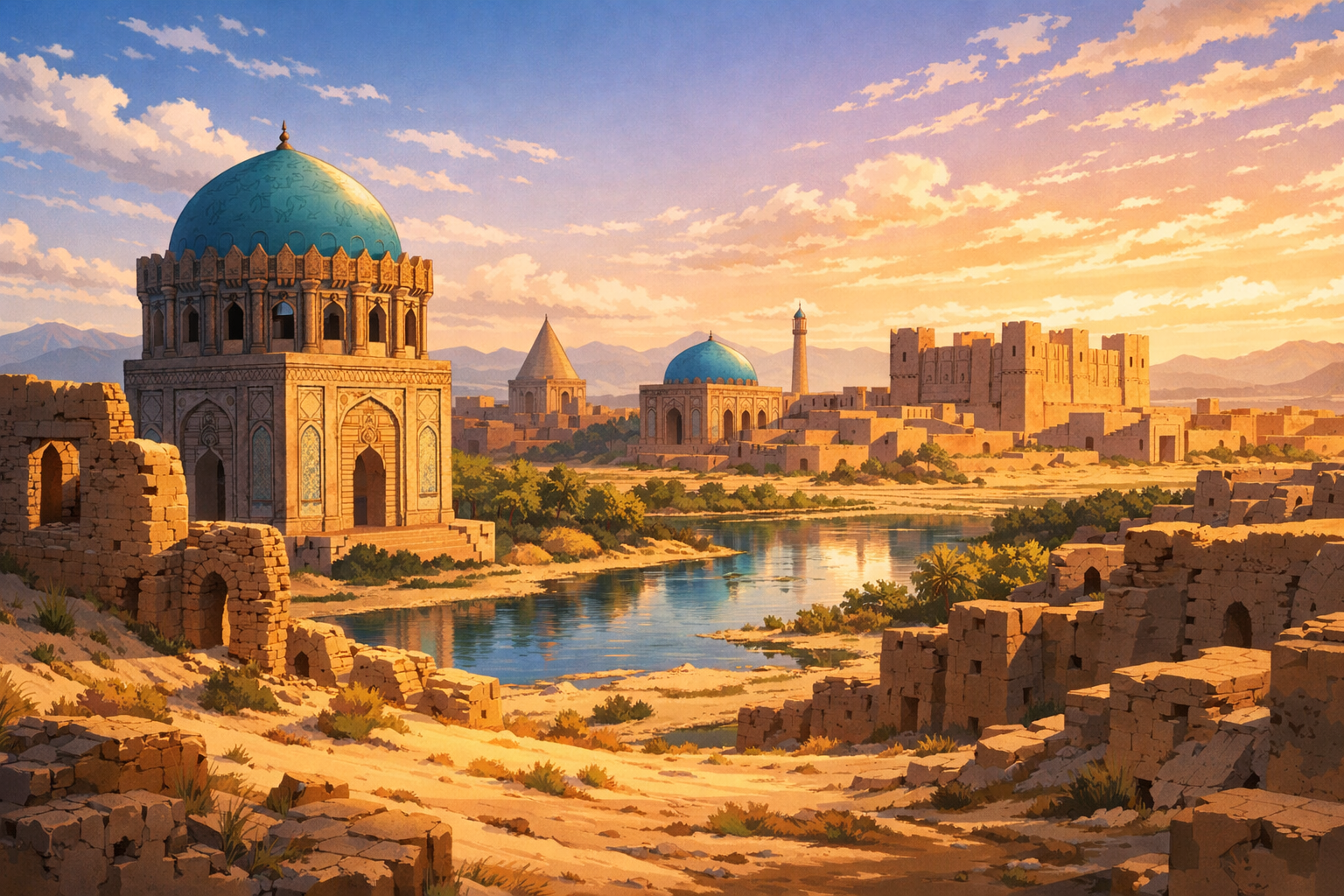
  • 🕌 The culmination is the mausoleum of Sultan Sanjar (12th c.): the cubic mass and monumental dome read like an architectural “beacon” of the steppe plain. Inside—rare clarity of proportions and light; outside—a silhouette that sets the scale of all Sultan-kala.

Day 5 — Merv: Kyz-kala and the city’s economic “machines”

  • 🚶 Greater and Lesser Kyz-kala are powerful earthen masses with characteristic ribbed buttresses. This is not just the romance of ruins, but traces of utilitarian architecture and the display of status.

  • 🧊 “Kepderikhana” and icehouses: economic infrastructure as part of the urban organism. Look at ventilation openings, orientation, and how they tie into the terrain—it makes it easier to imagine the logistics of water and food in an oasis climate.

Day 6 — Merv: Abdullah-khan-kala and Bayram-Ali-khan-kala

  • 🚶 A day for later fortified perimeters—Abdullah-khan-kala and Bayram-Ali-khan-kala. The route clearly shows how the city was “repackaged” in new eras: walls were renewed, emphases shifted, and the road network changed.

Day 7 — Islamic heritage of the oasis: Yusuf Hamadani and Ibn Zayd

  • 🕌 The Yusuf Hamadani complex is Merv’s Sufi topography: a sacred core, a pilgrimage rhythm, the link between road and shrine. Not only the halls matter here, but also the space around—the silence and the steppe wind let you sense the “breath” of caravan routes.

  • 🕌 The mausoleum of Muhammad ibn Zayd is another “voice” of the medieval city. Compare its décor, proportions, and placement in the landscape with Sanjar’s mausoleum—the variety of architectural solutions within a single center becomes immediately clear.

Day 8 — Gonur-Depe (Bronze Age Margiana): expedition day

  • 🚙 Off-road trip to Gonur-Depe (≈1.5–2.5 hours one way; last 20 km are dirt): the capital of ancient Margiana reveals the “zero level” of oasis urbanism—fire temples, palace, necropolis. This is an ideal “prelude” to Merv: you will see where the technologies and planning principles of oasis centers come from.

  • ☀️ Return to Mary—free evening and rest by the water/in the park: after the dusty road, it’s good to “reassemble” your impressions.

Day 9 — Talkhatan-baba: brick poetry of the 11th–12th centuries

  • 🚗 Trip to the Talkhatan-baba mosque (about 1 hour from Mary): a rare example of the region’s brick decorative “classics.” The frieze of arches and the calm plane of the walls convey the aesthetics of early Seljuk Turkmenistan. Return to Mary in the second half of the day.

Day 10 — Mary Museum: the “second chapter” of Merv under one roof

  • 🏛️ Mary Regional History Museum — artifacts from the excavations of Merv and Gonur-depe, ethnography, and the nature of the velayat. This is a day for “gluing” stone and context together: captions, dioramas, and display cases help reconstruct what was lost, understand the role of water and routes, and see the everyday life and jewelry of residents of different eras.

Day 11 — Merv at sunrise and sunset: architecture of light

  • 📷 An early departure to spots where the light works for volume: the eastern walls of Gyaur-kala at sunrise; sunset at the Mausoleum of Sanjar — warm side light “pulls out” the ribbed walls and emphasizes the dome’s profile. In the daytime — a break to rest at the hotel.

Day 12 — Return to Ashgabat + final walk

  • ✈️ Transfer: Mary → Ashgabat (flight ≈50–55 min or train ≈7 h). Build in extra time for transfers and check-in.

  • 🚶 Final walk around central Ashgabat: sum it up — from Bronze Age Margiana through Sasanian Gyaur-kala to Seljuk Sultan-kala. In your head, a coherent line comes together: “oasis — infrastructure — imperial city.”

Flight tickets

eSIM for travel

Buy PDF guide

Buy PDF guide — 25.71 USD

PDF — 25.71 USD