
Buy PDF guide

Buy PDF guide — 25.71 USD

PDF — 25.71 USD

ANCIENT MERV — OASIS AND EMPIRES

ANCIENT MERV — OASIS AND EMPIRES

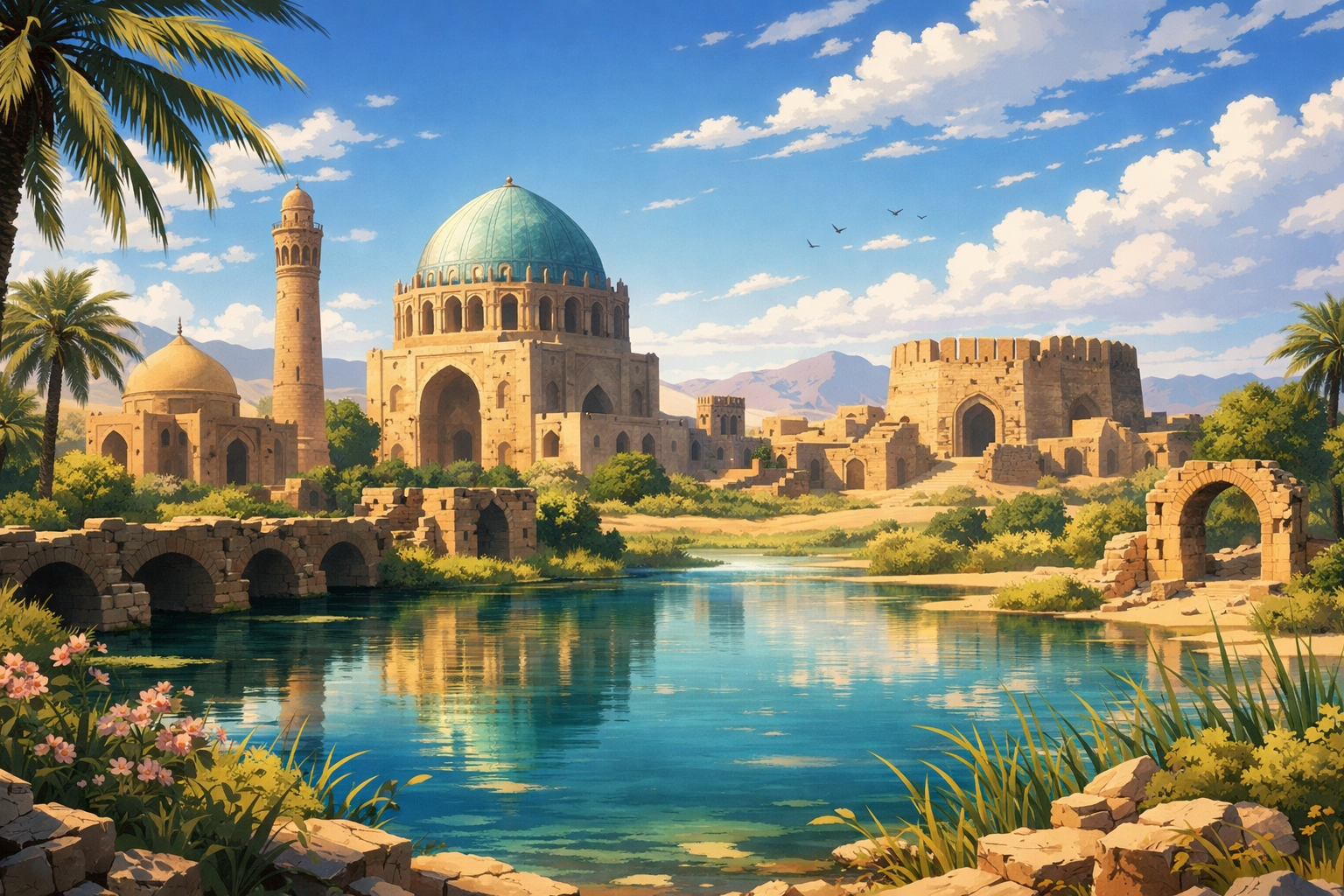
Trace the Silk Road from gleaming Ashgabat to the sand-brushed ruins of Ancient Merv, where oasis canals once fed an empire. Venture deeper to Bronze Age Gonur-depe in Margiana and the frontier citadels of Abiverd and Serakhs, before circling back across desert horizons.

🧭 DAY-BY-DAY ITINERARY

Ready-made country and city routes with daily plans, sights, transport and accommodation. Buy PDF guides for independent travel.

🧭 DAY-BY-DAY ITINERARY


Day 1 — Ashgabat: arrival, settling in, and a museum prologue

  • ✈️ Arrival in Ashgabat (ASB). Check-in and light adaptation to the time zone (UTC+5). After lunch — a visit to the State Museum of the State Cultural Center of Turkmenistan on Archabil (rich archaeology: Nisa, Margiana, Merv). From an “architectural eye” point of view, this is an introduction to the region’s relief and materiality: sun-dried brick, plaster, carving, domed structures.


Day 2 — Flight/train to Mary → evening reconnaissance in Bayramaly

  • ✈️/🚆 Transfer to Mary: a morning domestic flight Ashgabat → Mary (≈ 40–50 minutes) or a daytime/night train (≈ 6–8 hours) on the Trans-Caspian line via Kaka/Tejen. Upon arrival — transfer to the hotel and a short walk around Mary. At sunset, drive toward Bayramaly (≈ 30–40 minutes by car) to see the line of ruins on the horizon and grasp the oasis’s scale.

Day 3 — Ancient Merv I: Erk-Kala and Gyaur-Kala (the classical core)

  • 🚶 Morning — enter the territory of the historical and cultural park “Ancient Merv.” Start with Erk-Kala, the earliest fortified core: a ring rampart, platforms, and readable traces of early urban planning. Next — Gyaur-Kala with massive walls in sun-dried brick technique: from passages to towers to panoramas of the flat Mary landscape. Look at the wall profiles, masonry technique, and the “shadow graphics” of niches and buttresses.

Day 4 — Ancient Merv II: Sultan-Kala and the mausoleum of Sultan Sanjar

  • 🚶 Sultan-Kala is Seljuk capital scale: urban arteries, a citadel, and religious complexes. The climax is the Mausoleum of Sultan Sanjar (12th c.): a monumental cube under a dome, once turquoise-glazed; an ideal “geometry of power” and the interior’s spatial dramaturgy. Pay attention to the proportions of the arches, light openings, and traces of plaster decoration.

Day 5 — Kyz-Kala, Kesik-Kala and Merv’s “suburban palaces”

  • 🚶 A day of “estates” and fortifications: Greater and Lesser Kyz-Kala — rare fortification plasticity with “stitch-like” niches and powerful buttress relief; nearby — Kesik-Kala, service buildings, and caravan courtyards. Read the ensembles’ planning logic: how private and utilitarian spaces neighbored defense, and how mud-brick worked as the city’s “architectural fabric.”

Day 6 — Shrines of the oasis: Talkhatyn-baba and mausoleums of the 9th–12th centuries

  • 🚗 Morning trip to the Talkhatyn-baba mosque (11th–12th c., a three-aisled composition with a domed bay) and nearby mausoleums (of Muhammad ibn Zayd, ‘Abdallah ibn Burayda): brick ornament, restrained portals, and intimate interiors. This is the “quiet chapter” of Merv’s architecture, where techniques of brick decoration and the scale of “human measure” are most noticeable.

Day 7 — Gonur-depe (Margiana): the Bronze Age in the Karakum

  • 🚙 Expedition day by 4×4: Mary → Gonur-depe (≈ 3–4 hours one way on steppe tracks). On site — Margiana’s palace-temple complex (2nd millennium BCE): strict planning, cult rooms, traces of oasis canals. This is the region’s “ground zero” of history: before classical Merv — cities and sanctuaries of mud-brick, the rhythm of walls and openings without stone.

Day 8 — Mary: regional museum + rest

  • 🏛️ Visit to the Mary Regional Museum of History and Local Lore (archaeology of Merv and Margiana, ethnography, models and dioramas). After — free time: bazaar, teahouse, an unhurried evening. Reassemble the sequence in your head: Bronze Age → antiquity → early Islam → the Seljuks.

Day 9 — Abiverd (Ahal): a fortress city on the Great Silk Road

  • 🚗 Day trip Mary → Abiverd (Kaka district; road ≈ 2.5–3 hours one way via the M37/E60). Abiverd is a clearly legible early medieval fortress: ramparts, towers, citadel plan. Look at the relationship between terrain, wall lines, and entrance nodes — a “textbook” of desert-belt fortification.

Day 10 — Serakhs: the mausoleum of Abu-l‑Fazl (Serakhs-baba) and Yarty-Gumbaz

  • 🚗 Transfer to Serakhs (≈ 3.5–4 hours from Mary, closer to the Iranian border). The Mausoleum of Abu-l‑Fazl (early 11th c.) has a clear domed typology and elegant brick graphics; nearby Yarty-Gumbaz (1089) is a restrained volume with a “pure” dome. A day “about the dome”: proportions, squinches, the work of light, and acoustics in intimate volumes.

Day 11 — Ancient Merv III: a free day for “pinpoint” locations

  • 🚶 Return to favorite spots in the park: a second reading of Sultan-Kala, a walk along the gate lines, a photo session by Kyz-Kala at sunset. Optionally — additional oasis shrines or an early departure to the northern shallows of the Karakum. In the evening — packing for the flight.

Day 12 — Return to Ashgabat and finale

  • ✈️ Morning flight Mary → Ashgabat or a daytime train. Free time in the capital for final shopping and panoramas. The route summary is a coherent line: Margiana → ancient and Islamic Merv → Seljuk masterpiece (Sanjar Mausoleum) → Ahal fortresses.

Flight tickets

eSIM for travel

Buy PDF guide

Buy PDF guide — 25.71 USD

PDF — 25.71 USD