
Buy PDF guide

Buy PDF guide — 4.28 USD

PDF — 4.28 USD

Melnik - the smallest town, wine, and sandstone pyramids

Melnik - the smallest town, wine, and sandstone pyramids

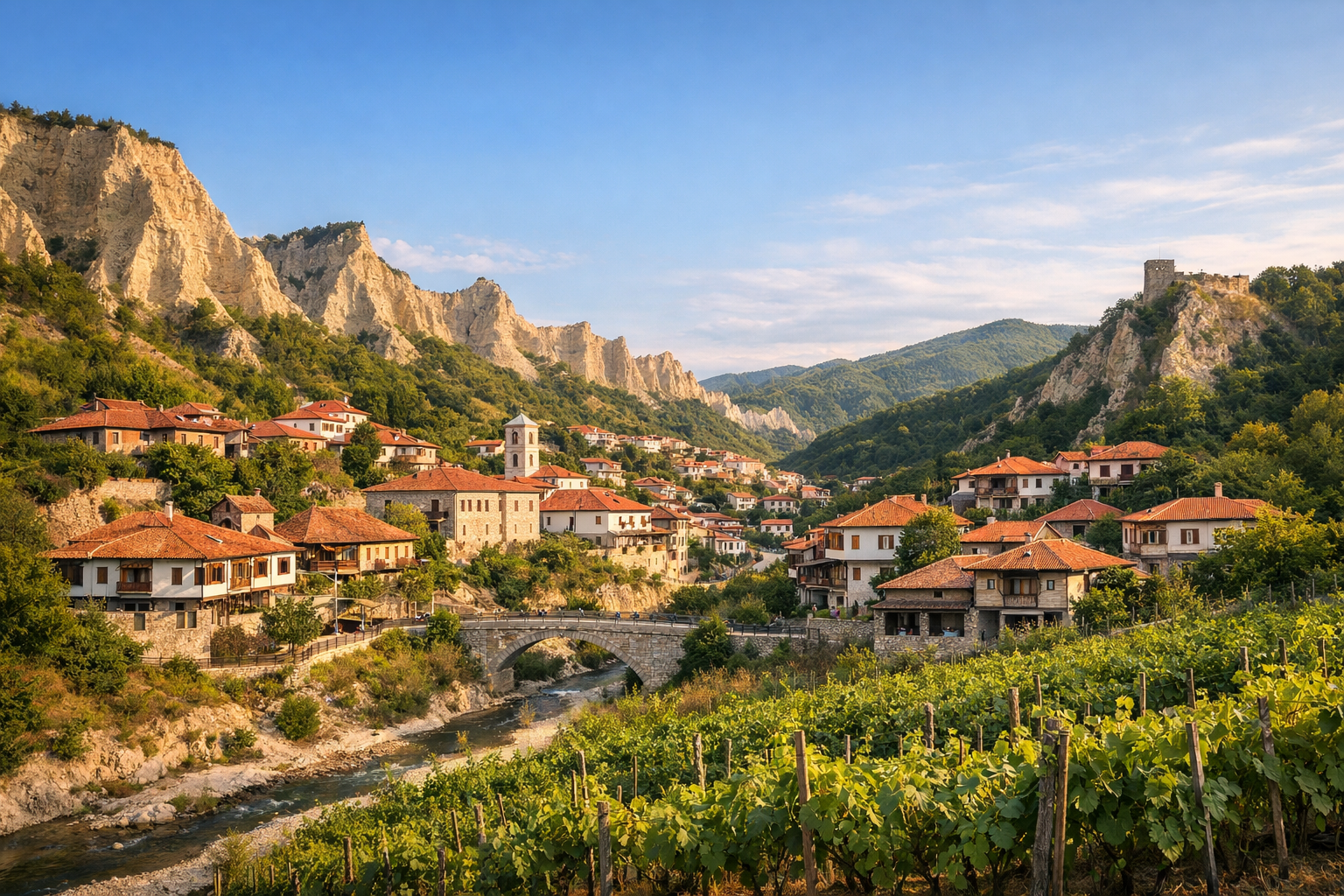
Melnik may be Bulgaria’s smallest town, but it leaves a big impression with sun-warmed stone houses, deep red wines, and the surreal sandstone pyramids rising above the valley. It’s an easy escape from Sofia, especially paired with the peaceful Rozhen Monastery just up the road.

🧭 DAY-BY-DAY ROUTE

Ready-made country and city routes with daily plans, sights, transport and accommodation. Buy PDF guides for independent travel.

🧭 DAY-BY-DAY ROUTE


Day 1 — Sofia → Melnik: the road, old town, and wine

  • 🚆/🚗 The most optimistic and realistic start to the route is flying into Sofia and then heading to Melnik. By car, the trip via the Struma motorway and then a regional road takes about 2 hr 45 min to 3 hr 15 min without long stops. If you travel by public transport, the most convenient option is to first get to Sandanski and then change to a local bus or taxi to Melnik; in that case, allow noticeably more time for connections and waiting. For a short two-day route, a car, private transfer, or pre-booked taxi from Sofia is the most comfortable option, especially if you want to avoid rushing and save your energy for walks.

  • 🏘️ Melnik is a tiny town with enormous character, hidden at the foot of the southwestern Pirin among fantastical sandy slopes. It is known as the smallest town in Bulgaria, but it does not feel “small” so much as intimate and almost theatrical: white houses with wooden bay windows, narrow streets, soft light on sandy embankments, and a wine theme that here is not a backdrop but the essence of the place. It is best to arrive around midday: check in, have a relaxed lunch, and give yourself a chance to breathe after the road. In this route, Melnik is not treated as a point to rush through — on the contrary, its beauty reveals itself precisely at a slow pace, when you are not just looking but listening to the silence, noticing facade details, and feeling how the landscape literally embraces the town from all sides.

  • 🏛️ After a rest, head to Kordopulov House — Melnik’s most famous house and one of the symbols of the Bulgarian Revival. It is not just a beautiful mansion, but almost an architectural portrait of local wine wealth: spacious halls, bright stained-glass windows, high ceilings, wooden galleries, and huge cellars where it is easy to imagine how large-scale Melnik’s wine trade was in the 18th–19th centuries. The house impresses not with flamboyance, but with its combination of prosperity and local identity. Inside, you especially feel that the town once lived not only on the edge of picturesque cliffs, but also at the crossroads of trade routes, tastes, and cultures.

  • 🏺 Then it is worth stopping by the Historical Museum of Melnik, housed in the Pashov House. This is a good place to bring together the town’s history: from medieval prosperity and spiritual life to winemaking traditions and the gradual transformation of Melnik from a major regional center into a rare small urban gem with an almost museum-like atmosphere. Here the route gains depth: the walk stops being simply beautiful and starts coming together as the story of a place where natural relief, wine trade, monastic culture, and old houses lived for centuries as a single whole.

  • 🍷 Toward evening, leave time to get acquainted with Melnik wine. This region has long been associated with red varieties and rich, warm flavors, and the very idea of a tasting here is seen not as separate entertainment, but as a natural continuation of a walk through town. It is better not to overload the day with far-off trips: choose a relaxed dinner in Melnik, take a walk through the central part after sunset, and watch how the sandy slopes turn pink in the soft light. A night in Melnik is especially valuable for its silence: after the daytime tourist hours, the town becomes very personal again, almost homelike.


Day 2 — Melnik: sand pyramids, Rozhen Monastery, and return

  • 🌄 It is best to start the morning in Melnik early, while the air is still cool and the light gently emphasizes the relief. The region’s main natural star is the Melnik Earth Pyramids, famous sandy formations of bizarre shapes: cones, towers, needles, mushrooms, and entire undulating ridges. These forms look almost unreal, as if they were sets for a film about a lost canyon, but that is exactly the magic of the place: nature created a landscape here that feels both fragile and monumental at the same time. A walk between viewpoints and trails does not require athletic heroics, but you should definitely allow extra time for it — at least 2–3 hours with stops for photos, catching your breath, and unhurried contemplation.

  • 🥾 One of the most beautiful options for the day is to walk or drive toward Rozhen Monastery. The hiking route through the pyramid landscapes is very scenic, but it requires comfortable shoes, water, and a calm pace; if you do not want a full trek, you can drive or take a taxi there in just a few minutes and then walk around the area once you arrive. For a two-day route, it is ideal to combine a moderate walk with a gentle pace so that the second day does not turn into a race.

  • ⛪ The Rozhen Monastery of the Nativity of the Mother of God is one of the region’s most important spiritual places and a rare site where landscape and architecture sound in unison. It is set among sandy slopes and the green folds of the foothills so organically that it seems not built, but grown out of this landscape. The inner courtyard, stone walls, arcades, ancient frescoes, and the calm of the monastic space create a completely different tone for the journey: after wine-filled and almost festive Melnik, here comes a feeling of focus and silence. It is a good pause in the route when you want not only to look, but simply to be.

  • 📸 After the monastery, leave time for short stops at viewpoints and panoramic spots. It is here that you can especially see why Melnik is loved not only for its wine, but also for its rare combination of a mild southern climate, pale sandy relief, and historic architecture. The landscape constantly changes depending on the angle and the light: in the morning it is graphic and almost silvery, by midday it turns golden, and toward evening it becomes honey-colored and warm.

  • 🚗 For the return road to Sofia, it is worth allowing about 3 hours of pure travel time, and in the holiday season and at the end of the day — a little more. The best logic for the second day is this: early breakfast, the nature part of the route, then Rozhen Monastery, a relaxed lunch or coffee, return to Melnik for your things, and drive back without rushing. That way, the route really remains a holiday rather than a checklist. In two days, you have time to see the essentials: the old wine town, its history, the natural wonder of the sand pyramids, and the monastic silence of the region.

Flight tickets

eSIM for travel

Buy PDF guide

Buy PDF guide — 4.28 USD

PDF — 4.28 USD