
Buy PDF guide

Buy PDF guide — 6.43 USD

PDF — 6.43 USD

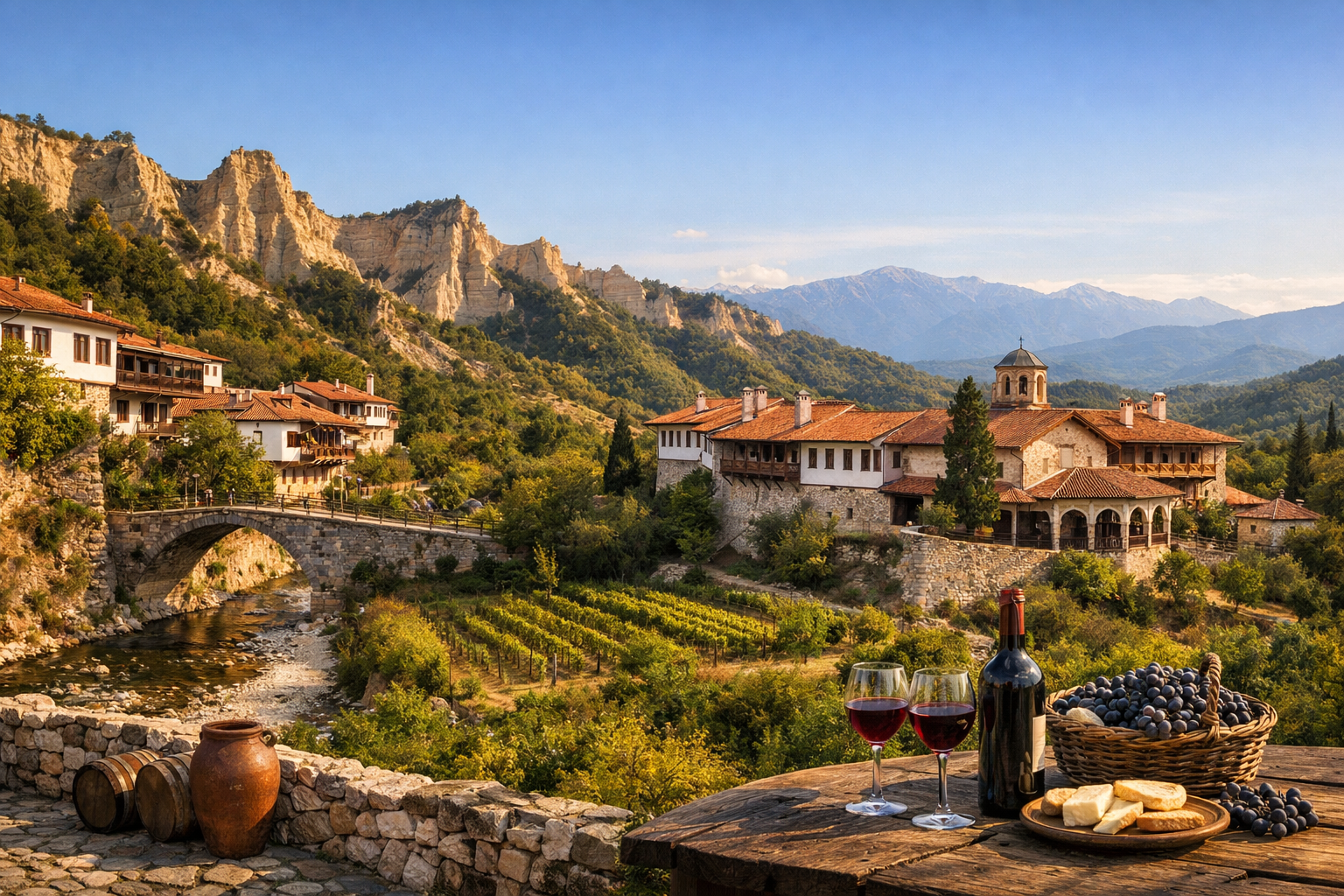
Melnik - Rozhen Monastery wine and history

Melnik - Rozhen Monastery wine and history

Discover Bulgaria’s smallest town, Melnik, where sandstone cliffs, old wine cellars, and centuries of history create a uniquely atmospheric escape. Pair a stroll through Melnik and the peaceful Rozhen Monastery with tastings at the region’s renowned wineries for a journey full of character and flavor.

🧭 DAY-BY-DAY ROUTE

Ready-made country and city routes with daily plans, sights, transport and accommodation. Buy PDF guides for independent travel.

🧭 DAY-BY-DAY ROUTE


Day 1 — Transfer to Melnik, the old town, and a first introduction to wine

  • 🚆 It makes sense to start the morning in Sofia: from the airport, it is convenient to take the metro to the area of the Central Railway and Bus Stations, and then transfer to an intercity bus to Sandanski. The trip itself from Sofia to Sandanski usually takes about 2 h 50 min, after which there is only a short final leg to Melnik by bus or taxi. In total, the journey from Sofia to Melnik with the transfer, waiting time, and a short break realistically takes about 4.5–5.5 hours, so it is better not to overload this day and to leave time for a relaxed check-in.

  • 🚶 Melnik is the smallest town in Bulgaria, but it does not feel “small” at all: it is an intimate stage set of white houses, narrow streets, wine cellars, and the soft outlines of the famous sand pyramids that seem to rise right up behind the facades. The town lies among the southern slopes of the Pirin Mountains and feels like a place where history is not arranged behind glass, but literally dissolved in the air. As you walk through the center, your eye keeps catching on old stone retaining walls, wine signs, and balconies in the spirit of the Bulgarian Revival. This is a place where it is especially good not to rush anywhere: Melnik is beautiful precisely at a slow pace, with pauses for coffee, wine, and long views over the pale slopes.

  • 🏛️ The main historical stop of the first day is Kordopulov House, the best-known architectural symbol of Melnik. It is a large 18th-century Revival house that belonged to a wealthy merchant family trading wine far beyond the region. Inside, what is especially impressive is the combination of residential architecture and practical business logic: spacious halls, windows with beautiful perspectives, carved details, and huge wine cellars literally cut into the rock. It is here that you understand especially clearly that Melnik wine is not a marketing theme for tourists, but a foundation of local identity. A visit is convenient to plan for the afternoon, when the road is already behind you and the pace of the day becomes more leisurely.

  • 🍷 In the evening, save some energy for a first tasting in Melnik itself or at one of the nearby wine spots in the region. The main character here is the local wine tradition associated with varieties from the Melnik vine family: the wines usually show a warm, spicy, southern profile in which you can catch ripe cherry, herbs, dry spices, and sometimes tobacco or leathery notes. It is best not to try to embrace everything at once: after the journey, a calm dinner with a glass of local red and an early rest is ideal, because the second day includes the monastery, panoramas, and a longer walk.


Day 2 — Rozhen Monastery, the Melnik Pyramids, and wineries

  • 🚶 The second day is the main purpose of the whole trip. In the morning, head to Rozhen Monastery, located about 5 km east of Melnik. It is one of the most important Orthodox monasteries in southwestern Bulgaria and the largest monastic complex in the Pirin region. The road itself is very beautiful: as you go uphill, wider and wider views open up over the hills, vineyards, and sandy landscape forms. If you walk or drive in the first half of the day, the light is softer and the atmosphere especially quiet—exactly the kind of mood you want to associate with a monastic place.

  • ⛪ Rozhen Monastery impresses not by its size, but by its wholeness. This is a place that does not shout about its importance, but reveals itself gradually: through the inner courtyard, dark wood, old frescoes, the silence of the galleries, and a sense of stability, as if time moves more slowly here than down in the valley. The complex is especially appealing because it preserves not a museum atmosphere, but a living spiritual one. Even if you arrive not as a pilgrim but as a traveler, the monastery easily gives that rare feeling of inner pause for which it is worth leaving big cities behind.

  • 🥾 After the monastery, the best continuation of the day is a short walk along the trails in the Melnik Pyramids area. These whimsical sandy formations are one of the most recognizable natural landscapes in Bulgaria: cones, ridges, spires, and almost sheer pale slopes create the impression of a semi-desert, almost Mediterranean world. In clear weather, the landscape looks especially cinematic: golden-beige forms, green patches of shrubs and vineyards, occasional roofs, monastery silhouettes, and distant mountain lines. It is reasonable to allow at least 2–3 hours for the walk, photos, and relaxed rest with views.

  • 🍇 Dedicate the second half of the day to the wineries of the region. A good scenario is to choose one closer and one more “panoramic” winery. Villa Melnik near the village of Harsovo is convenient for an organized tasting and getting acquainted with a modern interpretation of Melnik varieties, while Zlaten Rozhen near Kapatovo offers a beautiful combination of wine, rural landscape, and calm wine tourism. If you want more of a resort feeling, you can also look toward Zornitza Family Estate—this is already a story of a winery with a more gastronomic and spa-oriented mood. For transfers between points, the tasting itself, and meal breaks, it is honestly worth setting aside the entire rest of the day until evening, so as not to turn the wine route into a race.

Day 3 — Sandanski, archaeology, and return to Sofia

  • 🚗 The morning of the third day is best arranged as a gentle exit from Melnik’s intimate atmosphere into a more convenient transport hub of the region. After breakfast, head to Sandanski—the nearest larger town, through which it is easier to organize the return trip to Sofia. The transfer is usually short, but it is still worth leaving extra time for checking out of the hotel, possible waiting time for a taxi or bus, and road pauses.

  • 🏛️ If the schedule allows, be sure to stop at the Archaeological Museum in Sandanski. This town stands on the site of ancient Particopolis, and the museum helps you see the region not only as a land of wine and monasteries, but also as a territory of long Mediterranean-Balkan history. A good addition is a walk through Park “Sveti Vrach” and the central part of Sandanski, where the feeling of a southern Bulgarian town becomes completely different: wider streets, more resort-like air, more space, and more light.

  • 🌿 Sandanski is pleasant precisely as a final contrast to Melnik. If Melnik is almost a museum town, pressed in by slopes and the memory of a merchant past, then Sandanski breathes more freely: here you feel the balneological and park tradition, the Roman layer of history, and a more modern urban life. A few hours for an unhurried lunch, a short walk, and the museum give the trip completeness: history, monastery, nature, and wine come together into one line instead of remaining scattered impressions.

  • 🚌 The return to Sofia is best planned for the second half of the day by bus from Sandanski. The journey itself usually takes about 2 h 50 min, and if the final destination is the airport, add more time for the transfer in Sofia: from the Central Station / Bus Station to the airport, the metro is again convenient, with a transfer in the city center. In total, from Sandanski to Sofia Airport it is safe to allow about 4 hours including the city transfer, so it is better to leave without the risk of cutting it too close.

Flight tickets

eSIM for travel

Buy PDF guide

Buy PDF guide — 6.43 USD

PDF — 6.43 USD