
Buy PDF guide

Buy PDF guide — 15.00 USD

PDF — 15.00 USD

Mexico

Mexico

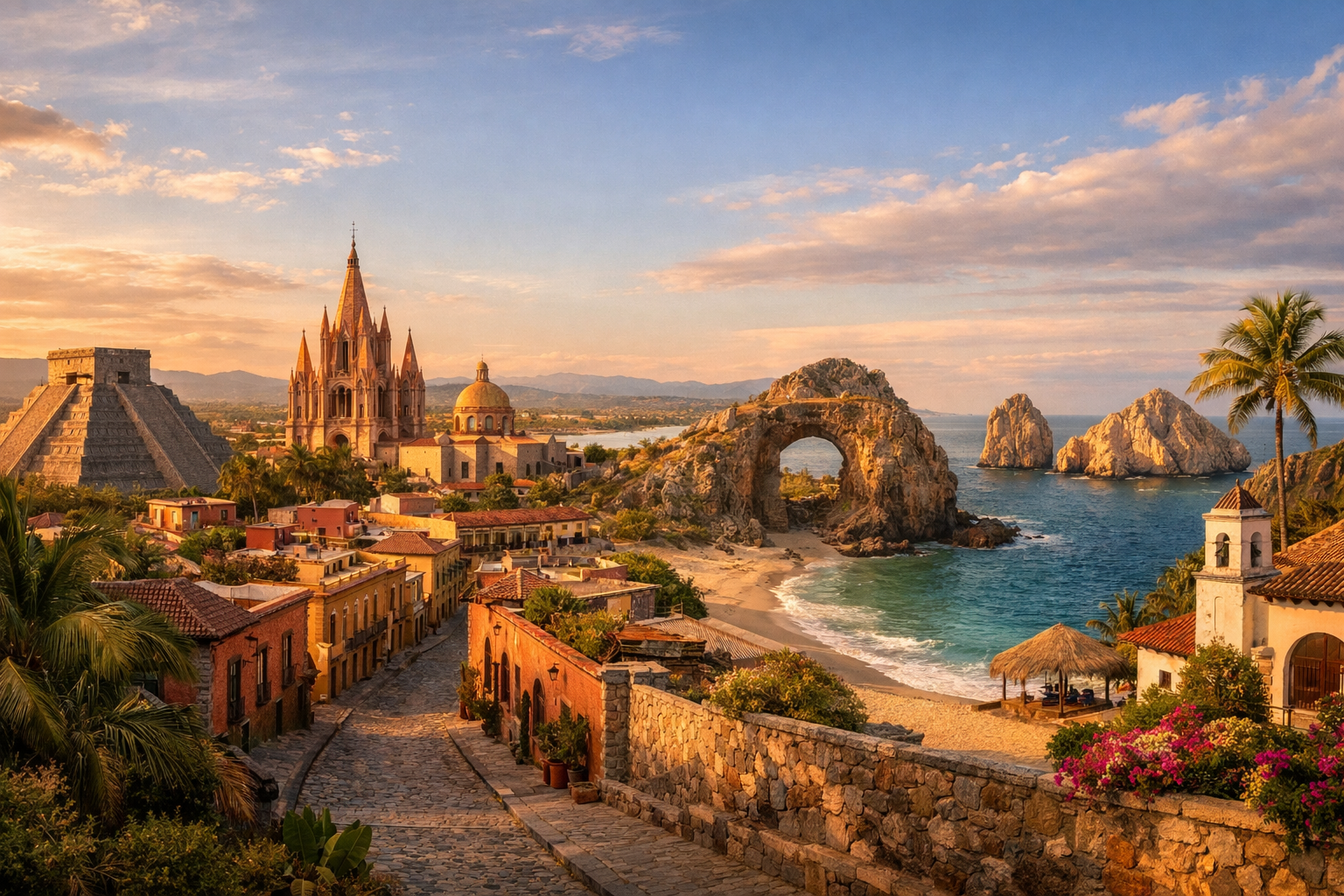
From the energy of Mexico City to the color and flavor of Oaxaca, Mexico is a journey full of contrast and character. Expect vibrant streets, unforgettable food, and a culture that feels alive at every turn.

🧭 DAY-BY-DAY ROUTE

Ready-made country and city routes with daily plans, sights, transport and accommodation. Buy PDF guides for independent travel.

🧭 DAY-BY-DAY ROUTE


Day 1 — Mexico City: Zócalo, Cathedral, and Templo Mayor

  • 🚶 The historic center of Mexico City is a powerful, multilayered city within a city, where the layers of the Aztec capital Tenochtitlan literally lie beneath your feet, Spanish colonial facades rise above them, and modern megacity life buzzes all around. It makes sense to start at the Zócalo — one of the largest city squares in the world and the symbolic heart of the country. The space feels almost theatrical here: the enormous flag, the facade of the National Palace, the cathedral with its heavy stone mass, and the constant movement of people create a sense of scale that photographs can hardly convey. Just a few steps away is the archaeological zone and museum of Templo Mayor — a place where you can literally see how the sacred Mexica complex opens up in the center of the modern capital. This is one of the best spots not just to “look at ruins,” but to feel the dramatic history of the city: from imperial center to colonial reconstruction. For the first day, it is better not to overload the route: after the flight and check-in, leave time for a slow walk through the center, coffee, an early dinner, and a restful sleep, because Mexico City fills you with impressions from the very first hours.


Day 2 — Mexico City: Chapultepec and the National Museum of Anthropology

  • 🚶 Chapultepec Park is not just a large urban park, but an entire cultural and natural world where residents of Mexico City relax, run, go boating, walk with their families, and spend Sundays as if the megacity around them did not exist at all. Its first section is especially convenient for travelers: here you can build a very comfortable day without exhausting transfers. Start with the National Museum of Anthropology — one of the finest museums in Latin America and, without exaggeration, an essential stop on any route through Mexico. It does not simply display artifacts, but brings together into a single image the civilizations of the Olmecs, Maya, Teotihuacanos, Zapotecs, and Mexica; after visiting, many places on the trip begin to feel deeper and more meaningful. Then smoothly move on to a walk along the alleys of Chapultepec, and if you still have energy, climb up to Chapultepec Castle, which stands on a hill and combines views, history, and a sense of monumental residence with European grandeur that is rare in the Americas. This day is worth planning with breaks for rest: the museum is large, the park is too, so it is better not to try to “gallop through” everything at once.

Day 3 — Mexico City: Coyoacán, the Frida Kahlo Museum, and the canals of Xochimilco

  • 🚕 Coyoacán and Xochimilco combine well into one day if you start without rushing and allow realistic time for the roads. From central Mexico City to the Coyoacán district, depending on traffic, it is usually best to count on about 30–45 minutes by taxi or car, and from there to the Xochimilco piers — another 25–40 minutes.

  • 🚶 Coyoacán is a completely different rhythm of Mexico City: not grand and overwhelming in scale, but intimate, shaded, colonial, and almost provincially artistic. Squares, inner courtyards, old churches, cafés, and street musicians make the district ideal for a more relaxed day after the powerful historic center and the museum marathon of Chapultepec. The main star here is the Frida Kahlo Museum, the famous Casa Azul, the house where the artist’s life is felt not as an abstract biography, but as a very personal space of pain, strength, color, and Mexican identity. After the museum, it is worth leaving time simply to walk around the neighborhood and have lunch. In the second half of the day, head to Xochimilco — one of the most recognizable and lively symbols of old valley Mexico City. A ride on a bright trajinera boat through the canals is not an open-air museum, but a noisy, musical, very local, and very Mexican experience: boats with food, musicians, families, and celebrations drift by, and it is precisely in this colorful chaos that the city’s true temperament reveals itself.

Day 4 — Transfer Mexico City → Oaxaca and evening in central Oaxaca

  • ✈️ The most comfortable transfer option between Mexico City and Oaxaca for a 7-day route is a short domestic flight. Including the trip to the airport, early arrival, and the transfer from Oaxaca airport to the center, allow about 4.5–6 hours of total time from hotel to hotel. The ADO bus is possible, but for such a short trip it takes up too much of the day’s energy.

  • 🚶 Oaxaca de Juárez after Mexico City feels like a change of scale and breathing. There is less noise pressure here, the pace is slower, and almost everything in the center invites you to walk: the warm stone of facades, green courtyards, churches made of volcanic tuff, low-rise buildings, and the constant presence of artisanal, gastronomic, and Indigenous cultural memory. After check-in, do not overload the day with museums: it is better to walk through the Zócalo and Alameda de León, reach the Santo Domingo de Guzmán church, catch the golden evening light on the stone, and simply let the city reveal itself through details — the smell of chocolate and corn, calm terraces, street musicians, and the special softness of the local atmosphere. This is an important day of “switching gears,” when the route stops being just a set of points and becomes a journey with its own rhythm.

Day 5 — Oaxaca: Santo Domingo, the Museum of Oaxacan Cultures, and the Ethnobotanical Garden

  • 🚶 This day is convenient to spend almost without transport, because the main sights are located in the very heart of the historic center. The Santo Domingo complex is one of the most impressive cultural scenes in southern Mexico: a majestic church, former monastery, museum, and garden form a space where colonial architecture, art, and the botanical heritage of the region come together into a complete experience. The Museum of Oaxacan Cultures is especially good because it helps you read the entire region not as a collection of beautiful facades and craft markets, but as a territory of deep pre-Hispanic, colonial, and modern memory. After the museum, it is ideal to move on to the Ethnobotanical Garden, where the plants of Oaxaca appear not as a backdrop, but as part of a civilizational narrative: agaves, cacti, trees, and medicinal and ritual species here show how deeply nature was and remains woven into local culture. This day does not require a frantic pace; on the contrary, its value lies in slowly observing stone, light, shadow, and detail. In the evening, you can leave time for dinner with local dishes and an early rest before the archaeological excursion.

Day 6 — Oaxaca: Monte Albán

  • 🚕 From central Oaxaca to the Monte Albán archaeological zone, people usually allow about 25–35 minutes by car or taxi each way. With the road, a walk around the plateau, a museum pause, photos, and rest, this is a full outing of at least half a day, and more often nearly the whole day if you do not rush.

  • 🚶 Monte Albán is one of those places where archaeology feels not like a collection of ancient stones, but like a grand gesture of human will over the landscape. The ancient Zapotec city is located on a leveled mountain plateau, and the very fact of its construction makes a strong impression: you climb above the valley and suddenly find yourself in a space where the horizon opens in all directions, while the ceremonial platforms, squares, and steps look at once austere and almost abstract. The scale of time is felt especially strongly here. Unlike the denser and noisier urban experience, Monte Albán gives you air, distance, and a rare sense of silence among ruins. It is better to go in the morning, while the sun is softer, bring water and a hat, and not try to cover everything at maximum speed: archaeological sites in Mexico reveal themselves more powerfully when there is room for stopping, looking into the distance, and contemplation, not just for photos.

Day 7 — Oaxaca: a free day in the center, markets, and an unhurried finish

  • 🚶 It is best to make the final day intentionally gentle and flexible, without a rigid race through mandatory sights. In Oaxaca this is especially appropriate: the city works beautifully not only as a set of attractions, but also as a space for taste, rhythm, and observation. You can start the morning with coffee and chocolate, then walk through the markets, peek into textile and craft shops, return to a favorite square or museum, and leave time for calm packing, rest, and a beautiful farewell to the trip. If you still have energy, you can walk once more to Santo Domingo or choose one of the city museums you did not have time to visit earlier. Such a finale helps not to “finish off the route,” but to gather the impressions into one whole: noisy and multilayered Mexico City, ancient civilizations, the colonial plasticity of Oaxaca, soft evening light, cuisine, markets, and the feeling that in one week you managed to see a compact but very meaningful cross-section of the country.

Flight tickets

eSIM for travel

Buy PDF guide

Buy PDF guide — 15.00 USD

PDF — 15.00 USD