
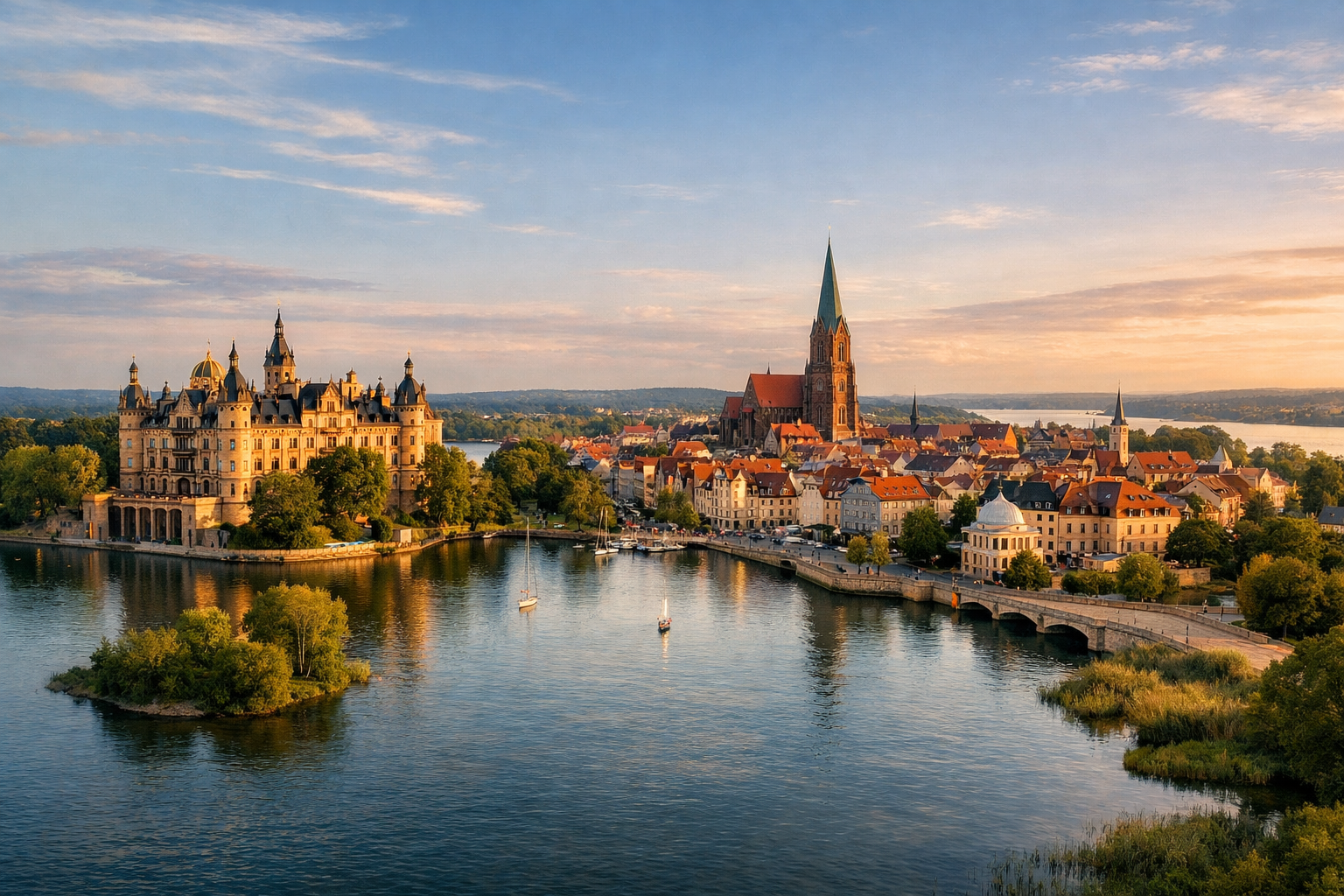
Day 1 — Schwerin: castle, island, and the city’s baroque panorama
🚆 It is best to plan your arrival in Schwerin for the morning. The most convenient rail option for most travelers from northern Germany is via Hamburg Hbf: the RE1 train goes to Schwerin Hbf in about 1 hour 40–45 minutes, after which it is usually another 10–20 minutes to the historic center on foot, by bus, or by a short taxi ride. This pace lets you avoid rushing, leave your luggage at the hotel, and begin getting to know the city in the first half of the day.
🚶 Start your route with Schwerin Castle — the main symbol of Mecklenburg-Western Pomerania and one of the most impressive palace residences in Germany. It stands on an island surrounded by water as if it were created especially for postcards: towers, spires, gilded details, reflections in the lake, and graceful bridges create an almost theatrical setting. From the outside the castle seems fairy-tale-like, but its power is not only in its romantic appearance. It is the heart of the former residence of the Mecklenburg dukes, a place where court architecture, politics, and landscape design merged into a single ensemble. Today, inside there is a museum with ceremonial interiors, where it is easy to imagine what life at a North German court looked like in the 19th century: stucco, furniture, painting, decorative arts, and halls where luxury does not shout, but instead creates an atmosphere of dignity and old European aristocratic culture.
🚶 After seeing the interiors, be sure to walk around the castle outside along the lakeside paths and continue into Schlossgarten and Burggarten. This is not just a park by the palace, but a whole system of views, avenues, terraces, and green perspectives where baroque grandeur coexists with a softer English garden aesthetic. It is pleasant to slow down here: sit by the water, walk among old trees, watch how the castle facades change depending on the light, and feel Schwerin’s main charm — the city does not overwhelm with scale, but unfolds in layers through water, greenery, and neat architecture.
🚶 Next, it makes sense to head to Alten Garten — one of the city’s most beautiful squares. Here you will see an almost perfect ceremonial composition of Schwerin: the castle, museum, theater, and the spacious openness of the urban setting. This place shows especially well that Schwerin is not just a small charming town by the water, but a historic capital with a distinct residential character. The facades here look noble and cohesive, while the atmosphere remains surprisingly calm even during tourist season.
🚶 In the second half of the day, head into the old town. A walk through narrow streets, the market square, and to Schwerin Cathedral lets you feel another side of the city — not courtly, but medieval and mercantile. There is less decorative pomp here and more intimacy: house gables, quiet lanes, small cafés, old facades, and the feeling of a city that does not try to impress through loudness, but enchants through composure. Schwerin Cathedral, built in brick Gothic style, raises this part of the route to a new emotional level: the vertical line of the tower, the reddish brick, and the restrained northern character create a powerful yet not cold impression.
💤 Leave the evening for a quiet rest by the water. An ideal option is a walk along Burgsee or heading to the embankments, where the castle begins to glow especially beautifully in the evening air. Do not overload the day with distant outings: the first day here is best lived as a slow entry into the city, with pauses for coffee, museum interiors, and long looks at the water. It is at this pace that Schwerin reveals itself most nobly.