
Buy PDF guide

Buy PDF guide — 6.43 USD

PDF — 6.43 USD

MECKLENBURG-WESTERN POMERANIA Rostock - Warnemünde

MECKLENBURG-WESTERN POMERANIA Rostock - Warnemünde

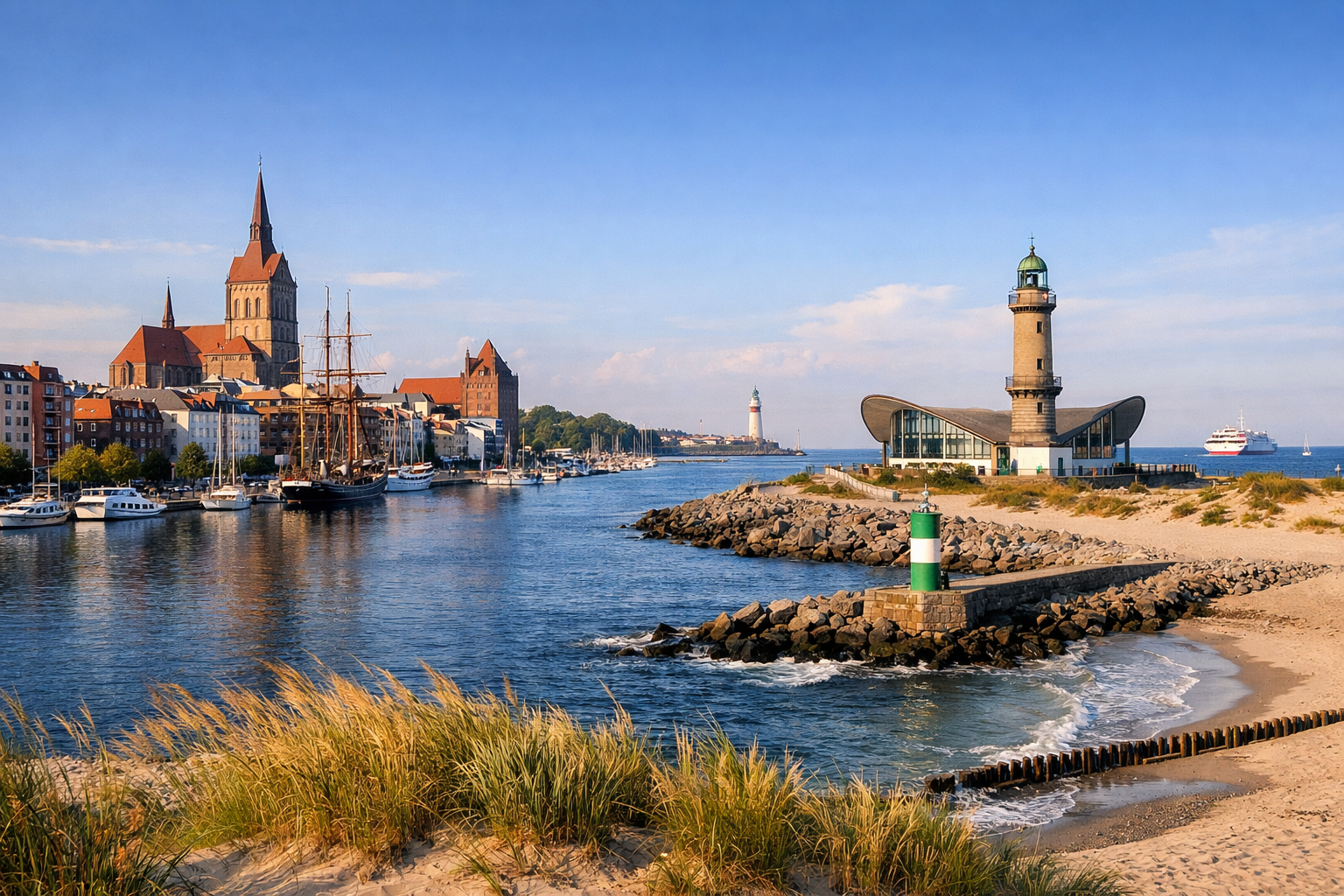
Discover the Baltic charm of Rostock and the seaside elegance of Warnemünde, where broad beaches, maritime flair, and fresh sea air set the scene. Cross to Hohe Düne for a quieter coastal escape, with dunes, marina views, and a relaxed northern atmosphere.

🧭 DAY-BY-DAY ROUTE

Ready-made country and city routes with daily plans, sights, transport and accommodation. Buy PDF guides for independent travel.

🧭 DAY-BY-DAY ROUTE


Day 1 — Rostock: old town, harbor, and the city’s maritime character

  • 🚆 If you arrive in Rostock by train, it makes sense to use the city as your first base without unnecessary fuss: from the main station it is easy to reach the historic center, and then move on to or head out to Warnemünde. Rostock itself is not just a “city by the sea,” but one of the most distinctive Hanseatic cities on the Baltic, where brick Gothic architecture, university life, and port energy combine into a remarkably coherent atmosphere. It is worth taking your time here: walk through the broad center with its shopping streets, reach Neuer Markt, feel the scale of the old facades, look at the town hall and St. Mary’s Church, and then gradually make your way to the city harbor on the Warnow River. It is there that Rostock reveals itself especially beautifully: in the reflections on the water, in the silhouettes of ships, in the cool sea breeze, and in the sense that this city has lived for centuries through trade, shipping, and a constant movement toward the horizon.

  • 🚶 After the historic center, it makes sense to spend a few hours on the Stadthafen waterfront and in the area around the port. This is not a museum set, but a living space where the old Hanseatic spirit exists alongside modern cafés, walking routes, and views of the broad water. It is especially pleasant to stroll here toward evening, when the light grows softer and the silhouettes of cranes, masts, and city towers take on an almost cinematic depth. If you want a cultural pause, you can add Kulturhistorisches Museum Rostock — one of the best ways to understand how Rostock grew from a medieval trading center into the most important city of Mecklenburg-Western Pomerania. Do not overload this day: it is better to keep the rhythm gentle, with a proper coffee break and dinner, because tomorrow the focus shifts to the sea and the beach side of the trip.

  • 💤 It is most convenient to spend the night either in central Rostock, if you want an urban base and short walks, or already in Warnemünde, if waking up by the sea matters more. The transfer between Rostock and Warnemünde is short, so both options are realistic.


Day 2 — Warnemünde: beach, Alter Strom, lighthouse, and seaside resort

  • 🚆 The trip from Rostock → Warnemünde on the local S-Bahn usually takes about 25 minutes, making this seaside district an ideal continuation of the route without tiring logistics. Warnemünde is a former fishing village that grew into one of Germany’s most beloved Baltic resorts, and its main charm lies in the fact that there is no split here between “sightseeing” and everyday life: everything works together — the wide beach, dunes, promenade, fishing boats, yachts, seagulls, old houses, and the flow of people who come here precisely for the sea air and the feeling of a holiday.

  • 🚶 Start the day with a walk along Alter Strom — the “Old Channel,” the old waterway by the harbor where boats, small shops, fish kiosks, cafés, and terraces line both sides. This is one of those places where there is no need to hurry to the “main spot”: the atmosphere itself is the main spot. Then head to the symbols of Warnemünde — the lighthouse and the Teepott building with its distinctive wave-like roof. From here it is especially beautiful to watch arriving ships and the long line of the beach. Warnemünde Beach is famous for its spaciousness: bright sand, a wide shore, the feeling of wind, and the open horizon make it not just a resort area, but a true northern stage where the sea sets the rhythm for the whole day. If the weather is kind, it is easy to spend several hours here without any program at all — simply walking along the water’s edge, relaxing on the sand, and watching coastal life.

  • 🏛️ For a deeper acquaintance with the place, it is worth stopping by Heimatmuseum Warnemünde, located in an old 18th-century fisherman’s house. It is a small but very rich stop: it helps you see what Warnemünde was before the era of mass tourism — a settlement of fishermen and pilots living in close connection with the sea. After the museum, you can walk along Alexandrinenstraße and the neighboring streets, where the old resort-village architecture is felt most clearly.

  • 🌅 In the evening, it is ideal to return to the water again: either to the beach, to the piers, or for a walk along Alter Strom. Warnemünde is especially good at dusk: the lighthouse glow, the creaking masts, the salty air, and the slow rhythm of the resort create a very complete end to the day. Spending the night in Warnemünde allows you not to rush in the morning and makes the third day as relaxed as possible.

Day 3 — Warnemünde and Hohe Düne: sea, ferry across the Warnow, and a calm finale

  • ⛴️ It is best to make the third day the most unhurried one. Start the morning in Warnemünde without early wake-ups or long transfers, and then head across the Warnow River to Hohe Düne by local ferry. It is a short but very atmospheric crossing: in just a few minutes you change your perspective on the whole resort and see the harbor, lighthouse, sandy shoreline, and yacht infrastructure from the other side. This crossing becomes part of the experience itself, not just a way to get from point A to point B.

  • 🚶 Hohe Düne feels calmer and more spacious than central Warnemünde. There is less bustle here, more yacht aesthetics, marinas, open sky, and the sense of an “upscale northern holiday.” A walk along the water past the yacht harbor and hotel complex offers a completely different rhythm — not noisy-resort-like, but contemplative and almost Mediterranean in mood, only in Baltic scenery. If you want to end the trip especially gently, this is the ideal place for a long late breakfast or lunch with a view of the water, and then simply to walk without a rigid plan.

  • 🌿 If you still have energy, after returning to Rostock you can add one major green or cultural accent — Zoo Rostock or Kunsthalle Rostock, depending on your interests. The zoo suits those who want more nature and an unhurried family rhythm, while Kunsthalle is better for those who love contemporary art and want to end on a cultural note. But on this route, the more important thing is not to overload the day: the Rostock — Warnemünde region is valuable precisely for its compactness, ease of transfers, and rare combination of city, sea, and resort relaxation without exhausting logistics.

  • 🚆 The return from Warnemünde to central Rostock takes about the same 25 minutes on the S-Bahn, so you can plan your departure toward the next city, station, or airport without setting aside an entire extra day, but with a sensible buffer for rest and connections.

Flight tickets

eSIM for travel

Buy PDF guide

Buy PDF guide — 6.43 USD

PDF — 6.43 USD