
Buy PDF guide

Buy PDF guide — 8.57 USD

PDF — 8.57 USD

MECKLENBURG-WESTERN POMERANIA - Rügen Island chalk cliffs beaches Binz

MECKLENBURG-WESTERN POMERANIA - Rügen Island chalk cliffs beaches Binz

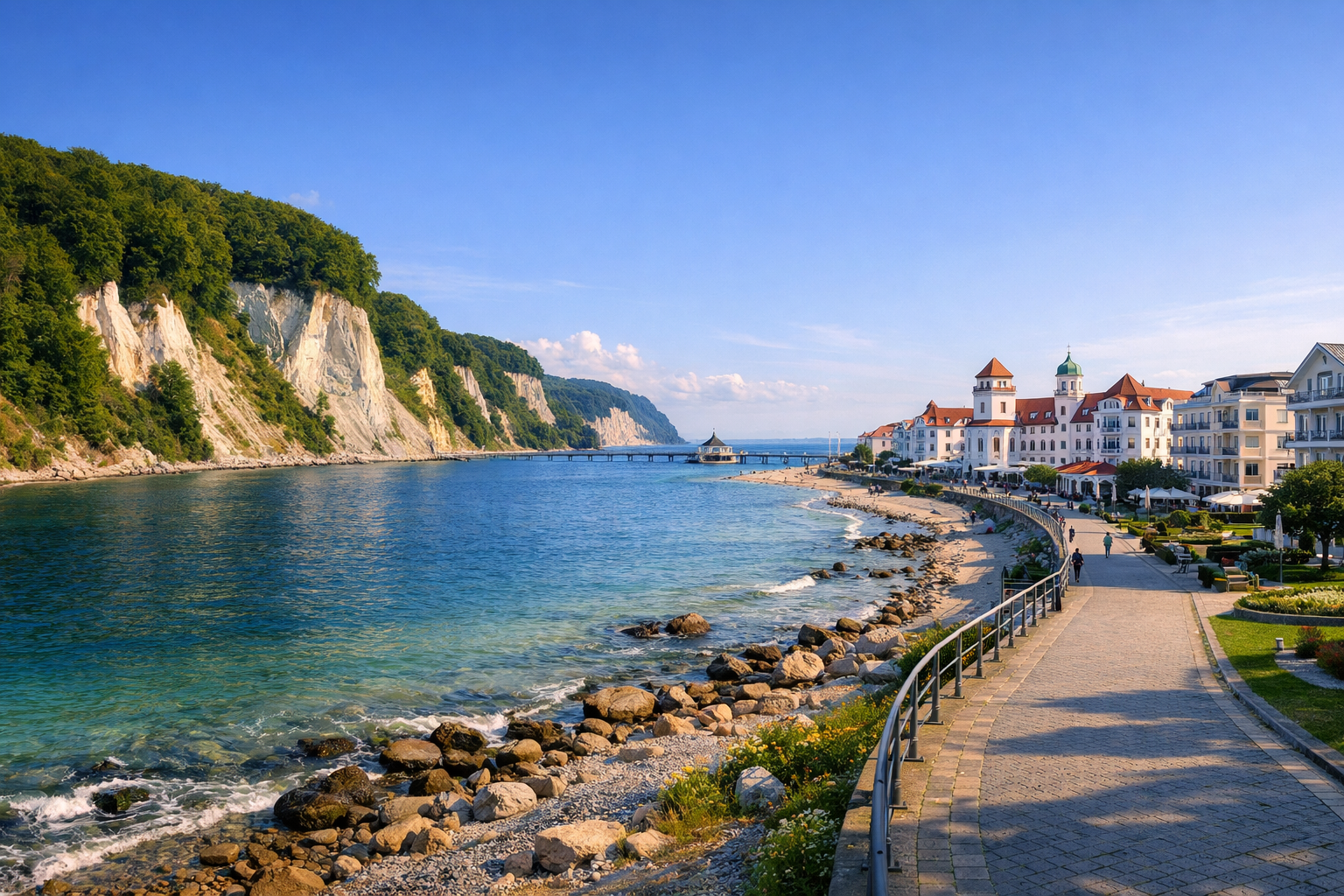
Mecklenburg-Western Pomerania shines on Rügen Island, where the white chalk cliffs of Jasmund rise above the Baltic and long sandy beaches stretch toward elegant seaside resorts. From the classic spa charm of Binz to the piers and promenades of Sellin and Sassnitz, this coast feels both wild and refined.

🧭 DAY-BY-DAY ROUTE

Ready-made country and city routes with daily plans, sights, transport and accommodation. Buy PDF guides for independent travel.

🧭 DAY-BY-DAY ROUTE


Day 1 — Binz: classic seaside resort, beach and promenade

  • 🚆 Transfer: Berlin → Ostseebad Binz. The most convenient option is a daytime Deutsche Bahn train with a change around Stralsund or a direct long-distance train in season; for a real trip, plan about 3 h 45 min – 4 h 30 min from Berlin Hbf to Binz, plus 10–15 minutes to get to the hotel and check in. This pace works well for a 4-day tour: no exhausting transfers and a full first evening by the sea.

  • 🚶 Binz is the most elegant seaside resort on Rügen, where classic German Bäderarchitektur, meaning white resort architecture with turrets, verandas, and ornate balconies, meets a wide Baltic beach and a relaxed holiday atmosphere. On the first day, it’s better not to scatter your energy on long outings, but to ease into the island gently: walk along Hauptstraße and toward the promenade, head to the beach, feel the salty air, the rhythm of the surf, and that special sense of northern resort aesthetics where everything looks bright, open, and slightly cinematic. The beach in Binz is long, comfortable, and very much “made right” for отдых: fine light sand, neat infrastructure, and the characteristic Strandkorb — wicker beach chairs that have long become a symbol of the German Baltic coast. Even if the water feels brisk, this is a place you’ll want to visit not only for swimming, but also for long walks along the waterline, especially toward evening, when the sun drops lower and the facades of the old villas begin to glow with a soft golden light.

  • 🚶 Be sure to devote part of the day to Seebrücke Binz and the waterfront. The pier here is not just a photo spot, but a true resort gesture: a direct line into the sea, wind, seagulls, the horizon, and beautiful panoramas of the coast. If you still have enough energy after the journey, you can walk farther south along the promenade to quieter stretches of beach and to the edge of the Granitz forest area, where the resort postcard gradually gives way to a natural landscape. It’s best to leave the evening in Binz without a rigid schedule: dinner by the sea, a walk after sunset, and an early rest. This is an important part of the route, because ahead there will be trails, viewpoints, and trips around the island, and the first day should not tire you out, but tune you in to the northern coast, space, light, and the rhythm of Rügen.


Day 2 — Jasmund and the chalk cliffs: Königsstuhl, beech forests, and the white coastline

  • 🚆 Transfer: Binz → Sassnitz / Nationalpark Jasmund. By regional train or bus with a change, the trip usually takes about 35–60 minutes to Sassnitz, then another roughly 20–30 minutes by bus to the Nationalpark-Zentrum KÖNIGSSTUHL area or to Hagen if you’re walking through the park. It’s best to leave early in the morning on this day and reserve almost the entire daylight period for nature, walks, and breaks at viewpoints.

  • 🚶 Jasmund National Park is the most famous natural scene on Rügen and one of those landscapes people travel to northern Germany for in the first place. This is where the island’s legendary chalk cliffs are found: dazzling white bluffs rising above the dark blue Baltic Sea, with ancient beech forests creating a dramatic, almost romantic contrast of color and texture. The main symbol of the region is Königsstuhl, the “King’s Chair,” one of the best-known viewpoints on the German coast. It is not just a cliff, but a whole image of Rügen: the white edge of the precipice, the sea’s vastness, moving clouds, and the feeling that the land here falls away into light and wind. Even in changeable weather, the place looks spectacular, and on a clear day the panoramas seem almost unreal in the purity of their lines.

  • 🚶 It’s worth planning the day so you can combine the modern visitor center Nationalpark-Zentrum KÖNIGSSTUHL with at least one полноценной walk along the park’s forest paths. Jasmund’s beech forests were added to the UNESCO World Natural Heritage list for a reason: they are a rare example of an almost untouched northern European forest landscape, where trees, ravines, damp air, and silence create the feeling of an old natural Europe. This is where the shift in scale is especially tangible: within an hour you move from resort Binz into a world where not facades and cafés dominate, but wind in the treetops, roots on the path, and flashes of the sea between the trunks. On this route it’s important not to rush: make stops, look at the color of the water, listen to the forest, and leave time simply to be present in the landscape.

  • 🚶 If you still have energy left, you can add a visit to Kreidemuseum Rügen in Gummanz — a museum that helps you understand not only the beauty, but also the geology of these places. Then the impression of the chalk coast becomes fuller: you see not just a beautiful picture, but an entire natural process, the history of the island’s formation, and the cultural layer connected with chalk mining on Rügen. It makes sense to plan the return to Binz in the evening without extra stops: the day is rich and highly photogenic, but also physically active.

Day 3 — Sassnitz and Prora: harbor character, sea views, and the history of the place

  • 🚆 Transfer: Binz → Sassnitz about 20–30 minutes by train, or longer by bus depending on the specific connection. Sassnitz → Prora / Binz then another 20–30 minutes. This is a convenient day without long transfers: you can calmly combine a city walk, a museum block, and time to relax by the sea.

  • 🚶 Sassnitz is the other face of Rügen. If Binz looks like a polished seaside resort, Sassnitz feels harsher, more port-like, and more lived-in — a town with character. Its old villas on the hills, harbor, waterfronts, and access to the sea create the atmosphere of a place that exists not only for holidaymakers, but is genuinely tied to the sea, fishing, and northern everyday life. It’s pleasant to walk through the old town and go down to the port: the rhythm changes, the color palette changes, and there is more wind, metal, piers, and a working Baltic mood. Visually, Sassnitz is very cinematic: slopes, stairways, rooftops, perspectives over the water, and the feeling that you are standing at the edge of the island.

  • 🚶 In the first half of the day, you can explore the harbor area and, if the museum’s opening hours work for you, visit Fischerei- und Hafenmuseum Sassnitz — a museum connected with the town’s fishing and maritime history. Even if the exhibition is compact, it complements the walk well: it helps you see in Sassnitz not only the attractive facade of travel, but also the island’s real economy and its ties to fishing culture, ships, and the harbor. After walking around Sassnitz, it’s worth leaving time for coffee or a late lunch by the water, and then heading on to Prora.

  • 🚶 Prora is one of the most powerful and ambiguous places on Rügen. Here there is an endless shoreline, a strip of pine forest, a broad beach, and at the same time a gigantic architectural complex conceived during the National Socialist era. Today the space is perceived in layers: as a resort zone, as a monument to the political history of the 20th century, and as an example of how places with a heavy past are reinterpreted and brought back into modern life. The documentation center in Prora is especially important in a route like this: after nature and resort beauty, it adds depth, historical tension, and the understanding that the Baltic is not only about leisure and landscapes, but also a territory of memory. After the museum, you can go out to Prora’s beach: long, open, and feeling freer than the center of Binz. In the evening — return to Binz and a calm dinner.

Day 4 — Sellin and Granitz: pier, forest castle, and a gentle finale by the sea

  • 🚆 Transfer: Binz → Jagdschloss Granitz usually takes 15–25 minutes by tourist transport/bus or longer on foot through the forest, then Binz/Granitz → Sellin another roughly 20–30 minutes by bus or train with a change. For the final day, it’s better to keep the route moderate: beautiful, but not overloaded, so you still have energy for the return journey.

  • 🚶 The morning can be devoted to Jagdschloss Granitz — a hunting lodge standing on Tempelberg among the forests of Granitz. This is one of the most beautiful historic spots in southeastern Rügen: the pale romantic silhouette of the castle, its rise above the forest, and the famous cast-iron spiral staircase inside the central tower. The climb to the viewing platform is worth the effort: from above, wide views open over the island, forests, bays, and the resort strip of coast. Here you can really feel the composition of Rügen as a whole: sea, greenery, sandy arcs of shoreline, and resort settlements come together into a single panorama. The castle itself adds an aristocratic note to the route and beautifully balances the previous days of nature, harbor atmosphere, and 20th-century history.

  • 🚶 After Granitz, it makes sense to go to Sellin — one of the most photogenic seaside resorts on the island. Its symbol is Selliner Seebrücke, perhaps the most spectacular pier on Rügen: a white building by the water, a long walkway into the sea, stairways, coastal lines, and an almost theatrical resort scene. Sellin feels a little more intimate and romantic than Binz: there is less urban straightforwardness here and more of the feeling of an old seaside resort where you want not to hurry, but simply walk, linger at viewpoints, and look at the water for a long time. It’s especially beautiful to approach the pier from above and then go down toward the beach to see the composition of the resort facade and the sea from the surf line.

  • 🚶 If there is time, you can add Bernsteinmuseum Sellin — a small amber museum that works well for the final day. It doesn’t overload the route, but it adds a local Baltic theme: amber as a natural material, as part of the maritime imagination, and as a cultural symbol of the coast. It’s best to finish the trip without rushing: a late lunch or coffee in Sellin, return to Binz for your luggage, and departure for the evening train, or one more night on the island. This finale makes the whole 4-day route feel complete: Binz gives you relaxation and seaside aesthetics, Jasmund natural power, Sassnitz and Prora texture and history, and Sellin with Granitz close the journey with a beautiful, calm, and very Rügen-like final chord.

Flight tickets

eSIM for travel

Buy PDF guide

Buy PDF guide — 8.57 USD

PDF — 8.57 USD