
Buy PDF guide

Buy PDF guide — 12.85 USD

PDF — 12.85 USD

Miami - beaches, yachts, clubs, and Cuban culture

Miami - beaches, yachts, clubs, and Cuban culture

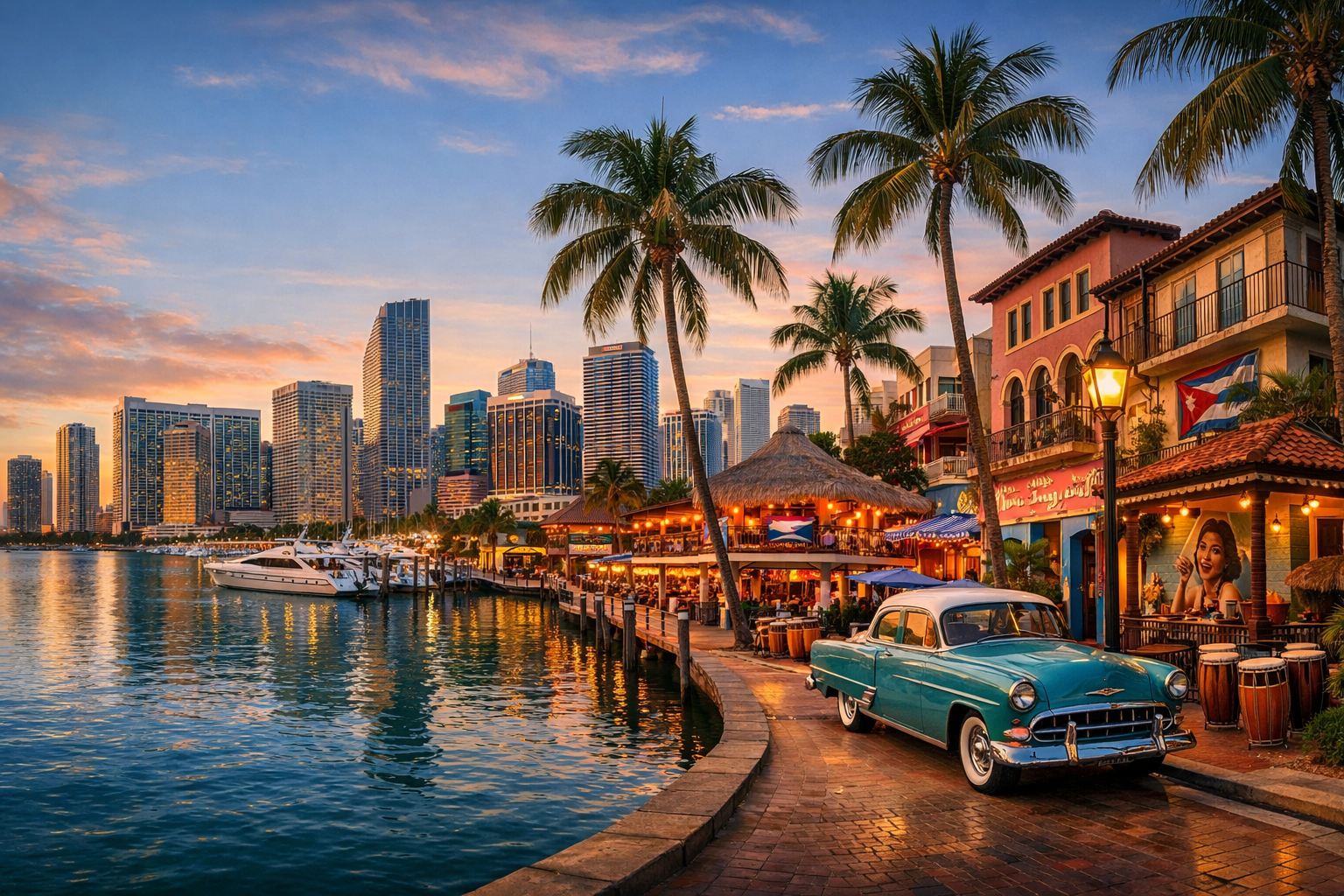
Miami is where sun-drenched beaches, sleek yachts, and legendary nightlife meet a vibrant Cuban soul. From the buzz of South Beach and Brickell to the color of Wynwood and the rhythm of Little Havana, the city blends tropical glamour with nonstop energy.

🧭 DAY-BY-DAY ROUTE

Ready-made country and city routes with daily plans, sights, transport and accommodation. Buy PDF guides for independent travel.

🧭 DAY-BY-DAY ROUTE


Day 1 — South Beach: ocean, Art Deco, and a gentle introduction to Miami’s rhythm

  • 🚶 It’s best to dedicate the first day to South Beach — that iconic Miami image where white sand, clean hotel lines, palm trees, and the ocean create an almost cinematic scene. Start the morning on the beach around 14th–21st Street: it’s a great place to catch the city’s “classic” mood without rushing, walk barefoot along the water, enjoy an early coffee with a view of the Atlantic, and simply let your body adjust to the humid air and sun. Then head to Ocean Drive and the blocks of the Art Deco Historic District: pastel facades, 1930s geometry, neon, balconies, and visual glamour work here not as museum décor, but as the living shell of the neighborhood. After lunch, it’s worth walking to Española Way or toward Lincoln Road, taking a long pause for rest and shopping, and then returning to the waterfront for golden hour. Leave the evening for a calm dinner with an ocean view or your first visit to a lounge bar: in Miami, it’s important not to try to “do everything at once,” but to enter the city through pleasure, light, and water.


Day 2 — Miami Beach: South Pointe, a yachting atmosphere, and a club night

  • 🚶 This day is best built around the southern part of Miami Beach, where the beach aesthetic becomes more elegant and “marine-like.” Start with South Pointe Park: it’s one of the best places to feel how Miami brings together the ocean, bay, promenade, bike paths, and views of passing cruise ships. It’s especially pleasant to walk here in the morning, when the light is softer and the air is not yet too heavy. Then you can walk along South Pointe Park Pier and return to the SoFi and South Beach area, leaving time for a leisurely lunch and rest by the pool or on the beach. In the second half of the day, it’s worth planning a boat or yacht cruise on Biscayne Bay: it’s from the water that the city comes together in the right panorama — the Downtown skyscrapers, bridge lines, islands, and expensive waterfront villas. It’s sensible to allow 1.5–2 hours for the cruise itself and about another hour for boarding, waiting, and getting to the marina. In the evening — Miami club life: the South Beach area is convenient for a late dinner, cocktails, and shifting into nightlife mode. It’s better not to overload the daytime plan so you still have energy by night: in Miami, nightlife is not a “checklist item,” but a full scenario for several hours.

Day 3 — Downtown, Brickell, and Biscayne Bay: modern Miami, water, and skyline

  • 🚶 After the beach days, it’s good to switch to urban Miami — glassy, vertical, and more dynamic. Start in Downtown: Bayfront Park, Bayside, and the Biscayne Bay waterfront create the feeling of an open city by the water, where a walk easily combines with short coffee stops, views of yachts, and the constant movement of people. Then you can hop on the free Metromover and take a loop through the center: it’s one of the most convenient ways to see Downtown and Brickell without wasting extra time and energy. Brickell shows another side of Miami — businesslike, stylish, with dense tower development, restaurant terraces, and the feeling of a city that lives not only on vacation, but also on ambition. During the day, it’s worth leaving 2–3 hours for an easy sequence of Bayfront Park → Metromover → Brickell City Centre/Brickell area, plus a lunch break and some rest in an air-conditioned space, because the heat feels especially intense on this part of the route. Closer to evening, a second water accent works perfectly: a rooftop cocktail or a sunset cruise on the bay. This is a day about contrast — from the bright morning shoreline to the glossy evening of skyscrapers, where Miami looks not just like a resort, but like a full-fledged southern metropolis.

Day 4 — Wynwood and the museum layer: street art, design, and contemporary culture

  • 🚶 On the fourth day, it’s best to step away from the purely beachside image and look at Miami as a city of art and visual experimentation. Start the morning in Wynwood: here, walls, shutters, courtyards, and facades literally function as an open-air exhibition. The area is great because you don’t need to “cover it by checklist” — it opens up through slow walking, details, random turns, galleries, coffee shops, and design stores. Allow at least 3–4 hours, taking into account the heat, stops, and photos: in Wynwood, it’s easy to stay longer than planned. After that, it makes sense to move to Museum Park — to Pérez Art Museum Miami and Frost Science. Even if you choose only one museum, the combination with the waterfront and spacious park gives the feeling of the cultural center of new Miami. If you want more history specifically related to Miami Beach, you can swap part of the program for The Wolfsonian or The Bass, but it’s not worth trying to cover all the museums in one day. This day should be visually rich but not exhausting: contemporary art, urban design, a bit of museum time, a bit of water, and an evening in an area where dinner feels more local and creative than on the oceanfront promenade.

Day 5 — Coconut Grove and Vizcaya: tropical elegance, gardens, and a softer side of Miami

  • 🚶 Day five is for a greener and more aristocratic mood. Start with Vizcaya Museum and Gardens: this is one of the most beautiful and atmospheric historic complexes in the region, where Mediterranean fantasy, European interiors, gardens, and views of Biscayne Bay come together into a sense of the old world in the tropics that is rare for Florida. It’s convenient to allow 2.5–3.5 hours for the visit, because here it’s important not just to walk through the halls, but to give yourself time for the terraces, alleys, water, photos, and resting in the shade. After Vizcaya, move on to Coconut Grove — a neighborhood that sounds completely different from South Beach: less showy glamour, more trees, quiet streets, yachting aesthetics, marinas, cafés, and a measured life by the bay. It’s pleasant here to have a late lunch, take a short pause, and then stroll along the bayside mood, looking at the boats and feeling a more intimate, affluent, and mature Miami. If at the beginning of the trip you saw the city as beaches and clubs, on this day it opens up as a place of gardens, old money, water, and slow southern comfort.

Day 6 — Little Havana: Cuban culture, music, cigars, and a farewell evening

  • 🚶 The final day should be dedicated to Little Havana — a neighborhood without which the image of Miami would be incomplete. Start on Calle Ocho, where Spanish speech, the smell of coffee, a window with pastelitos, cigar kiosks, domino parks, and music create not a tourist postcard, but the cultural nerve of the city. Here it’s important to move slowly: stop for Cuban coffee, listen to locals talking, look at mural-covered walls, peek into small shops, and let the area reveal itself through sound and rhythm. A format that works well is 2–3 hours for the neighborhood itself with stops, then a late lunch or early dinner in a Cuban restaurant, after which you can add HistoryMiami Museum in Downtown if you want historical context about the city and its migration layers. In terms of timing, the route is realistic: Little Havana is easy to combine with a short trip to the center, and for transfers it’s worth allowing roughly 20–35 minutes by taxi depending on traffic. It’s better to build the end of the trip not around rushing, but around taste and atmosphere: rum, music, a warm evening, the city’s final lights, and the feeling that Miami is not only beaches and clubs, but also a powerful Latin-Caribbean cultural energy.

Flight tickets

eSIM for travel

Buy PDF guide

Buy PDF guide — 12.85 USD

PDF — 12.85 USD