Buy PDF guide

Buy PDF guide — 29.99 USD

PDF — 29.99 USD

LUCCA • WALLS AND TOWERS

LUCCA • WALLS AND TOWERS

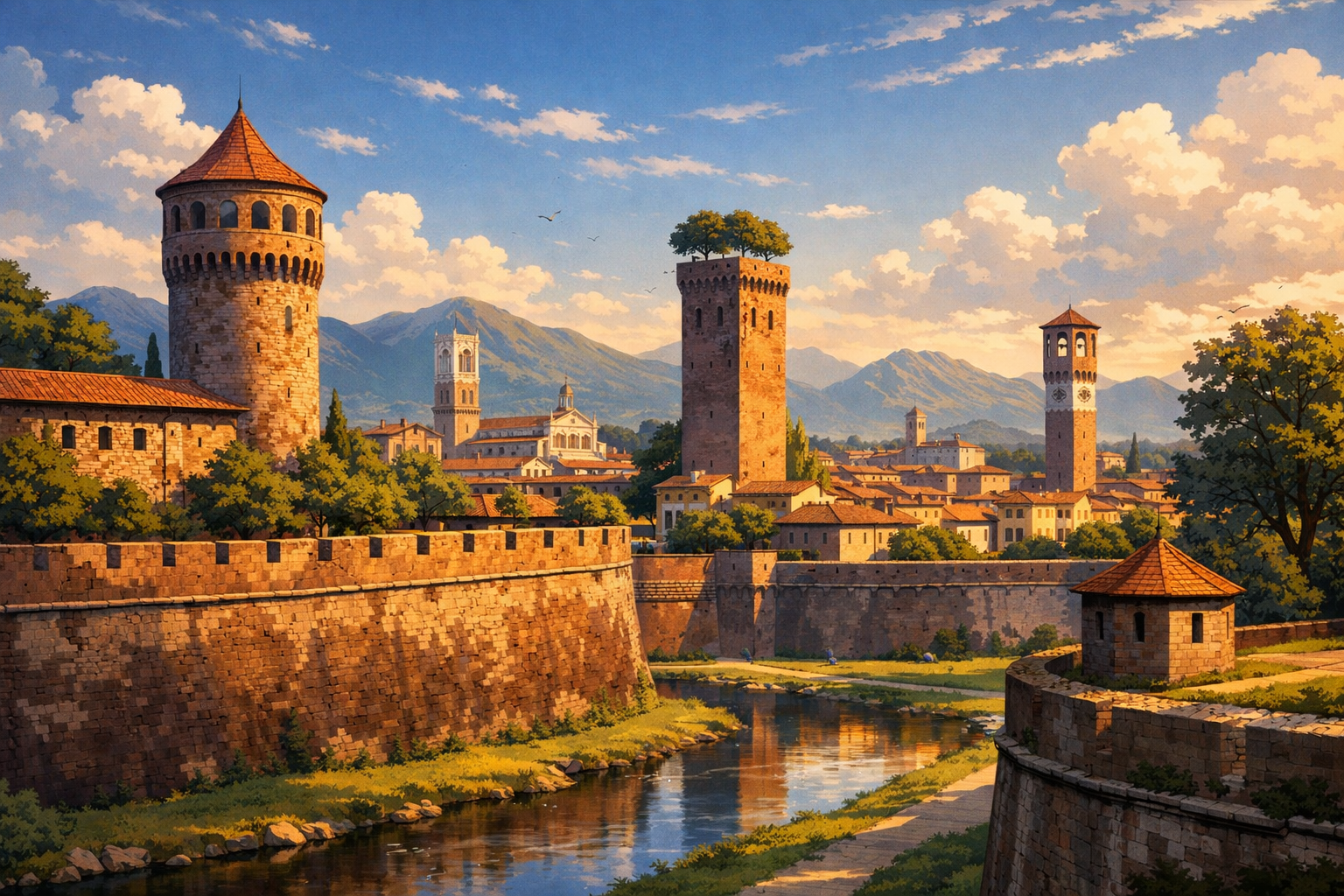
Pedal along Lucca’s tree-lined Renaissance walls and gaze over a maze of towers, palaces, and sunlit squares. From this graceful Tuscan base, venture into the wild Garfagnana, the sands of Versilia, and the icons of Pisa and Florence.

🧭 DAY-BY-DAY ITINERARY

Ready-made country and city routes with daily plans, sights, transport and accommodation. Buy PDF guides for independent travel.

🧭 DAY-BY-DAY ITINERARY


Day 1 — Arrival via Pisa and a first loop on the walls

  • ✈️ Fly into Pisa (PSA), take the Pisamover to Pisa Centrale railway station (≈ 5 minutes), then a regional train to Lucca (≈ 25–30 minutes). 🏨 Check in and head straight for your “first date” with the city — Lucca’s Renaissance walls (Mura di Lucca): a wide shady promenade about 4.2–4.9 km long, turned into a park. Walk a calm half-loop from Porta San Pietro to Baluardo San Colombano and Baluardo San Donato: it’s the best way to feel the scale and gentle rhythm of Lucca, where the green crown of the walls embraces the entire historic center.


Day 2 — Towers and the amphitheater: Torre Guinigi, Via Fillungo, Piazza dell’Anfiteatro

  • 🚶 Start the morning at Torre Guinigi (entrance from Via Sant’Andrea, 45): climb up to the “hanging garden” with oaks on the roof and look over the city’s red roofs from a medieval tower. Then stroll along Via Fillungo — the main shopping street with elegant signs and courtyards. Lunch is best planned at Piazza dell’Anfiteatro — the oval square follows the outline of the ancient Roman amphitheater: the entrances recall former arches. In the evening, return to the walls for sunset light — it falls softly on the brick and plane trees.

Day 3 — Clocks and botany: Torre delle Ore, the Botanical Garden, and Palazzo Pfanner

  • ⏰ Climb Torre delle Ore on Via Fillungo — the city’s tallest tower, with a working clock mechanism and narrow spiral staircases. Then head to Orto Botanico di Lucca (Via del Giardino Botanico, 14): a two-hundred-year-old garden with collections of woody and aquatic plants; stone paths, quiet ponds, and green “pockets” for a pause. Toward evening, stop by Palazzo Pfanner (Via degli Asili, 33): a baroque garden with bosquets and statues, where refined geometry pairs with the intimate feel of an old family palace.

Day 4 — The cathedral quarter and Puccini

  • ⛪ The San Martino complex: Duomo di San Martino and the Cathedral Museum on Piazza Antelminelli — a “treasury” with late Gothic and Renaissance masterpieces, from Jacopo della Quercia’s “Ilaria del Carretto” to reliquaries and textiles. After that — Museo Casa Natale Giacomo Puccini (Corte San Lorenzo, 9): the composer’s birthplace, with manuscripts, a piano, and the atmosphere of the maestro’s “private biography.” In the evening — a chamber concert or a stroll past Teatro del Giglio and the cafés on Piazza del Giglio.

Day 5 — Villas and gardens of Lucca: Villa Reale di Marlia

  • 🌿 A short trip north to Villa Reale di Marlia (Via Fraga Alta 2, Marlia/Capannori): an estate complex with a water theater, lemon houses, and long alley perspectives. It’s a great place to combine landscape-design history with a “visual detox”: go unhurriedly, alternating garden rooms and open lawns. On the way back to Lucca — a short bike ride through Parco Fluviale del Serchio: river embankments where locals run and cycle.

Day 6 — The Nottolini Aqueduct and a “green line” to the hills

  • 🚶 From Porta San Pietro, walk along the Acquedotto del Nottolini — a 19th-century neoclassical aqueduct on hundreds of arches that leads the eye toward the foothills of Monte Pisano. This is a day of “structure and rhythm”: brick, arcades, rural views, and very calm movement. Bring a picnic and a blanket — there are many quiet spots to pause along the route.

Day 7 — Garfagnana: the medieval towns of Barga and Castelnuovo

  • 🚆 Take the regional line into the mountains: Castelnuovo di Garfagnana and Barga — stone citadels above the valleys. Views of the Apuan Alps, narrow streets, the sound of bell towers, and a slow lunch on the square. Return the same way: you’ll see how Lucca’s “urbanism of walls” rhymes with the region’s mountain fortresses.

Day 8 — Versilia: the sea and Art Nouveau in Viareggio

  • 🏖️ By train to the sea: Viareggio — Liberty-style facades on the promenade, the pier, and a long beach. In the morning — a swim and a walk along the seafront; in the afternoon — cafés and gelato in the shade of modernist balconies. In the evening — the train back to Lucca: a pleasant contrast between a “sea day” and the intimate evening quiet of the walls.

Day 9 — Pietrasanta: art and marble

  • 🗿 The “Little Athens of Tuscany”: in Pietrasanta, sculpture lives in the squares and workshops, and contemporary art sits alongside a Romanesque basilica. Walk around Piazza del Duomo, pop into one or two galleries, and let your eyes “fill up” on stone and light. Return by train via Viareggio.

Day 10 — Spas and a funicular: Montecatini Terme

  • ♨️ A rest day in Montecatini Terme: parks around the historic spa buildings, neoclassical colonnades, terrace cafés. Take the funicular up to Montecatini Alto for views over the Pistoia and Lucca plain. It’s a gentle “mid-route” day — minimal museums, maximum fresh air.

Day 11 — Pisa: Campo dei Miracoli and the Arno River

  • 🏛️ A short trip — and you’re in the Piazza dei Miracoli: the Leaning Tower of Pisa, the Duomo, the Baptistery, and the Camposanto come together in a “white” architectural symphony. Then — a walk to the Arno riverbanks and a glass in the sun. In the evening — back to Lucca: the towers greet you again above the walls.

Day 12 — Florence for one day: a Renaissance concentrate

  • 🎨 By train to Santa Maria Novella — then a walking loop through the historic center: the Duomo, Piazza della Signoria, Ponte Vecchio. If museums are your thing, choose at most one (Uffizi/Accademia) so you don’t “lose” the Florence of streets and courtyards. Return to Lucca in the evening — perfect for “digesting” the day over a relaxed dinner.

Day 13 — Contemporary art and antiquity: Lu.C.C.A. and Domus Romana

  • 🖼️ Lu.C.C.A. – Lucca Center of Contemporary Art (Via della Fratta, 36) — intimate exhibitions and a great “contrast” to the classics. Then — Domus Romana (Via Cesare Battisti, 15): an archaeological layer in the very heart of the city, where fragments of a Roman house sit alongside a cozy exhibition. At sunset — a final loop around the walls by bicycle.

Day 14 — A Lucca-style finale: walls, towers, a last dinner

  • 🌅 In the morning — your favorite stretch of the walls and “your” courtyard/square. In the afternoon — leisurely shopping (olive oil, honey, posters, books about Lucca), one more cup of coffee at Piazza del Giglio. In the evening — dinner to the sound of bell towers and a farewell walk along the bastions: Lucca stays in memory as a city of walls, light, and quiet details.

Flight tickets

eSIM for travel

Buy PDF guide

Buy PDF guide — 29.99 USD

PDF — 29.99 USD