
Buy PDF guide

Buy PDF guide — 29.99 USD

PDF — 29.99 USD

LONG BEACH

LONG BEACH

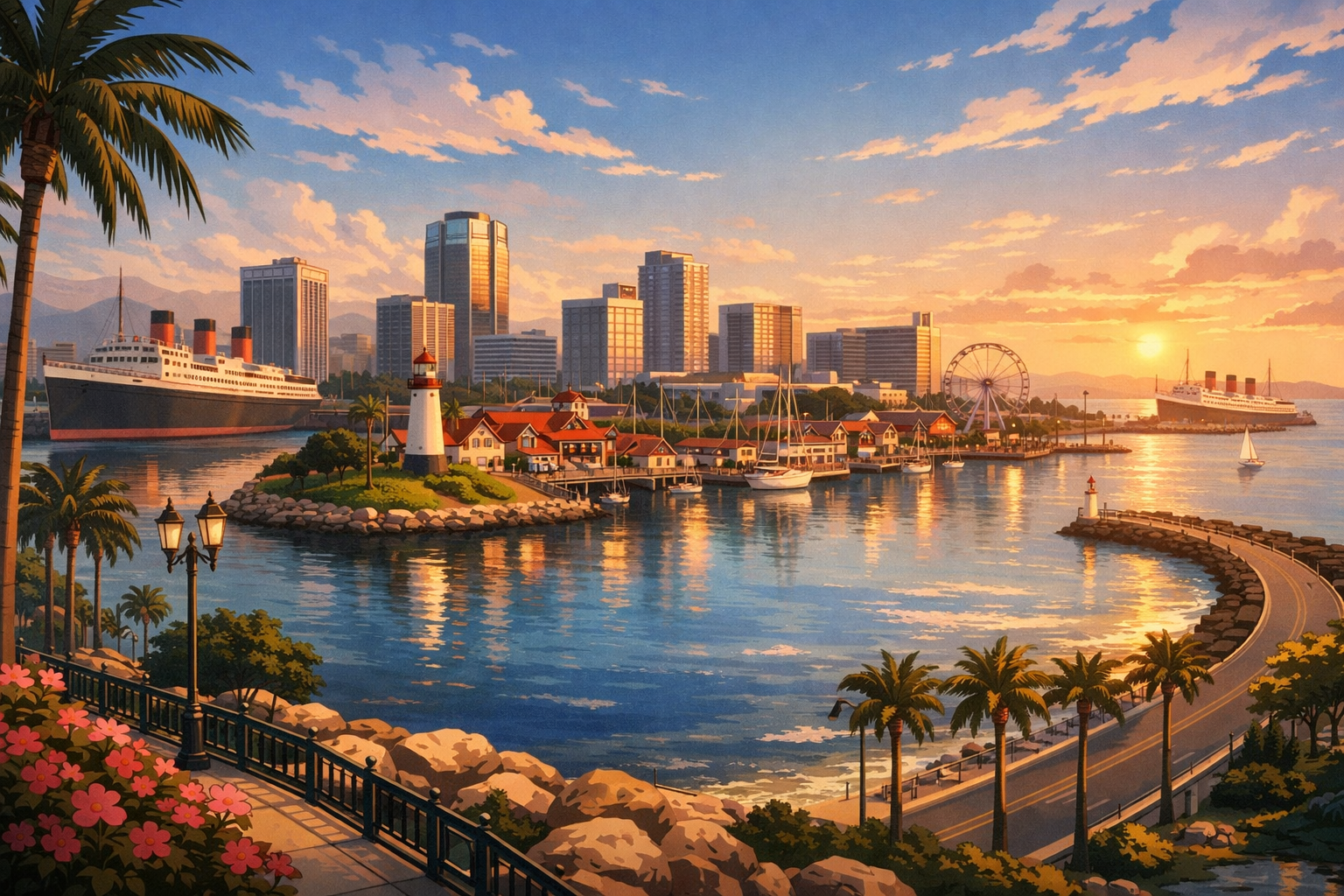
Long Beach blends oceanfront energy with laid-back California charm, from the Downtown Waterfront and the iconic Queen Mary to the canals of Naples and the boutiques of Belmont Shore. Wander the creative streets of the East Village Arts District, then head to Bixby Knolls for a lively local scene of cafés, culture, and neighborhood character.

🧭 DAY-BY-DAY ITINERARY

Ready-made country and city routes with daily plans, sights, transport and accommodation. Buy PDF guides for independent travel.

🧭 DAY-BY-DAY ITINERARY


Day 1 — Long Beach: Downtown Waterfront and a gentle start by the water

  • 🚶 It’s best to devote the first day to getting to know the side of Long Beach that usually makes people fall in love with it right away: an open waterfront, marina, palm trees, wide skies, and a very Californian rhythm without any rush. Start in the Rainbow Harbor and Shoreline Village area, where the walk naturally turns into an easy route: water, yachts, little bridges, open views of the bay and the city. There’s no need to “check off” a list of spots here — it’s more important to catch the feeling of a seaside city that is at once resort-like, urban, and a little cinematic. Plan 3–4 hours on the first day for a relaxed walk with breaks for coffee, photos, and rest on benches by the water. If your flight arrived that same day, don’t overload the program: it makes sense to end the evening with an early dinner by the waterfront and go to bed early to adjust without rushing.


Day 2 — Long Beach: Aquarium of the Pacific and Shoreline Park

  • 🚶 On the second day, it’s convenient to move from the city-postcard feel to one of Long Beach’s main attractions — the Aquarium of the Pacific. This is not just a family spot, but a large, modern, highly visual museum-ocean complex where it’s easy to spend half a day without feeling rushed. It’s best to come in the morning and plan at least 3 hours for the exhibits, interactive areas, and short breaks to rest. After the aquarium, don’t try to add too many complicated stops: pair it with a walk through Shoreline Aquatic Park and along the water. It’s a well-balanced day — first rich impressions indoors, then air, space, and a relaxed walk with views of the harbor, bridges, and the silhouette of the Queen Mary in the distance.

Day 3 — Long Beach: Queen Mary and Queensway Bay

  • 🚶 This day is dedicated to the city’s most famous historical icon — the Queen Mary. It’s better to give it its own time block, because it’s not just a “ship for photos,” but a complete experience: art deco, maritime history, the scale of the liner, and the special atmosphere of an old transatlantic voyage. It’s easy to get there from downtown on the free Passport route or with a short taxi/rideshare trip; depending on your starting point, the journey usually takes about 10–20 minutes. Plan 2.5–4 hours for the visit, especially if you want to explore at an unhurried pace and stop for coffee or a late lunch with a view of the water. Afterward, don’t overload the day with museums: it’s better to walk around Queensway Bay, look at the city skyline from the other side, and leave the evening free.

Day 4 — Long Beach: Belmont Shore, the beach, and Second Street

  • 🚶 After the waterfront center and the historic liner, it’s time to see a more “local” and resident-loved side of Long Beach. Belmont Shore is a sunny neighborhood with a great balance of beach, walking, and city life. In the morning, start with Ocean Boulevard and the beachfront: it’s pleasant here simply to walk along the shore, listen to the ocean, and watch the city’s rhythm change. Then move toward Second Street — the district’s main axis with cafés, small shops, and lively but not aggressive activity. It’s best to build the day without rushing: a walk, a late breakfast or lunch, a little shopping, then back to the water again. From downtown, allow around 20–30 minutes by bus or car, and at least half a day once you’re there.

Day 5 — Long Beach: Naples Island and the canals

  • 🚶 Naples is one of the most beautiful and photogenic corners of Long Beach, and a slow format works best here. The area is famous for its canals, little bridges, neat houses, and an almost Mediterranean mood that unexpectedly blends with Southern California. The ideal scenario is to come closer to the morning or at golden hour in the second half of the day, walk along the water, make a loop around the little islands, and not try to “speed up” the stroll. This is a day for 2–4 relaxed hours plus time for a café nearby in Belmont Shore. It’s easy to walk here from Second Street, and from downtown the trip usually takes around 20–30 minutes by car or longer by public transport with transfers. Naples works especially well as a breather day between museums and a denser cultural program.

Day 6 — Long Beach: Museum of Latin American Art and East Village Arts District

  • 🚶 Today’s focus is art and urban character. The Museum of Latin American Art gives Long Beach important cultural weight: it’s a place where modern and modernist art of Latin America and the Latino experience come through vividly, emotionally, and without dryness. It’s reasonable to allow 1.5–2.5 hours for the museum, after which it works well to continue the day in the East Village Arts District. Here the city speaks a different language: galleries, street art, independent coffee shops, more “textured” urbanism, and the feeling that Long Beach is not only beach and postcard scenery, but also a living creative center. The day works well on foot, and within downtown 10–20 minutes of easy walking is often enough between points. In the evening, you can stay for dinner in downtown without any long transfers.

Day 7 — Long Beach: Long Beach Museum of Art, Bluff Park, and Ocean Boulevard

  • 🚶 This day is about a beautiful combination of art and the ocean horizon. The Long Beach Museum of Art stands on a high bluff and is itself part of the experience: an old house, gardens, a panorama of the water, and very clear, bright Californian air. There’s no need to rush here — allow 1.5–2 hours for the exhibitions and time to look around the grounds. After the museum, it makes sense to walk along Ocean Boulevard and Bluff Park: this is one of those routes where the main thing is not the number of stops, but the line of movement itself — palm trees, the slope toward the water, cyclists, the wide coastal perspective. If the weather is good, the day turns out almost ideal for a “soft,” contemplative pace. Add a long lunch or coffee with a view and don’t plan anything complicated for the evening.

Day 8 — Long Beach: Earl Burns Miller Japanese Garden and the university-side east of the city

  • 🚶 After the coastline and downtown, it’s worth shifting to a calmer, greener part of the city. Earl Burns Miller Japanese Garden on the campus of California State University, Long Beach is a day about silence, water, bridges, stones, careful composition, and a completely different tempo. It’s best to go here without rushing, understanding that this is not a “grand” attraction, but a refined space for visual reset. 1–2 hours is enough for visiting the garden, but together with the trip and walks around the area, plan for half a day. From downtown the trip usually takes about 20–30 minutes by car and longer by bus. This kind of day is especially good in the middle of the itinerary, when you want a break from the busier waterfront locations and to return your attention to quiet details.

Day 9 — Long Beach: Rancho Los Alamitos and California’s historic landscape

  • 🚶 Rancho Los Alamitos helps you see Long Beach much more deeply than you usually expect from a seaside city. This is no longer about modern towers, the marina, and waterfronts, but about early Californian history, gardens, an old ranch, and an almost rural sense of space. The day here is built calmly: the journey, the grounds themselves, a walk through the historic complex, small pauses in the gardens and by the outbuildings. It’s easy to spend 1.5–3 hours here. From downtown it’s about 25–35 minutes by car, and noticeably longer by public transport, so it’s worth building in extra time. This route is especially valuable because it reveals the region’s layered character: Long Beach turns out to be not only a city of beaches and port views, but also part of a much longer Californian story.

Day 10 — Long Beach: Rancho Los Cerritos and Bixby Knolls

  • 🚶 Continue the historical theme, but now in another part of the city. Rancho Los Cerritos is another important layer of local history, and it pairs well with a walk in the Bixby Knolls neighborhood. The ranch itself gives the atmosphere of old Southern California: broad grounds, a historic house, a garden, and a sense of the past preserved in the middle of the modern urban fabric. After the visit, for which it is reasonable to allow 1.5–2 hours, head to Bixby Knolls — a district with a more local, residential, and food-oriented atmosphere. It’s pleasant here simply to walk without a list of must-see spots, have a coffee, and feel how the city changes outside the tourist core. The trip here from the coast may take 20–30 minutes by car.

Day 11 — Long Beach: Pacific Island Ethnic Art Museum and Alamitos Beach

  • 🚶 One of the most underrated days of the route — cultural, intimate, and very human. The Pacific Island Ethnic Art Museum is a small but meaningful place that adds quiet depth to the trip and expands the geography of impressions far beyond the usual Californian set. This is not a half-day museum, but rather a smart and atmospheric stop for 45–90 minutes, after which it’s good to step back out into the city and continue the day at Alamitos Beach or in the neighboring blocks. The pairing works perfectly: first a concentrated cultural impression, then light, air, and a long walk along the coast. If you still have energy, you can add an unhurried evening in East Village or return to a favorite spot in downtown.

Day 12 — Long Beach: a free day by the water, seasonal AquaBus/AquaLink, and revisiting favorite places

  • 🚶 On the twelfth day, it’s better to consciously avoid building a rigid plan. Long Beach opens up well through repetition: once downtown, the beaches, and the neighboring districts are already familiar, returning to favorite places gives a completely different feeling. If the seasonal AquaBus or AquaLink routes are running, you can use them as a light scenic element of the day rather than as a mandatory goal. An alternative is to return to Shoreline Village, walk the waterfront line once more, have a late breakfast, and take a long pause by the water. This is also a convenient day for rest, laundry, shopping, or changing pace after the busier days filled with museums and transfers.

Day 13 — Long Beach: Pike Outlets, evening downtown, and the city rhythm after sunset

  • 🚶 The penultimate day can be given to a lighter urban scenario: The Pike, the waterfront zone, shops, a movie theater, cafés, and simply the pleasure of already navigating the city as not quite a tourist. There’s no need for a strict route here — it’s enough to set a general axis of movement around downtown and the waterfront. During the day, you can shop or simply take a long walk, and in the evening stay in the center, when the lighting, reflections on the water, and the silhouette of the Queen Mary turn Long Beach into a very beautiful evening scene. This day works well without haste and without the urge to “fit in something else.” Let it be about comfort, convenience, and the pleasure of experiencing the city again.

Day 14 — Long Beach: final loop — ocean, favorite neighborhood, and a calm departure

  • 🚶 It’s best to keep the last day short and easy, especially if you have a flight or transfer ahead. The ideal format is a final loop through the area that turned out to be the most “yours”: downtown waterfront, Belmont Shore, Bluff Park, or Naples. Don’t try to squeeze in one more big museum: it’s better to leave time for breakfast, packing, a short walk, and a beautiful farewell to the city. If logistics allow, end the trip with a view of the water — for Long Beach, that’s the most fitting finale. This city is remembered not for one loud landmark, but for the sum of impressions: light, ocean air, layered history, calm neighborhoods, and the ability to be at once a resort, a port, an art scene, and a place for slow travel.

Flight tickets

eSIM for travel

Buy PDF guide

Buy PDF guide — 29.99 USD

PDF — 29.99 USD