
Buy PDF guide

Buy PDF guide — 8.57 USD

PDF — 8.57 USD

Lisbon, (entertainment) — Bairro Alto, fado, riverside clubs, surfing

Lisbon, (entertainment) — Bairro Alto, fado, riverside clubs, surfing

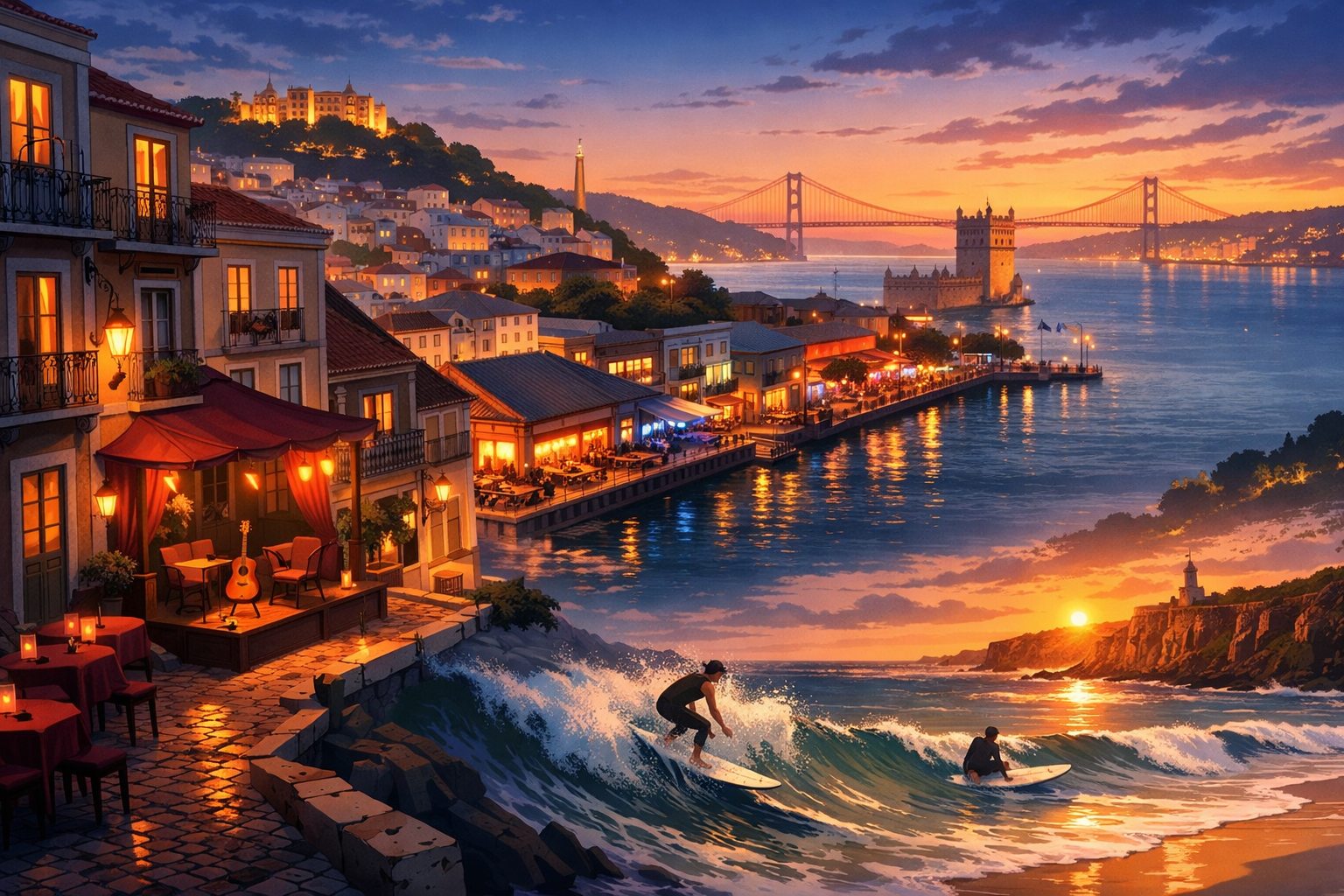
Lisbon moves to its own rhythm, from the soulful fado drifting through Alfama and the late-night energy of Bairro Alto to the riverside bars and clubs of Cais do Sodré. Beyond the city, Belém invites slow sunset strolls, while Costa da Caparica brings Atlantic surf and wide sandy beaches within easy reach.

🧭 DAY-BY-DAY ITINERARY

Ready-made country and city routes with daily plans, sights, transport and accommodation. Buy PDF guides for independent travel.

🧭 DAY-BY-DAY ITINERARY


Day 1 — Lisbon: Bairro Alto, Chiado, and an evening above the Tagus

  • 🚇 After landing at Humberto Delgado Airport, it’s wise to allow about 35–50 minutes to reach central Lisbon, including baggage claim and buying or topping up a Navegante card. To areas like Baixa, Chiado, and Bairro Alto, the fastest option is usually the metro on the red line with a transfer, followed by the last 8–15 minutes on foot, because the historic center sits on hills and some streets are simply easier to cover by walking rather than by transport. If you want to arrive right at your hotel door with a suitcase, allow around 25–35 minutes by taxi or ride-hailing app outside the heaviest rush hour. After check-in, it’s best to leave at least 1–1.5 hours to rest: Lisbon opens up beautifully in the evening, and you really will need your energy here — the city constantly offers stairs, viewpoints, and the temptation to turn into yet another alley with azulejos, lanterns, and wine bars.

  • 🚶 Bairro Alto is not just a neighborhood but a whole nighttime coordinate system of Lisbon, where one city hides by day and a completely different one appears after sunset. In daylight there are quiet façades, laundry on balconies, workshops, little shops, and cafés, but in the evening the quarter seems to wake up: narrow streets fill with voices, music, laughter, the smell of grilling food, and wine in glasses that guests casually hold right out on the pavement. The atmosphere here is not strictly clubby, but rather street-bar energy at its liveliest: people drift from door to door, from terrace to terrace, and the whole district works as one shared space for strolling, flirting, and improvising. That is exactly why it’s better not to overload the first evening with museums and transfers, but to devote it to the rhythm of Lisbon itself — go up to Miradouro de São Pedro de Alcântara, watch the city sink into golden light, then slowly descend through Chiado back into Bairro Alto and give yourself time to simply absorb this famous bohemian energy of the capital.

  • 🌇 In terms of evening logic, the route is very convenient: from Praça Luís de Camões to the São Pedro de Alcântara viewpoint it’s usually a 10–15 minute uphill walk, then you can wander through the neighboring streets of Bairro Alto, have an aperitif, enjoy dinner, and later at night decide whether to stay in the quarter’s bars or keep going toward the river. For the walk itself, the viewpoint, and an unhurried dinner, it makes sense to set aside about 4–5 hours without rushing. If your arrival is early, this day also works well in a soft mode: check-in, a short nap, a sunset walk, one long dinner, and an early return to the hotel. If, on the other hand, you have plenty of energy, Bairro Alto is ideal for feeling Lisbon immediately from its brightest side — not as an open-air museum, but as a city that loves the evening and knows how to turn the street into a stage.


Day 2 — Lisbon: Alfama, fado, and a late outing to the riverside clubs

  • 🚶 The second day is best devoted to old Lisbon — Alfama — because it is here that the city’s connection to fado becomes clearest. In the morning and daytime, this district is especially wonderful: the light falls softly on the façades, the lanes are still relatively calm, and the stairs, arches, tiny squares, and terraces with views over the rooftops and the Tagus create the feeling of a city that grew not by ruler but by memory. Alfama is a labyrinth where there is no need to hurry; here it is more interesting not to follow the shortest route, but to allow yourself extra turns. You should set aside at least 3–4 hours for walking through the quarter, its viewpoints, and old streets, with pauses for coffee and rest, because the climbs here are constant. An excellent focal point for the day is the Museu do Fado: it helps you not simply listen to fado in the evening, but understand it as an urban emotion — music of longing, fate, the sea, loss, dignity, and inner fire.

  • 🏛️ Museu do Fado is located in Alfama, near Santa Apolónia station, so it fits easily into a daytime route without long detours. After the museum, it’s a good idea to rest a little and return to the hotel for 1–2 hours, because the evening will be long. The key rhythm of this day is not to try to see everything at once, but to preserve your energy for a fado dinner and a late continuation. Fado itself is best planned for early evening: arrive without rush, have dinner calmly, and listen to the music in the atmosphere it was born for — intimate, almost private, where the voice fills the space more strongly than any decoration. Even if you don’t know the language, fado in Lisbon is felt physically: conversations fade in the pauses, glasses ring, the guitar sounds especially dry and close, and the whole evening becomes not a tourist checklist item, but a very personal experience of the city.

  • 🌙 After fado, the logical continuation of the evening is to head down to Cais do Sodré and the riverfront. From Alfama to this part of the center, by taxi or by a short combination of walking and transport, it usually takes about 15–25 minutes depending on your starting point and the time. The area by the river is already a different Lisbon: less traditional, more dance-oriented, with late bars, concert venues, and nightlife that gravitates toward the waterfront and the late-night movement around Cais do Sodré and the docks. This contrast makes the day especially powerful: first old stone Lisbon and fado, then the dark waters of the Tagus, lights along the embankment, music, a more contemporary crowd, and the feeling that the city knows how to be both melancholic and very alive at the same time. For the return trip to your hotel, allow 10–20 minutes by car or 20–35 minutes on foot if you decide to end the night with a leisurely walk through the center.

Day 3 — Lisbon: Belém, the waterfront, and a long evening by the river

  • 🚋 The third day works well as a more spacious and visual one: after the intimate center and night streets, it’s worth going to Belém, where Lisbon opens up more broadly — through the river, the wind, monumental waterfronts, and maritime history. From Chiado or Cais do Sodré to Belém, it is usually convenient to go by surface transport in about 25–35 minutes, and if you start closer to Santos or the riverfront, even faster. Here the geometry of the city is completely different: fewer cramped alleys, more air, sky, and water. Belém’s waterfront offers that rare urban scale where you feel not only the capital, but also a port, imperial memory, the departure points of maritime expeditions, and the constant presence of the Atlantic, even if through the Tagus estuary.

  • 🏛️ This day is easy to build around MAAT and a walk along the waterfront, and if you wish, add Museu Nacional de Arte Antiga or Museu da Carris depending on your interest in art and transport history. MAAT is especially good not only for its exhibitions, but for the architecture itself: the building seems to grow out of the shoreline and invites you not just to go inside, but to climb up, look around, feel the reflections of light on the ceramic surface, and see how the river becomes part of the urban landscape. In Belém, it is important not to rush: there is plenty of space here for a slow walk, photos, a coffee break, and simply relaxing by the water. For the museum and the waterfront, it makes sense to allow about 4–5 hours, especially if you want time for a calm lunch without rushing.

  • 🌃 In the evening, return to the river again, but this time without any mandatory cultural program — just for the atmosphere of the nighttime waterfront. You can start with a sunset walk around Santos or Cais do Sodré, and then continue toward the bars and club venues by the water. This is the best day for a full night out: after a daytime route without extreme climbs, you usually have more energy than after Alfama, and the river itself looks especially striking in the evening — lights on the water, wind from the embankment, long terraces, music, and the feeling of an open, free city. If you want balance, take a 1–1.5 hour break at the hotel before the night part. This rhythm lets you avoid burning out and still experience a Lisbon night properly — not in fragments, but with a beautiful warm-up from sunset to dancing.

Day 4 — Costa da Caparica: surfing and an Atlantic finale

  • 🏄 The final day is worth dedicating entirely to the ocean and surfing — it’s the best counterpoint to the city districts, fado, and nightlife. Although Lisbon itself is not directly on the ocean shore, Costa da Caparica is relatively easy to reach: by car or taxi from the center it is usually about 25–40 minutes depending on traffic and the beach you choose; by public transport with transfers, you should allow roughly 50–80 minutes. So it’s better to head out in the morning, especially if you’re planning a lesson at a surf school. For a first or relaxed session, it is sensible to set aside 2–3 hours for the lesson itself, plus time for changing, briefing, resting after the water, and lunch by the beach.

  • 🌊 Costa da Caparica is already a completely different rhythm of Portugal: a wide sandy shore, an open horizon, salty wind, lines of surf, and the feeling that the city has been left somewhere beyond the bridge and the hills. Even if you are not an experienced surfer, the format of the day works brilliantly here: a morning lesson, then a warm shower, a late lunch with an ocean view, a barefoot walk along the waterline, and a long pause without museum tempo or city noise. For those who are already more confident on the board, local schools and instructors usually help choose a spot according to the day’s conditions, while beginners get that soft first contact with the Atlantic for which many people choose Lisbon as an urban base for a surf trip.

  • ☀️ It is best to plan your return to Lisbon closer to evening, leaving yourself a bit more time for rest, packing, or a final dinner in the center. If your flight is not early the next day, you can end the trip beautifully without another major night program: a glass of wine in Chiado, dinner around Cais do Sodré, or a short walk through the already familiar streets of Bairro Alto, which by then will feel almost like your own. This kind of finale is what makes the route feel whole: you manage to see Lisbon not only as a capital of history and music, but as a city living in constant connection with water — the river, the port, the waterfront, and finally the ocean.

Flight tickets

eSIM for travel

Buy PDF guide

Buy PDF guide — 8.57 USD

PDF — 8.57 USD