
Buy PDF guide

Buy PDF guide — 10.71 USD

PDF — 10.71 USD

Las Vegas - casinos, shows, desert excursions, and parties

Las Vegas - casinos, shows, desert excursions, and parties

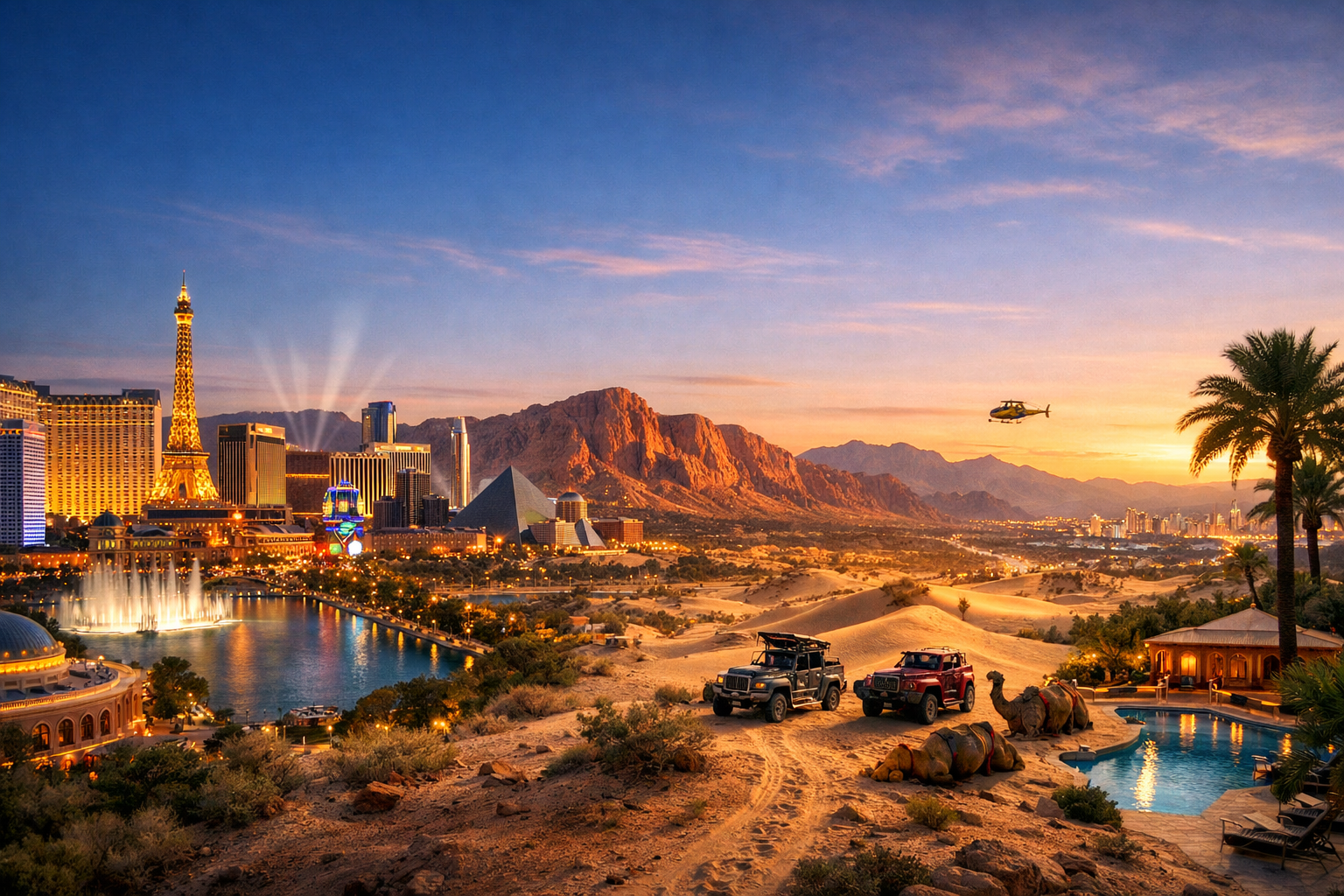
Las Vegas dazzles with iconic casinos, world-class shows, and the electric energy of the Strip, from the Bellagio fountains to the grandeur of Caesars Palace. Beyond the neon, Downtown brings vintage charm, while Red Rock and Valley of Fire reveal a stunning desert escape before the city pulls you back into its legendary nightlife.

🧭 DAY-BY-DAY ITINERARY

Ready-made country and city routes with daily plans, sights, transport and accommodation. Buy PDF guides for independent travel.

🧭 DAY-BY-DAY ITINERARY


Day 1 — Las Vegas: arrival, south and central Strip, casinos, and the first show

  • ✈️ After landing at Harry Reid International Airport, it’s best to allow around 30–45 minutes for baggage claim and getting to ground transportation. The trip to the central Strip usually takes about 15–25 minutes by taxi or rideshare, but during the evening rush and on days with major events it can stretch to 30–40 minutes. After check-in, don’t overload your first day: Las Vegas works through contrasts of light, scale, and temperature, so it’s helpful to give yourself 1–2 hours for a shower, rest, and adjustment after the flight. Closer to sunset, head out for a walk along the Bellagio → Caesars Palace → The LINQ Promenade section: this area has a very dense concentration of “classic” Vegas — resort facades, enormous gaming floors, streams of tourists, gleaming storefronts, and the feeling that the city functions like an endless stage.

  • 🎰 It’s best to get your first introduction to casinos without rushing: go into Bellagio for its more elegant atmosphere and the sense of “luxury” Vegas, then compare it with the more theatrical and grand aesthetic of Caesars Palace. Even if you’re not seriously gambling, it’s interesting to walk through the gaming floors, hear the sounds of slot machines, watch the rhythm of the tables, and feel how show business, hotel design, and азарт blend together here. Allow 10–20 minutes walking time between hotels, but remember that distances in Vegas are deceptive: huge buildings, escalators, crossings over boulevards, and crowds eat up time faster than the map suggests.

  • 🌊 The evening is best finished at Bellagio: the fountains work as the city’s main “ceremonial” gesture, turning an ordinary stop into a small ritual. After that, it’s worth going to one major show instead of trying to fit in everything at once. The most classic option is “O” by Cirque du Soleil at Bellagio: it’s not just a circus performance, but an almost dreamlike water production with strong visual dramaturgy. Allow about 90 minutes for the show itself, plus 30–45 minutes for entry, finding your seats, and leaving calmly afterward. After the performance, leave yourself another hour for a late dinner or a cocktail — the first day should end beautifully, but without exhaustion, because four more very full days are still ahead.


Day 2 — Las Vegas: immersive Vegas, AREA15, parties, and the night rhythm

  • 🛸 It’s best not to start the second morning too early: after the first Vegas night, a comfortable pace matters more than discipline. Sleep in, have a calm breakfast, and only toward late morning or noon head to AREA15. From the central Strip, the trip by taxi or rideshare usually takes about 10–20 minutes, depending on traffic. It’s a good point for a change of impressions: if yesterday was “classic” Vegas with marble, fountains, and casinos, here the city opens up as a space of immersive art, light installations, neon fantasy, and club energy.

  • 🎨 The main anchor of the day is Meow Wolf’s Omega Mart. Formally it looks like a supermarket, but in reality it’s a surreal labyrinth where the everyday world starts to crack at the seams and turns into an interactive art quest. It’s reasonable to allow 2.5–3.5 hours for the visit without rushing: the space invites slow exploration, discovering hidden passages, strange products, plot details, and visual “drops” into other realities. After that, give yourself a break for food and recovery — another 60–90 minutes. In Las Vegas, it’s very important to plan not only activities, but also moments when you can simply sit, cool down, drink water, and catch your breath.

  • 🌃 In the evening, the day can easily be put together in a “dinner + nightlife” format. You can return to the Strip, rest a little at the hotel for 1–1.5 hours, and only then go out for the evening program. The Wynn/Encore area, Caesars Palace, and nearby club venues are convenient for a stylish night out: here the atmosphere is more polished, the lighting is expensive-looking, the service is carefully staged, and there’s a feeling of a major performance even off the stage. If you want to avoid a club line and have a more controlled evening, choose a lounge or a show with a late start. If you want an actual party, allow at least 30–60 minutes for the trip, entry check, and waiting. The best principle for Las Vegas is one main night experience per evening, not trying to “do everything,” because logistics and lines quickly drain your energy.

Day 3 — Las Vegas: Downtown, neon, city history, and Fremont Street at night

  • 🏙️ Dedicate the third day to Downtown Las Vegas — it’s a different Vegas, less glossy and more historic, where beneath the tourist brightness it’s easier to feel how the city was assembled from a desert road junction, the gambling business, the show industry, and the cultural myth of nonstop freedom. From the central Strip, the trip to Downtown usually takes about 15–25 minutes by car. Start with The Mob Museum: it’s one of the best ways to get the context without which Vegas remains only a beautiful set. Allow about 2–3 hours for the museum, especially if you’re interested in the history of organized crime, law enforcement, Prohibition, the underground economy, and how all of this intersected with the city’s growth.

  • 📸 After the museum, have a relaxed lunch and move on to The Neon Museum. It’s convenient to travel between the points in 5–10 minutes by taxi or rideshare, or a bit longer if combining it with the bus. The Neon Museum is especially good closer to evening: the old signs here are not just “beautiful objects,” but visual archaeology of Las Vegas. This place gathers the city’s history through letters, bulbs, colors, fonts, and myths about resorts that disappeared, were rebuilt, or changed eras. It’s useful to allow 1.5–2 hours for the visit. If you can get an evening slot, the atmosphere will be especially strong: the museum works like a half-open memory of Vegas, where the past literally glows in the dark.

  • 🌈 The final stop of the day is Fremont Street Experience. Here Las Vegas becomes louder, cheaper, freer, and a little more chaotic than on the Strip. The huge light canopy, street musicians, bars, crowd noise, sharp neon, and constant sense of improvisation create a completely different urban rhythm. This is a good evening for walking without a strict script: you can simply wander, go into bars, watch live performances, and soak up the atmosphere of the old gambling center. But it’s important to remember basic safety in a large tourist area: keep an eye on your belongings, don’t carry documents and large amounts of cash unless necessary, and don’t overdo alcohol if you plan to return late to the hotel.

Day 4 — Las Vegas: desert excursions, Red Rock Canyon or Valley of Fire

  • 🏜️ It’s best to make this day a natural counterpoint to everything you’ve already seen in the city. Las Vegas is especially impressive when, after the night lights and glass, you suddenly step into the silence of the desert, red rocks, and a wide sky. The most convenient option is Red Rock Canyon National Conservation Area: from the Strip, the drive usually takes about 30–40 minutes by car. It’s a good choice if you want to return to the city for dinner and avoid making too long of an outing. For a short excursion with photo stops and 1–2 easy walks, allow 4–6 hours including the drive. If you want a more “cinematic” landscape and are ready for a longer day, you can choose Valley of Fire State Park — it’s usually about 1–1.5 hours each way from Las Vegas, so the whole route will take 7–9 hours.

  • ☀️ A desert day requires more discipline than it seems. Even if the walk looks easy, take plenty of water, a hat, sun protection, and closed comfortable shoes. The best departure time is early morning, especially in the warm season, when after noon the temperature and dry air quickly build up fatigue. Don’t plan an intense night program on this day without a break: after the desert, your body usually “drops” into tiredness, even if emotionally you feel uplifted. The optimal rhythm is to return to the hotel, rest for 2–3 hours, take a shower, and only then choose a calm dinner or one beautiful evening activity.

  • 🍸 In the evening after a nature excursion, a softer Vegas works best: a panoramic restaurant, a leisurely walk along the Strip, a cocktail bar, or an observation point like High Roller at The LINQ Promenade. This is the ideal moment to see the city with a different perception: after desert tones, rocks, and long horizons, the neon feels even brighter, and all the resort architecture seems almost unreal. That contrast is what makes Las Vegas such a strong route: here you can experience not only the night and casinos, but also the scale of the desert that surrounds it all.

Day 5 — Las Vegas: calm morning, selective finale, last casinos, and departure

  • 🧳 It’s best not to overload the last day. Las Vegas quickly becomes sensorily exhausting, so the end of the trip benefits from a calmer pace. If you’re staying on the Strip, start with a late breakfast and a short walk along your favorite section of the boulevard — for example, around Bellagio, Caesars Palace, or Wynn. This is a good moment for final photos, a small shopping break, and “gathering” your impression of the city not through new places, but through revisiting familiar ones. If you want, you can add a short visit to Springs Preserve — a quieter cultural-and-natural alternative to a noisy finale and an interesting way to see the desert ecology and the valley’s history in a museum format.

  • 🎲 If you want to close the casino chapter nicely, set aside 1–2 hours for one last gaming floor rather than doing a “tour of all the hotels.” It’s important to leave time for packing, check-out, and the trip to the airport without stress. For leaving the hotel to Harry Reid International Airport, it’s usually reasonable to allow about 20–25 minutes of pure driving time from the central Strip, but taking into account waiting for the car, loading luggage, and possible traffic, it’s better to have at least a 60–90 minute buffer before your desired arrival time at the airport. For domestic flights, it’s often comfortable to be at the airport 2 hours before departure; for international ones, even earlier.

  • ✨ The finale in Las Vegas doesn’t necessarily have to be loud. Sometimes the best last frame is not another party, but a slow look at the city that lives like a continuous performance: the Bellagio fountains, the shine of glass at Wynn, the dense human river on the Strip, the old neon of Downtown, and the desert that begins almost immediately beyond the limits of the resort spectacle. If the route was balanced, in five days you’ll see not only a “city-attraction,” but also a place where luxury, theatricality, history, and harsh landscape constantly argue with one another — and that is exactly why Las Vegas is so hard to forget.

Flight tickets

eSIM for travel

Buy PDF guide

Buy PDF guide — 10.71 USD

PDF — 10.71 USD