
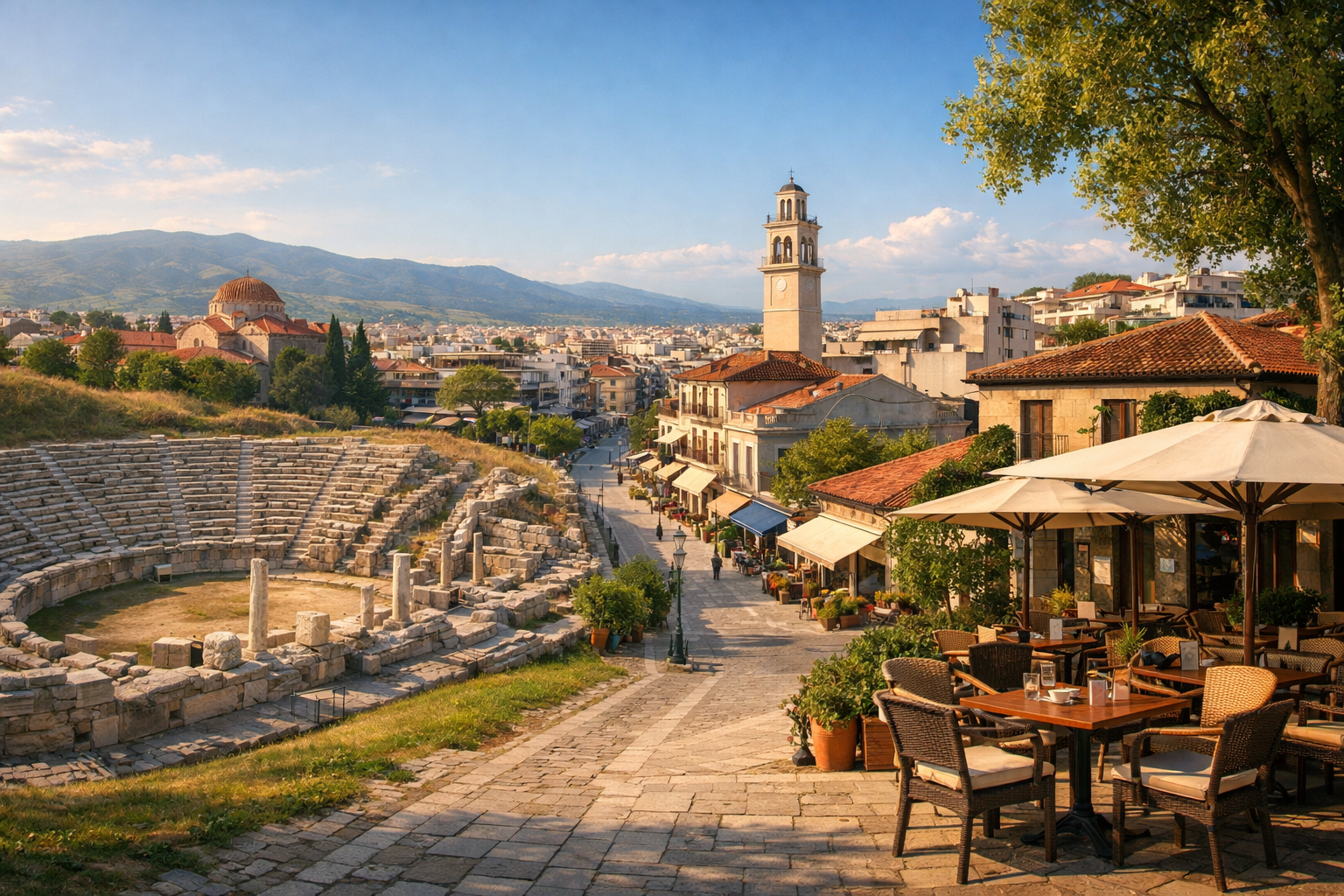
Day 1 — Larissa: center, A’ Ancient Theatre, Frourio hill and an evening in cafés
🚶 Start getting to know Larissa from the historic center — a city that does not try to be a "stage set for tourists," but lives its real, very Greek, very local life. It is the capital of Thessaly, a major university and business center, so the balance between antiquity and everyday life is especially pleasant here: ancient ruins stand next to lively pedestrian streets, shops, coffee houses and squares where locals meet not for a pretty picture, but because that is simply how their ordinary day is arranged. In the morning, it is worth walking through the Central Square and the neighboring pedestrian quarters, slowly blending into the city’s rhythm, having your first coffee at an outdoor table and watching Larissa gradually wake up. There is little showy tourism here and a lot of genuine southern European urban coziness: parents with children, students, people going about their business, conversations on terraces, the clatter of dishes and a gentle bustle all around.
🚶 The main historic gem of the day is the A’ Ancient Theatre, the First Ancient Theatre of Larissa, one of the city’s most impressive monuments. It was built in the first half of the 3rd century BC at the southern foot of the acropolis and is associated not only with theatrical and musical performances, but also with the political life of the Thessalian League. This is not a museum under glass, but a powerful reminder of how deeply antiquity is woven into the fabric of modern Larissa: marble rows, a semicircle of seating, traces of later Roman reconstructions — all of this is literally built into the city landscape. It is best to allow about 40–60 minutes for the visit, with pauses for photos and quietly taking in the details. It is here that the contrast, rare for European cities, is felt especially strongly: you are standing by a Hellenistic theater, and just a few minutes away modern streets, shop windows and cafés are already waiting.
🚶 After the theater, it makes sense to go up to the Frourio hill area and walk to the Basilica of Saint Achillios, the Bezesteni and the neighboring streets of the city’s old core. This is the part of Larissa where the historical layers are especially easy to read: ancient, Byzantine, Ottoman and modern elements do not push one another out here, but come together into a single urban character. A walk through this area does not require haste — on the contrary, it is better to allow yourself to slow down, peek into side streets, linger at viewpoints and simply wander without a rigid goal. It is convenient to set aside 1.5–2 hours for the whole block, including a short rest. During the day, you can stop for lunch in the center and then arrange a long “Greek” coffee break: in Larissa, café culture is not an add-on to the itinerary, but an important part of city life. It is pleasant to sit for a long time here, order not only coffee but also dessert, watch people and catch the atmosphere of a real Thessalian city.
🚶 It is best to end the evening on the pedestrian streets around the center and Postal Square: this is when Larissa reveals itself in its warmest way. When the daytime heat fades, the city switches into a mode of strolling, meeting and long conversations. Light from shop windows and bars, unhurried groups, music from cafés, glasses of wine and aperitifs on terraces create a very lively but not tiring mood. If you want a gentle ending without overload, leave 2–3 hours simply for “being in the city”: dinner, coffee or a cocktail, a short walk, returning to the hotel on foot or by taxi. Such an evening is especially valuable because it shows Larissa not as a set of sights, but as a full-fledged Greek city where people truly love spending time outside the home.