
Buy PDF guide

Buy PDF guide — 29.99 USD

PDF — 29.99 USD

KYRGYZSTAN

KYRGYZSTAN

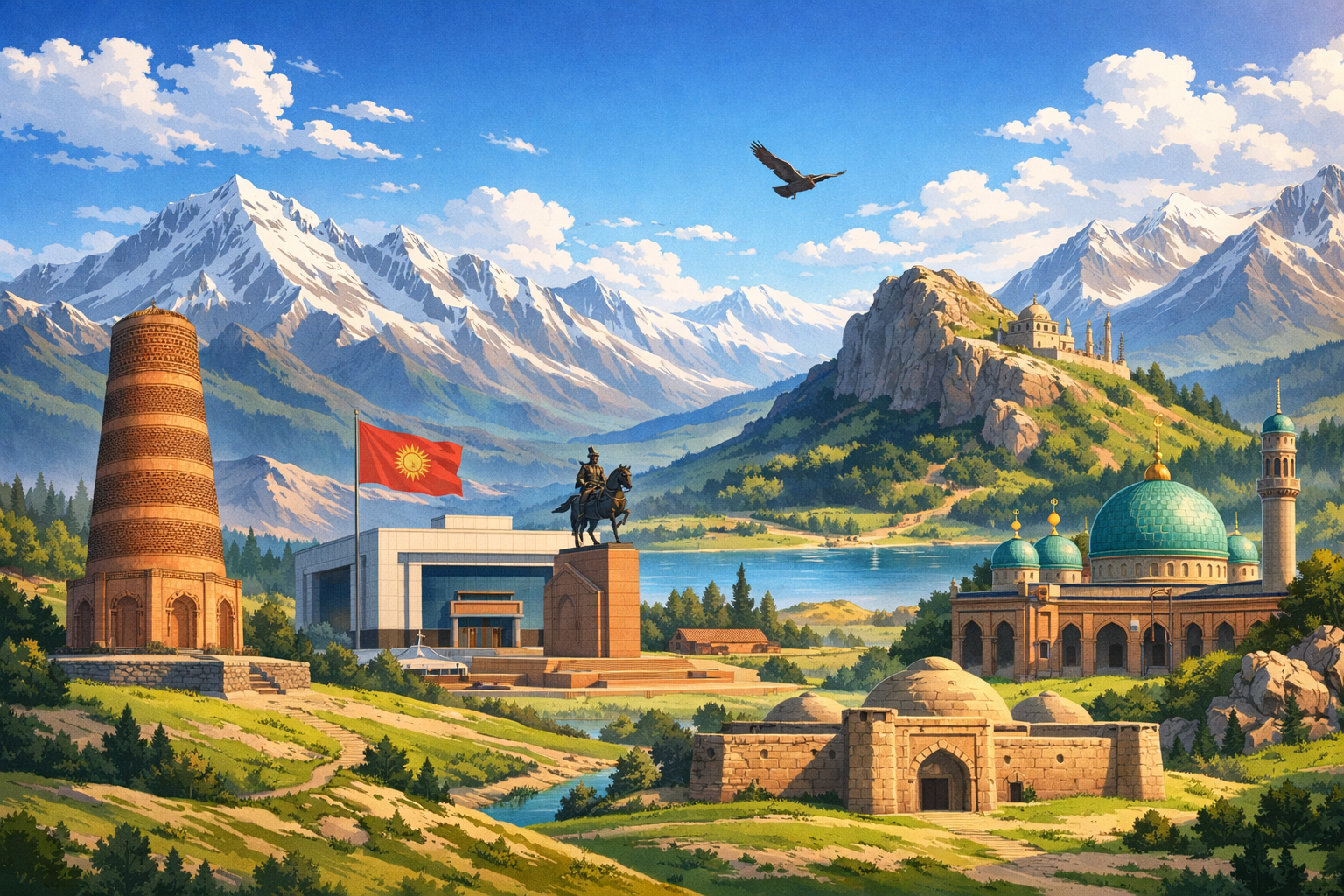
From leafy Bishkek, skirt Issyk-Kul’s shining shore at Cholpon-Ata and Karakol, then roll through Bokonbaevo and Kochkor to the yurt-dotted high pastures of Son-Kul. Follow the Silk Road to Naryn and the stone caravanserai of Tash-Rabat before looping back to the capital, trading boulevards for eagle hunters, alpine trails, and star-lit nights.

🧭 DAY-BY-DAY ITINERARY

Ready-made country and city routes with daily plans, sights, transport and accommodation. Buy PDF guides for independent travel.

🧭 DAY-BY-DAY ITINERARY


Day 1 — Bishkek: Ala‑Too and museums

  • 🚶 Bishkek’s center is compact and green: from Ala‑Too Square (a symbol of the country’s independence) axial views open onto the Kyrgyz Ala‑Too Range, and key buildings and museums stand around the perimeter. Drop by the State History Museum—its exhibits cover the history of nomadic tribes, khanates, and the Soviet period; then take a walk through the oak grove (Oak Park) and along Erkindik Boulevard. The Gapar Aitiev National Museum of Fine Arts holds a rare collection of nomadic ornaments, silk embroidery, birch-bark and felt works (shyrdak), as well as paintings from the Soviet and contemporary periods. To immerse yourself in the spirit of old Frunze, visit the M.V. Frunze Memorial House-Museum, with a late-19th-century wooden house “built into” the pavilion. At sunset, head to the lively Osh Bazaar: spices, dried fruit, samsa, and baklava fill the air with an eastern aroma—an ideal spot for a first foodie introduction to Kyrgyzstan.


Day 2 — Bishkek: Ala‑Archa National Park

  • 🚶 Ala‑Archa is an alpine national park 35–40 km south of the capital. It’s best to go in the morning: in 1 hour you move from city avenues to cedar and spruce gorges, where glacial rivers roar and granite walls of peaks hang over the valley. Basic route options: an easy riverside trail to the Ala‑Archa meadow; a more substantial trek to Ak‑Sai waterfall; for experienced hikers—a climb to the “Panorama Trail” with glacier views. Facilities at the entrance: park ticket office, parking, gazebos, and barbecue areas; deeper in begins pristine “wilderness.” Return to the city by the second half of the day—there will be time for dinner in local teahouses and a stroll along Chuy Avenue.

Day 3 — Transfer: Bishkek → Cholpon‑Ata (with a stop by Burana Tower)

  • 🚆 Transfer: Bishkek → Cholpon‑Ata along the north shore of Issyk‑Kul: ≈ 3.5–4.5 h by car (≈ 240–280 km; via Balykchy). Minibuses take 4.5–5 h.

  • 🚶 On the way, it’s worth taking a one-hour detour to Burana Tower—an 11th-century minaret on the site of the ancient city of Balasagun. Not tall, but striking, the tower bears traces of earthquake damage and is surrounded by stone balbal statues and the remnants of the settlement. Then continue to Issyk‑Kul: the ribbon of road runs between the northern spurs of the Tian Shan and the mirror of the “never-freezing” lake (the world’s second-largest high-mountain lake). Upon arrival in Cholpon‑Ata—an evening promenade, delicate juniper scents, and the first views of snowy ridges across the water.

Day 4 — Cholpon‑Ata: Rukh Ordo and Petroglyphs

  • 🚶 The “Rukh Ordo” cultural complex is an open-air museum right on the shore of Issyk‑Kul: five chapels of different faiths, a sculpture park, and exhibitions about traditions and history. In contrast to the modern complex, there is the “stone garden”—an open-air museum with two thousand petroglyphs (8th century BCE — 12th century CE). On the boulders are argali, snow leopards, hunting scenes; around them are burial mounds and stone circles. It’s ideal to come at golden hour: the carving relief comes alive in side light.

Day 5 — Transfer: Cholpon‑Ata → Karakol (north shore of Issyk‑Kul)

  • 🚆 Transfer: Cholpon‑Ata → Karakol: ≈ 2.5–3 h by car (≈ 140 km) along the shore via Tyup.

  • 🚶 Karakol is a cozy town with late-19th–early-20th-century wooden buildings and a multiethnic heritage. Must-sees: the Dungan Mosque (Chinese architecture without a single nail), the Holy Trinity Cathedral made of Tian Shan spruce, and the bazaar with the legendary “ashlyan-fu” (Dungan noodles). On the outskirts, by the Mikhailovka bay, is the N.M. Przhevalsky museum and memorial with a view of the eastern basin of Issyk‑Kul.

Day 6 — Karakol: museums and the historic center

  • 🚶 Start with the Karakol Historical Museum—here you’ll find the photo archive of traveler Ella Maillart, the everyday life of settlers, and nomadic artifacts. Then take an easy stroll through the old quarters: carved window frames, merchants’ mansions, atmospheric teahouses with samsa and lagman. In the second half of the day, drive out to the Przhevalsky memorial complex (about 9 km from the center) and walk through the conifer forest above the lake.

Day 7 — Around Karakol: Jety‑Oghuz and Barskoon

  • 🚐 Jety‑Oghuz is known for the red conglomerate cliffs “Seven Bulls” and “Broken Heart,” a resort with thermal springs and piercingly green meadows. It’s easy to combine viewpoints with short trails here. For more advanced travelers—go up the valley to the Barskoon waterfalls along a road that once led to a strategic pass; the cascades hide in a conifer forest, and the high-mountain views remind you how close the Tian Shan glaciers are.

Day 8 — Karakol: Altyn‑Arashan, hot springs and a relaxation day

  • 🚶 Altyn‑Arashan is a mountain valley with a series of hot springs and views of snowy peaks. The road is technical (only a 4×4 with a driver) or you can hike; on site there are wooden baths, small hut saunas, meadows, and a river. The best plan is to arrive by midday, alternate soaking and walking, return to Karakol before dusk, and end the day with dinner of Dungan and Uyghur dishes.

Day 9 — Transfer: Karakol → Bokonbaevo (south shore) + “Skazka” Canyon

  • 🚆 Transfer: Karakol → Bokonbaevo: ≈ 3–4 h by car along the south shore (via Tamga/Tosor).

  • 🚶 On the way—“Skazka” (Fairy Tale) Canyon: bright clay-and-sand ridges and whimsical “castles.” A short trail from the highway leads to the panorama; it’s hot in summer—bring water and a hat. In Bokonbaevo you can arrange a demonstration of eagle hunting with a golden eagle (ethically—as a reenactment of the tradition without prey) and stay in an ethno yurt camp by the lake’s edge.

Day 10 — South Issyk‑Kul at an unhurried pace

  • 🚶 A “slow” day: a morning swim on a wild beach, a picnic with views of the Teskey Ala‑Too, then clay workshops and souvenirs from local cooperatives (felt, wool felt, carving). Toward evening—a short outing to a small salty lake or to tracts with hot springs (on the advice of CBT Bokonbaevo locally).

Day 11 — Transfer: Bokonbaevo → Kochkor → ascent to Song-Kul

  • 🚆 Transfer: Bokonbaevo → Kochkor: ≈ 2–2.5 h by car. Then—departure to Song-Kul (yurt camps at 3016 m): via the Tuz-Ashuu pass from the Kyzart side or the Kalmak-Ashuu pass from the Kochkor side, depending on road conditions. In a 4×4 the ascent usually takes 2–3 h from Kochkor/Kyzart; in the shoulder seasons restrictions are possible.

  • 🚶 Evening at Song-Kul is the magic of the high-mountain plateau: flocks of partridges, cloud shadows, a starry sky with no light pollution. Yurt camps offer dinner made from local products and warm blankets; nights are cool even in summer.

Day 12 — Song-Kul: nomadic heritage and transfer to Naryn

  • 🚶 Morning at the lake: a horseback ride across the jailoo (summer pastures), getting acquainted with nomads’ daily life—felting, milking mares and kumis. After lunch—descent to Naryn via a high-mountain pass (roads are seasonally open): views of stark plateaus and canyons of the central Tien Shan. By evening—check-in at a hotel and a walk along the Naryn River embankment.

Day 13 — Naryn: trip to the Tash-Rabat caravanserai

  • 🚆 Transfer: Naryn → Tash-Rabat: ≈ 2–3 h one way (≈ 110–120 km). Asphalt to the turnoff into the Kara-Koyun valley, then a graded road to the caravanserai at 3200 m; in bad weather the road may be restricted.

  • 🚶 Tash-Rabat is one of the most impressive monuments of the Great Silk Road: a stone caravanserai of the 10th–15th centuries with a domed hall and vaulted cells, hidden in a harsh mountain valley. An atmosphere of “beyond the edge of the inhabited world”: wind, feather grass, high-mountain clouds. Returning to Naryn, arrange an early dinner and pack for the transfer.

Day 14 — Transfer: Naryn → Bishkek

  • 🚆 Transfer: Naryn → Bishkek: ≈ 4.5–5.5 h by car (depending on the pass and weather). Upon arrival—a final stroll along Erkindik and souvenirs (felt wall panels, cedar products, honey).

Flight tickets

eSIM for travel

Buy PDF guide

Buy PDF guide — 29.99 USD

PDF — 29.99 USD