
Buy PDF guide

Buy PDF guide — 6.43 USD

PDF — 6.43 USD

Corfu - Old Town, fortresses, promenade, cafés, island atmosphere

Corfu - Old Town, fortresses, promenade, cafés, island atmosphere

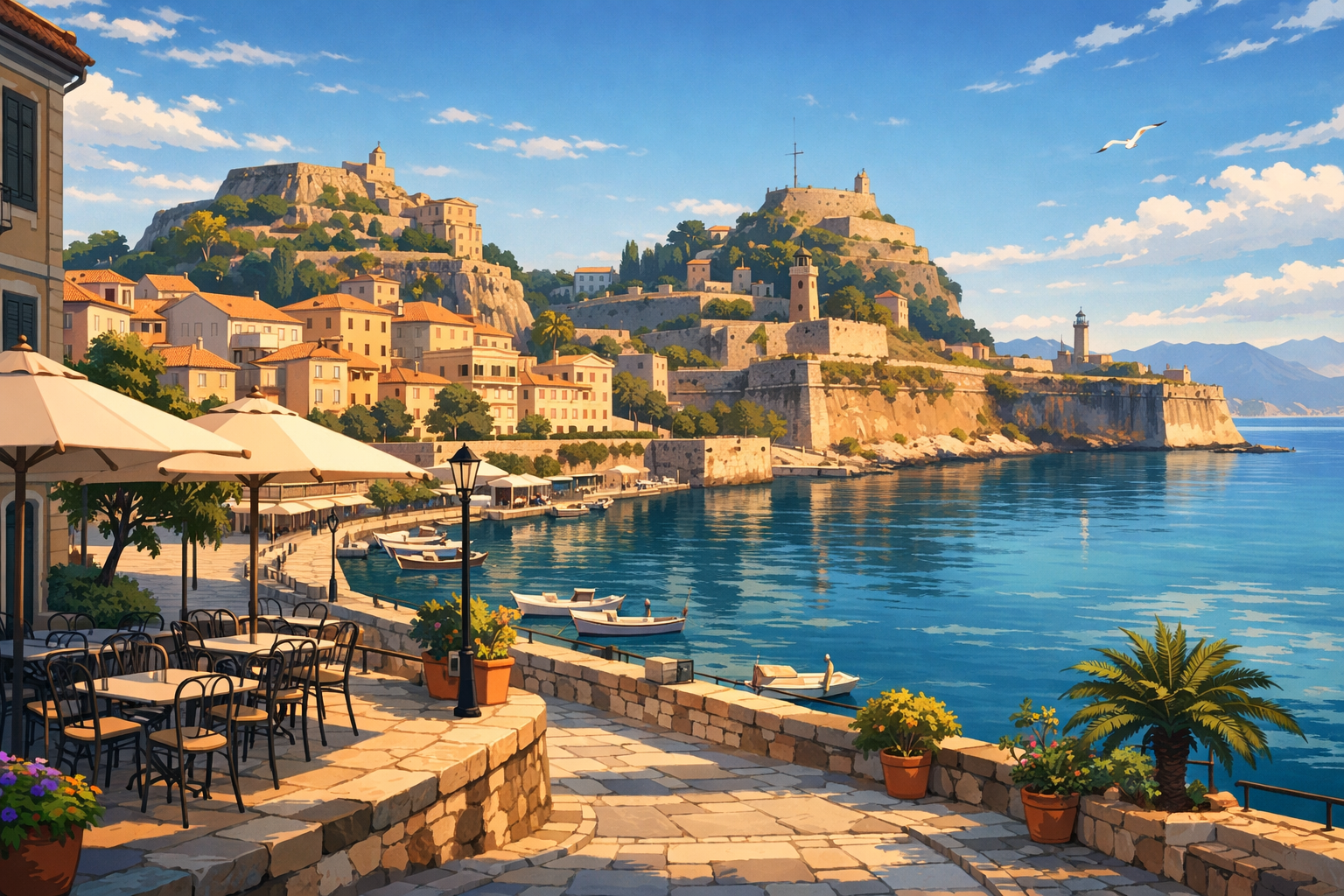
Corfu charms with its atmospheric Old Town, where Venetian fortresses rise above winding streets full of character. Stroll along the waterfront promenade, linger at a café in the warm sea breeze, and soak up the island’s relaxed, elegant feel.

🧭 DAY-BY-DAY ITINERARY

Ready-made country and city routes with daily plans, sights, transport and accommodation. Buy PDF guides for independent travel.

🧭 DAY-BY-DAY ITINERARY


Day 1 — Corfu: Old Town, Liston, Spianada, and the evening waterfront

  • 🚕 The trip from Corfu Airport to the Old Town usually takes about 10–15 minutes by taxi without serious traffic. If you want to save money, city bus line 15 connects the airport, the San Rocco area in the center, the intercity bus station, and the port, so for staying in Kerkyra this is the most practical public option. After check-in, it’s better not to overload the first day: Corfu is beautiful precisely at a slow pace, when narrow streets, the smell of salt, shutters on pastel houses, and the shimmer of the sea come together into that very island atmosphere people travel here for.

  • 🚶 Corfu Old Town is a rare place where Mediterranean lightness meets real historical depth. The city is included on the UNESCO World Heritage List: its layout, arcades, dense network of narrow “kantounia,” Venetian facades, French urban touches, and British squares create the feeling that you are walking through a Greek island, Italy, and an old Ionian port all at once. Start the route with an unhurried walk without a strict goal: here it is important to allow yourself to get lost among the lanes of Campiello, small courtyards, laundry overhead, shady stairways, and tiny shops. Old Corfu is not so much “seen” as experienced step by step.

  • ☕ An essential part of the first day is Liston and Spianada Square. Liston, with its arcades and cafés under the columns, is considered one of the most recognizable urban scenes on the island: it’s pleasant to pause here for coffee, a late breakfast, or an aperitif while watching the rhythm of the city. And right opposite opens up Spianada — a huge elegant square that gives air and light space after the tight streets. This contrast is especially good in Corfu: just a few minutes ago you were walking through stone passages between house walls, and then you step out to an open horizon, lawns, palm trees, and views of fortress silhouettes. It is here that the resort-like, maritime, slightly aristocratic soul of Kerkyra is felt most strongly.

  • 🏛️ In the second half of the day, it is convenient to visit the Palace of St. Michael and St. George, home to the Museum of Asian Art. Even if you do not plan to spend long in the galleries, the location itself is magnificent: a monumental building at the edge of Spianada, next to the sea and bastions, fits perfectly into the walk. If you do go inside, it makes for a beautiful cultural highlight of the day — an unusual museum for an island, with collections of Asian art that offer a break from the sun and add substance to the route.

  • 🌊 Closer to sunset, head to the waterfront by the Old Fortress and the sea views along Garitsa Bay or to the Faliraki area at the northern edge of the Old Town. Here the soft Corfiot island character is especially easy to feel: boats on the water, warm wind, light on stone, unhurried conversations at tables by the water. The evening is best finished in a café or small taverna in the Old Town — slowly, with pauses, so that Corfu reveals itself not as a set of sights, but as a living island city with a very beautiful pace of life.


Day 2 — Corfu: Old Fortress, sea views, museum highlights, and atmospheric cafés

  • 🚶 The morning of the second day is best devoted to Corfu’s Old Fortress. From Liston and Spianada it is only a short walk here, usually about 10–15 minutes on foot, and the approach to the entrance is already impressive: a bridge, open space, stone walls, and the feeling that before you is not a museum object but a real guard post at the edge of the sea. The Old Fortress is one of the keys to understanding Corfu: it was precisely the system of fortifications and the strategic position at the entrance to the Adriatic that made the city so important to the Venetian world and the entire eastern Mediterranean.

  • 🏰 Inside the fortress, it is worth allowing at least 2–3 hours, including the climb, photo stops, and rest. This is not a place to “dash in and out”: here it matters to climb slowly along the terraces, look at the sea, the line of the Old Town, the red roofs, bell towers, the palace, and Spianada Square. The higher you climb, the more the perception of the city changes: from below Corfu seems cozy and intimate, and from above it suddenly becomes clear how carefully it was designed as a fortified port. The best part of the Old Fortress is not only the walls and bastions, but also the panorama, where sea, city, and stone come together in an almost theatrical picture.

  • ☕ After the fortress, be sure to take a long break for coffee or a light lunch near Spianada or on a street with a view of the city arcades. Corfu does not require haste: after the climb in the heat and the viewpoints, it is better to give yourself 1–1.5 hours to rest. This rhythm makes the route more comfortable and realistic, especially in summer. The city has many pleasant places for coffee, desserts, and late breakfast, and the atmosphere of Liston and the neighboring streets is ideal precisely for sitting longer than you planned.

  • 🏛️ In the second half of the day, you can choose one of the museum highlights depending on your interests. If you want an intimate and more spiritual atmosphere, the Byzantine Museum of Antivouniotissa in the northern part of the Old Town is a good choice, hidden among old streets and closer to the historic fabric of the quarters. If archaeology and the island’s ancient past are more interesting, it is worth going or walking to the Archaeological Museum of Corfu. And if you want something small but unusual, the Banknote Museum in Agios Spyridon Square makes an excellent short stop that is easy to combine with a walk through the center.

  • 🌅 The sunset of the second day is best met by the water again, but with a different mood: walk along the shoreline from the Old Fortress, linger at the viewpoints, and then return to the old quarters for an evening coffee, cocktail, or dinner. At night Corfu is especially beautiful: the warm stone of the walls, the yellowish light of lanterns, the almost Venetian texture of the lanes, and the soft hum of a resort town create that very “island romance” that is hard to reproduce anywhere else.

Day 3 — Corfu: New Fortress, old port, Mon Repos, and a finale with a maritime mood

  • 🚶 Start the third day with the New Fortress, which rises above the northwestern part of the Old Town, over the old port area. From the central quarters of Kerkyra it is usually about a 15–20 minute walk here, but the climb is noticeable in places, so it is better to start in the morning while it is not too hot. The New Fortress feels different from the Old one: it is less “postcard-perfect,” but more austere, massive, and truly military in character. Arcades, passages, stone vaults, and viewpoints create the impression of a powerful defensive machine built into the city’s terrain.

  • 🏰 It is reasonable to allow 1.5–2 hours for visiting the New Fortress. From here there are wonderful views of the old port, the roofs of Kerkyra, domes and towers, as well as the line of the sea around the city. After the Old Fortress, it is here that the defensive logic of Corfu is especially easy to read: the city seems squeezed between bastions and the sea, yet it does not look heavy — on the contrary, it is surprisingly bright, lively, and cozy. This combination of fortress history and a light resort atmosphere is what makes Corfu unique.

  • ⚓ After the fortress, head down toward the old port and walk along the waterfront stretches in the northern part of the city. This is a less ceremonial but very real Corfu: a fishing rhythm, boats, working maritime life, views of the walls, light on the water. Here the route becomes more “local” and less postcard-like, which is especially pleasant on the final day. For lunch, it is worth choosing a café or taverna with a maritime mood, without haste, planning for a long stop and rest.

  • 🌿 In the second half of the day, if you want to step away a little from the dense urban fabric, head to the Mon Repos area. By taxi it is usually about 10 minutes from the center, on foot about 30–40 minutes at an easy pace, depending on the starting point. This is a good finale for the route: a palace-and-park zone, greenery, ancient layers of history, proximity to the sea, and a more relaxed mood. Even the road toward Mon Repos is pleasant, because the cityscape gradually changes: from bastions and lanes to more open, coastal, and green landscapes.

  • ☕ The final hours of the trip are best spent by the water — in the Anemomilos area, Garitsa Bay, or back in the center if you want to say goodbye to the Old Town. The last evening in Corfu should be very simple in meaning: sea, light, coffee or a glass of wine, a slow walk along the waterfront, and one more loop through your favorite streets. In three days, Corfu does not need to be “done completely”; its task is to leave an aftertaste. And if the route is planned well, what will remain in memory will be not only the fortresses and squares, but also a special Ionian softness, where history here sounds not solemn, but light, salty, and beautiful.

Flight tickets

eSIM for travel

Buy PDF guide

Buy PDF guide — 6.43 USD

PDF — 6.43 USD