
Day 1 — Transfer from Sofia and first introduction to Koprivshtitsa
🚆 The best start is to leave Sofia in the morning. If you are traveling by public transport, the most convenient option is to first take a train to Koprivshtitsa railway station and then transfer to a taxi or a pre-booked transfer to the town itself: the station is not in the historic center, so it is best to allow separate time for the final stretch. The whole trip from Sofia to the center of Koprivshtitsa usually takes about 2.5–3.5 hours depending on the train + transfer combination or a car journey. By car, the route is realistic to plan at about 2–2.5 hours without long stops; it is better not to leave too late so you do not lose daylight on the winding roads and check-in.
🏨 After arrival, leave your things at the hotel and do not try to “complete” all the museums at once. Koprivshtitsa reveals itself best slowly: this is not a town for racing through a checklist, but a rare place where the very fabric of the streets already works like an open-air museum. Give yourself 45–60 minutes for a calm lunch and a short rest after the road, especially if you came from the airport or after an early departure from Sofia.
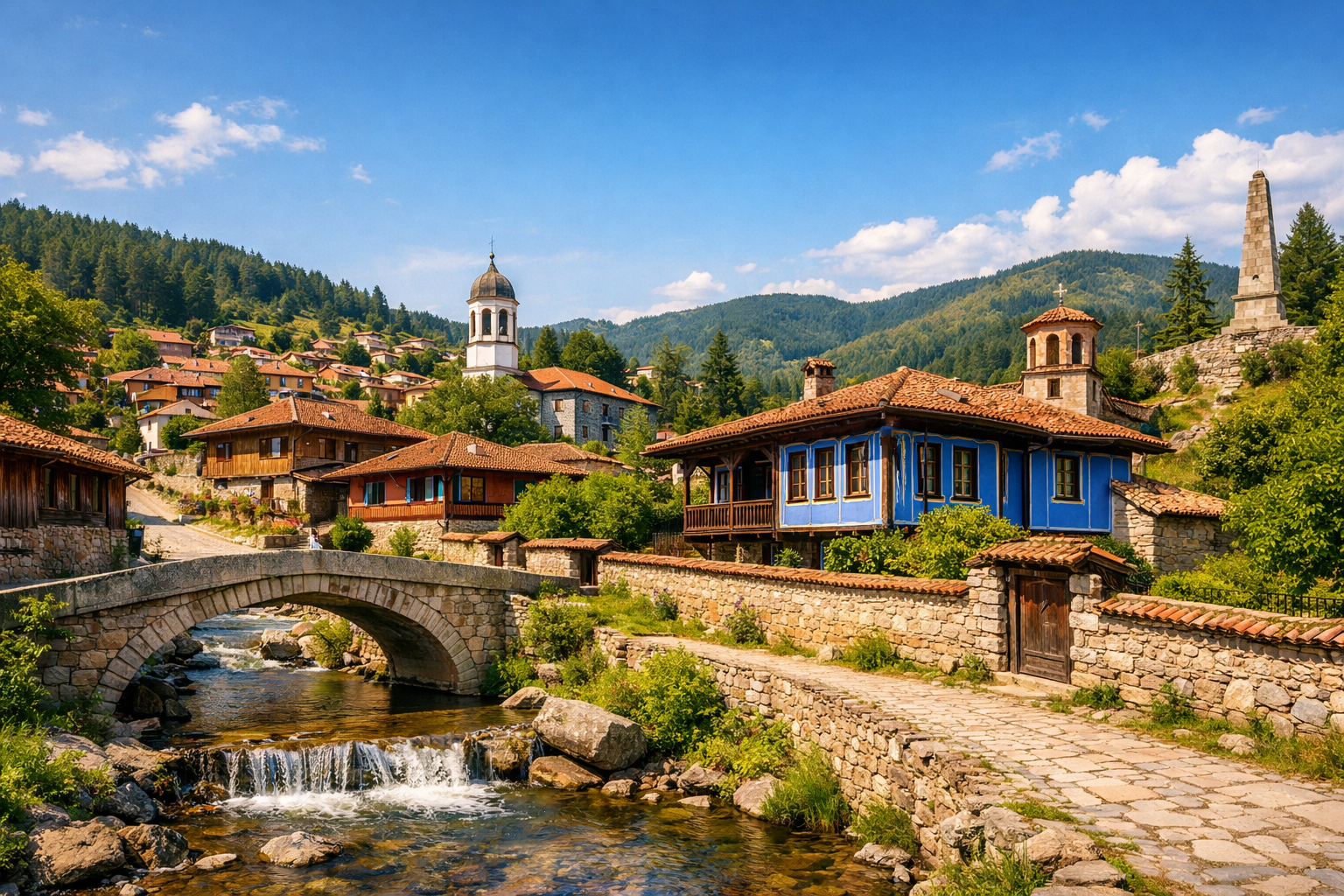
🚶 It makes sense to build your first walk around the very center of the old town: stone bridges across the Topolnitsa, cobbled streets, bright house facades with carved verandas and characteristic bay windows. Koprivshtitsa is one of the most complete images of the Bulgarian Revival: here it is not just individual “picture-postcard” houses, but an entire environment where architecture, relief, gardens, wooden gates, and mountain slopes come together into an almost theatrical 19th-century setting. Already in the first hour in town, you get the feeling that time moves more slowly here: you can hear the water, smell wood and grass, and the colorful house walls look especially expressive against the greenery of the hills.
🏛️ For the first half of the day after check-in, it is best to choose 2 key house museums so as not to overload your impressions. Start with the Todor Kableshkov House Museum — one of the symbols of the town and an essential place for understanding the April Uprising. Then move on to Lyutova House: this shifts the focus to something different — not so much revolutionary history as the elegance of everyday life, decorative painting, wood, textiles, and the refined taste of a wealthy Koprivshtitsa household in the mid-19th century. It is easy to move between the museums on foot; within the historic part of town, allow 10–15 minutes for walking between them, and around 30–50 minutes to explore each house at a relaxed pace.
🌄 Toward evening, head up toward the Georgi Benkovski monument and the viewpoints on the hill. This is a very fitting end to the first day: after interiors and historical narratives, the town suddenly opens up as a whole — with multicolored houses, the river valley, roofs, gardens, and the soft lines of Sredna Gora. At sunset, Koprivshtitsa is especially beautiful: the light falls on the facades in a warm golden layer, and the quiet streets begin to feel even more intimate. After the walk, leave the evening free for an unhurried dinner and an early rest: a 2-day route here benefits not from the number of stops, but from the right rhythm.