
Buy PDF guide

Buy PDF guide — 6.43 USD

PDF — 6.43 USD

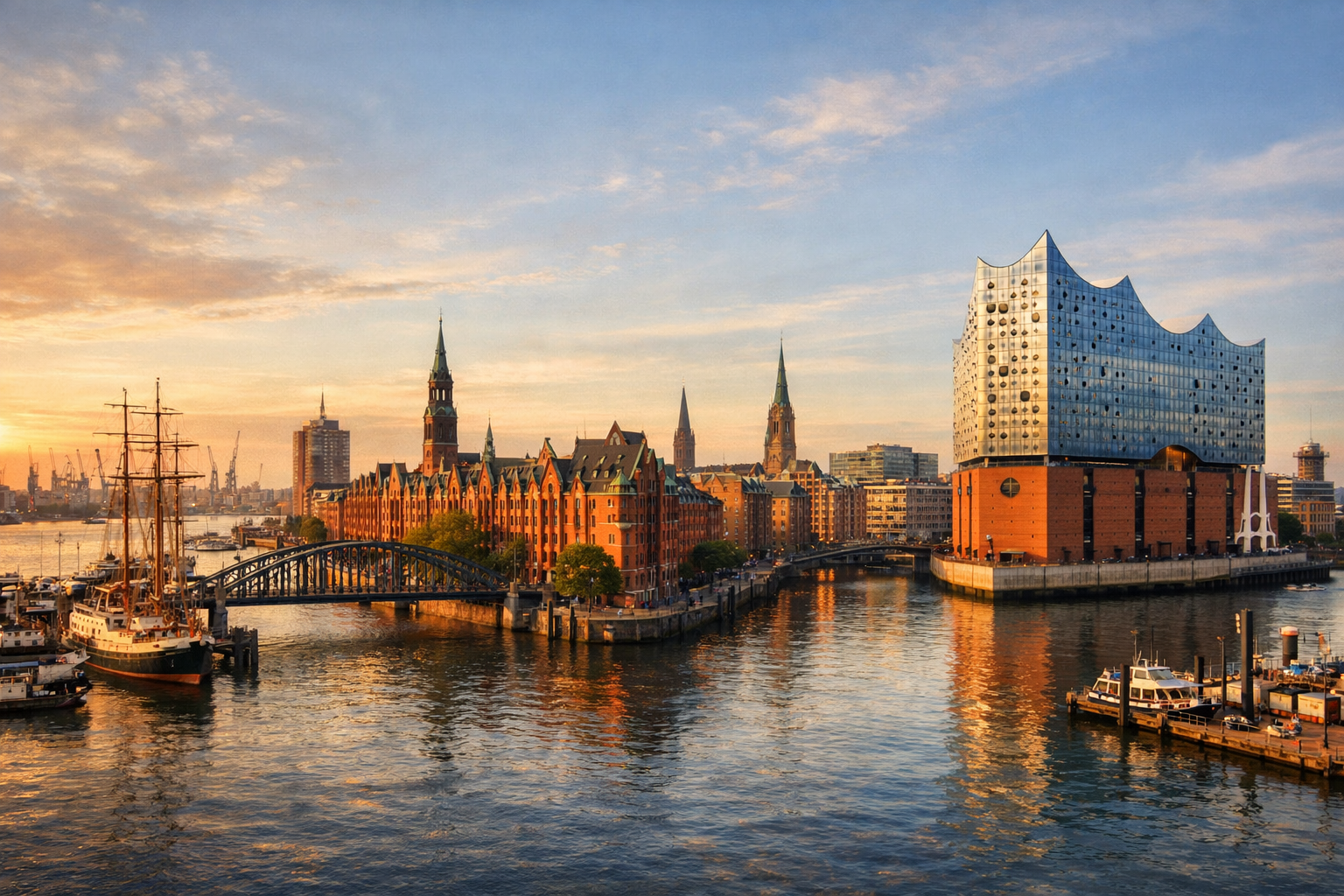
Classic Hamburg Port Elbe Philharmonic Hall Speicherstadt

Classic Hamburg Port Elbe Philharmonic Hall Speicherstadt

Discover Hamburg where the busy harbor sets the rhythm of the city and the striking Elbphilharmonie rises above the waterfront. Wander on into the red-brick canals of Speicherstadt, where maritime history and modern elegance meet.

🧭 DAY-BY-DAY ITINERARY

Ready-made country and city routes with daily plans, sights, transport and accommodation. Buy PDF guides for independent travel.

🧭 DAY-BY-DAY ITINERARY


Day 1 — Hamburg: harbor, waterfronts, and the Elbe

  • 🚆 Arrival in Hamburg and transfer from the airport to the center: take the S1 suburban train to Hamburg Hauptbahnhof for about 25 minutes, then another roughly 10–15 minutes by U-Bahn, bus, or taxi to the HafenCity / Elbphilharmonie area. If you are checking into a hotel by the Elbe, allow extra time for walking with luggage and getting oriented — in total, from the terminal to the hotel it is usually reasonable to count on about 50–70 minutes.

  • 🚶 It is best to dedicate the first day to the very feeling of Hamburg as a great port city. Start with the Landungsbrücken area — one of the liveliest and most cinematic parts of the city, where the Elbe opens up as a broad, windy, constantly moving stage. Here you hear ship signals, see HVV ferries, tourist boats, tugboats, and sightseeing vessels, and along the piers you can feel that special North German rhythm in which the sea, trade, and everyday urban life are inseparable. Even a simple walk along the promenade makes it clear why Hamburg was Germany’s gateway to the world for centuries: water here is not a backdrop, but the main force shaping the city’s architecture, character, and mood.

  • ⛴️ From Landungsbrücken, it is convenient to take a short ride on a public HVV ferry or a harbor sightseeing boat. For a first introduction, this is an especially good choice: from the water, Hamburg feels completely different than it does from the streets. Before your eyes pass docks, terminals, old port structures, and the new HafenCity districts, while the famous Elbphilharmonie gradually rises like a glass crest above the brick base of a former warehouse. For this outing, including boarding and waiting time, it is worth allowing about 1–1.5 hours so you do not have to rush and can calmly enjoy the views.

  • 🚶 After the water portion, head to the Elbphilharmonie. The walk from Landungsbrücken to Elbphilharmonie takes about 20–25 minutes at a comfortable pace along the water. Elbphilharmonie is not just a concert hall, but a modern symbol of Hamburg, where the city’s industrial past is joined with its cultural ambitions. The massive brick base recalls the port memory of the place, while the glass wave-like structure above seems to continue the movement of river and air. Even if you are not going to a concert, visiting the building itself is already a distinct experience: the long curved escalator, the dramatic ascent toward the light, and the exit onto the Plaza all work almost like a theatrical prelude to meeting the city.

  • 🌆 Be sure to linger longer on the Elbphilharmonie Plaza. From here, a panoramic view opens onto the Elbe, HafenCity, the towers of the center, and the red-brick masses of Speicherstadt. It is better to allow not just 15 minutes “for the record,” but at least 45–60 minutes with extra time for entry, photos, and a coffee break. This moment is especially beautiful closer to evening, when the light softens, the glass facades begin to reflect the sky, and the harbor gradually lights up. If you manage to be here during golden hour, you will see one of the most expressive urban panoramas in Northern Europe.

  • 💤 Keep the evening calm: dinner in HafenCity or a return to the Elbe promenade without long transfers. After the journey and a full first day, it is better not to overload the route. From Elbphilharmonie to most of the recommended hotels in this area, it is a 3–15 minute walk, which makes the district an ideal base for a short and realistic three-day tour.


Day 2 — Hamburg: Speicherstadt and a museum day

  • 🚶 Dedicate the second day to Speicherstadt — the legendary warehouse district that, together with Kontorhausviertel, is part of the UNESCO World Heritage list. This is not just a beautiful historic area, but a rare example of how utilitarian trade infrastructure turned into one of the most atmospheric urban spaces in Europe. Red brick, narrow canals, bridges, towers, gates, reflections in dark water, and the almost theatrical perspective of the streets create the feeling that you have stepped inside an old engraving brought to life in a modern city. Morning is the best time for a walk: fewer people, softer light, and a stronger sense of the stern elegance of port architecture.

  • 🚶 From the Elbphilharmonie area to the central part of Speicherstadt, it is only about a 10–20 minute walk, depending on the entry point you choose. This makes the route very convenient: no metro, no extra transfers, short walks, and the option to pause at a café at any moment. As you walk along the canals, be sure to notice not only the facades but also the scale: the warehouse buildings were constructed as true machines of trade, and even in their beauty you can always feel their practical origin.

  • 🏛️ The main stop of the day for most travelers is Miniatur Wunderland. Even if you are usually indifferent to model displays, this place can surprise you: here the miniature world has been turned into an incredibly complex technical and almost cinematic attraction. Trains, airports, cities, mountains, lighting, moving cars, and thousands of tiny scenes and details create an effect in which adults quickly forget that they came “just to look at models.” It is sensible to allow at least 2.5–3 hours for the visit, and preferably about 4 hours including queues, breaks, and the fact that it is easy to stay longer than planned.

  • ⚓ After lunch, the International Maritime Museum Hamburg works perfectly, located in the historic Kaispeicher B. It is a very logical continuation of the city’s theme: after the living harbor and warehouse district, you enter a space where the history of seafaring, navigation, shipbuilding, and distant expeditions unfolds as a great human saga. Nine exhibition decks make the visit feel not monotonous but gradually unfolding: from the age of sails and maps to technology, naval fleets, cargo, and oceanic research. Even without covering the entire museum, 1.5–2.5 hours here gives deep context that helps you see Hamburg itself in a new way.

  • ☕ Toward evening, leave time for an unhurried walk along the canals of Speicherstadt without the goal of “seeing everything.” It is precisely at dusk that the district becomes especially photogenic: the brick facades grow warmer, the water darkens, the bridges and windows begin to glow, and the city around you seems to slow its pace. If you still have energy, you can add a short visit to the Deutsches Zollmuseum — it complements the themes of trade, borders, and port logistics well, but on a short tour it is better viewed as an option rather than a must.

  • 💤 Returning to the hotel on this day is again convenient on foot. Most walks between Elbphilharmonie, Speicherstadt, and the museums fit within 10–25 minutes, so the route turns out full but without exhausting transport strain. This is exactly that rare city day when the cultural program feels dense, yet physically remains very comfortable.

Day 3 — Hamburg: HafenCity, the center, and a final flourish

  • 🚶 The third day is best arranged more gently: no rushing, a beautiful finale, and enough time for the flight. Start the morning in HafenCity — a modern district that shows how former port areas can be transformed into an architecturally ambitious and comfortable urban environment. Here you will find broad promenades, neat public spaces, new residential and cultural buildings, terraces by the water, and a sense of open air. Unlike the dramatic and almost fairy-tale Speicherstadt, HafenCity feels calmer, brighter, and more modern, but it is precisely in this contrast that Hamburg’s richness becomes clear.

  • 🚶 Then you can walk toward the center, taking a short route across the bridges to Rathaus and the inner quarters of the city. The walk from HafenCity to the central streets usually takes about 20–30 minutes on foot. Along the way, it is especially pleasant to watch how port Hamburg gradually turns into a more classic urban landscape with shopping streets, squares, and civic architecture. If you want to add some greenery, a good option is Planten un Blomen — a large city park that is easy to reach by U-Bahn or partly on foot with a short combined ride.

  • 🏛️ For a final museum highlight, Hamburger Kunsthalle is an excellent choice. It is one of Germany’s most important art museums, and it gives the route a different, quieter, more contemplative note after the harbor, water, and industrial aesthetics. The collection spans many eras, so even a short 1.5–2 hour visit can become a full cultural event. What is especially valuable is that Kunsthalle is located near Hauptbahnhof: this is also convenient from a logistics perspective if you plan to stop by the hotel for your things after the walk and then head to the airport.

  • 🍽️ For lunch or an early dinner, it is best to return closer to the water — to HafenCity or the Elbphilharmonie area. A finale by the Elbe works almost perfectly: after three days, the district already feels familiar, and the final return here gives a sense of completion to the route. You can head back toward the promenade once more, walk along Kaiserkai, or simply sit by the water watching the city continue in its maritime rhythm.

  • 🚆 Departure for the airport: if you are starting from the Elbphilharmonie / Speicherstadt area, it is usually worth allowing about 45–60 minutes to Hamburg Airport without a large buffer, and about 75–90 minutes in a more cautious scenario with transfer time, waiting, and luggage. In practice, the most convenient route is usually via Hamburg Hauptbahnhof or Jungfernstieg and then onto the S1. For a short trip around Hamburg, this is one of the most pleasant formats: you spend almost no time on long transfers, and the three days come together as a coherent route centered on water, brick-built history, and modern architecture.

Flight tickets

eSIM for travel

Buy PDF guide

Buy PDF guide — 6.43 USD

PDF — 6.43 USD