
Buy PDF guide

Buy PDF guide — 29.99 USD

PDF — 29.99 USD

CHINA

CHINA

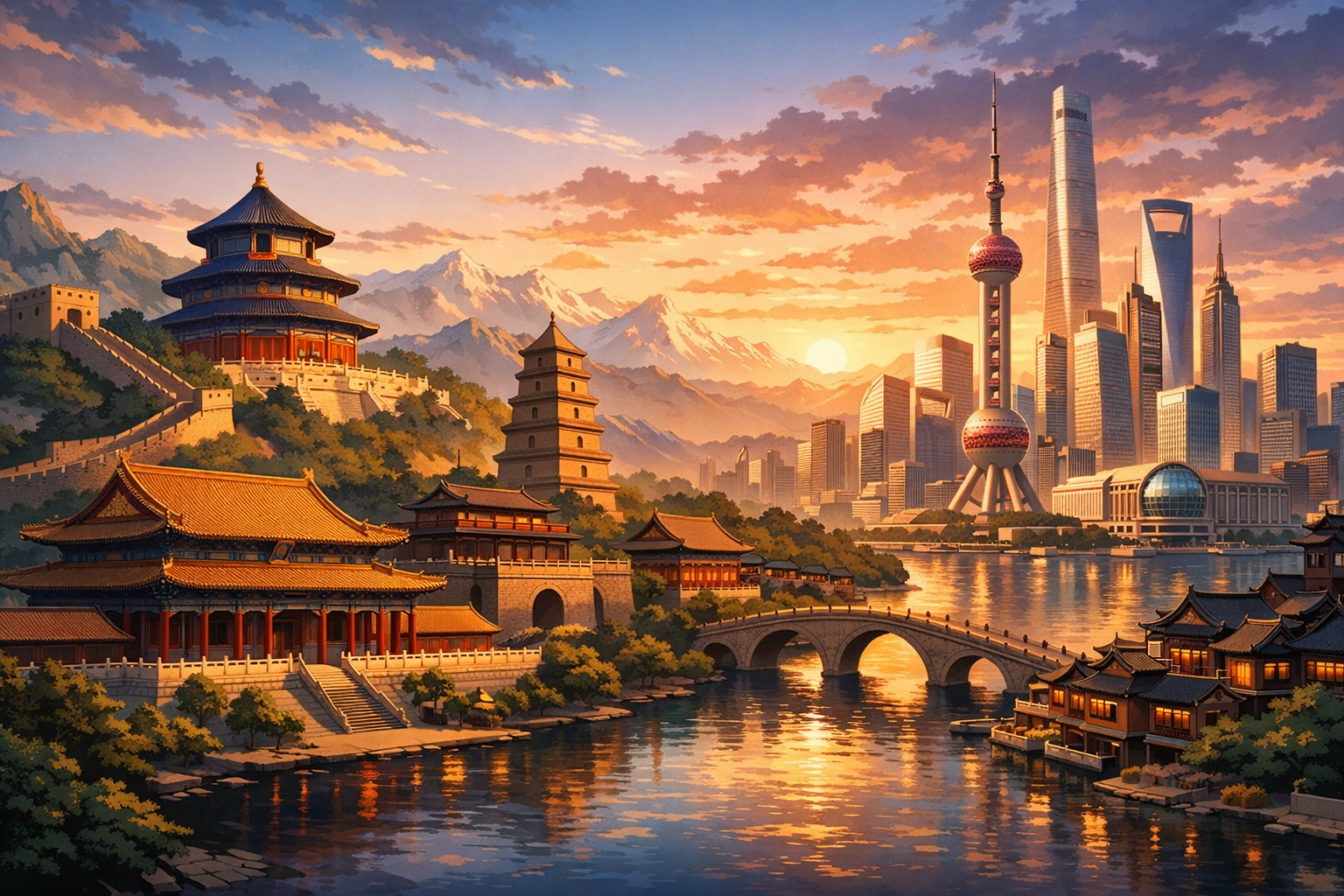
Start in Beijing among imperial palaces and the Great Wall, stand before Xi’an’s Terracotta Army, then glide into Shanghai’s glittering skyline along the Bund. China fuses timeless tradition with electric modernity on a single, unforgettable route.

🧭 DAY-BY-DAY ITINERARY

Ready-made country and city routes with daily plans, sights, transport and accommodation. Buy PDF guides for independent travel.

🧭 DAY-BY-DAY ITINERARY


Day 1 — Beijing: Tiananmen, the Forbidden City, and the panorama from Jingshan

  • 🚶 Start in the heart of Beijing—Tiananmen Square. Pass through the Meridian Gate into the Forbidden City—the former imperial palace of the Ming and Qing, now the richest open-air museum. Red walls, jade lions, carved dragons on the gutters, and golden roofs line up along an axis that runs toward Jingshan Park. Take your time: the Hall of Supreme Harmony, the treasure galleries, and the Clock Pavilion convey the scale of the empire. Exit through the North Gate straight into Jingshan Park: climb “Coal Hill”—from here you get a perfect panorama of the entire palace complex and the old neighborhoods. The atmosphere changes at dusk: city lights flare up, and the palace roofs recede into a warm haze.


Day 2 — Beijing: Temple of Heaven and old hutongs

  • 🚶 Morning at the Temple of Heaven is the best way to feel the city’s rhythm: under the blue-tiled roofs of the Qinian Dian Hall (Hall of Prayer for Good Harvests), locals practice tai chi, play jianzi, and sing in choirs. The geometry of the paths, cypresses, and perfectly circular layout create a sense of calm. Afterward, head to the hutongs around Nanluoguxiang and to the Drum/Bell Towers: teahouses and tiny eateries hide behind gray gates with carved doorframes. Peek into siheyuan courtyards to see how timeless everyday life coexists with new coffee shops and craft boutiques.

Day 3 — Beijing: the Summer Palace on Kunming Lake

  • 🚶 The Summer Palace is the quintessence of Chinese garden-and-park art: pagodas on hills, a long covered corridor with thousands of paintings, cool shade, and views over Kunming Lake. Walk across the Seventeen-Arch Bridge, stop by the Garden of Virtue and Harmony, and climb to the Tower of Buddhist Incense for a panorama of green hills. Back in the center, end the day with an unhurried stroll around Beihai or dinner in the Wangfujing area with a tasting of Peking duck.

Day 4 — Beijing: the Great Wall of China (Mutianyu)

  • 🚶 The Mutianyu section is a scenic, well-maintained, and less crowded option of the Wall. Battlements and watchtowers rise over the ridge and then disappear into oak and pine forests. Take the chairlift or cable car up to towers 14–23, walk along the crest with spectacular views, and ride the toboggan down—childlike joy guaranteed. Returning to the city by evening leaves time for a tea ceremony or a relaxing foot massage.

Day 5 — Beijing: the National Museum of China and modern Beijing

  • 🚶 The National Museum of China on the east side of Tiananmen is an ideal “through-line” route across history: from ancient bronzes to jade ornaments and porcelain. Afterward, head to the CBD business district: glass towers, the CCTV building’s arch, galleries, and parks beneath skyscrapers show the contrast of modern Beijing. At sunset—go to Jingshan Park or the Houhai lakes: lantern lights reflect in the water, and the sound of the erhu dissolves into the evening air.

Day 6 — Transfer Beijing → Xi'an and the Xi'an City Wall in the evening

  • 🚆 Transfer: Beijing (Beijing West/北京西) → Xi'an (Xi'an North/西安北) by G high-speed train: ≈ 4h 20m–6h 40m depending on the service; the fastest trains (e.g., G87) make minimal stops. Tickets open in advance; e-boarding with a passport is convenient.

  • 🚶 In Xi'an, check in and head to the South Gate (Yongningmen/永宁门) of the ancient city wall: sunset colors on the stone and soft lighting on the towers create a rare atmosphere. Bicycle rental lets you ride part of the wall or take a short romantic walk along the parapet with views of streetlamps and red lanterns.

Day 7 — Xi'an: the Terracotta Army and the Huaqing Palace Hot Springs

  • 🚶 The Terracotta Army is a 20th-century archaeological discovery that transformed our understanding of ancient China: in enormous pavilions, open excavations reveal ranks of warriors, horses, and chariots, each figure with unique features. Afterward—Huaqing Hot Springs at the foot of Mount Lishan: gardens, pavilions, and legends of Yang Guifei. Back in the city, try a tasting of Xi'an dumplings or biang-biang noodles in a traditional style.

Day 8 — Xi'an: Shaanxi History Museum and the Giant Wild Goose Pagoda

  • 🚶 The Shaanxi History Museum is one of the country’s strongest regional museums: polychrome Tang pottery, jade items, and Zhou-era relics. Then head to the Giant Wild Goose Pagoda: the temple ensemble, carillons, the promenade, and musical fountains on the square at dusk fill the space with light and sound.

Day 9 — Xi'an: the Muslim Quarter and Beilin (Stele Forest)

  • 🚶 In the morning—visit the Great Mosque on Huajue Lane: an amazing blend of Islamic tradition and Chinese architecture with gardens, arches, and carved pavilions. Next—wander the streets and alleys of the Muslim Quarter: sesame halva, roujiamo, and the aroma of spices. In the afternoon—Beilin Museum (Stele Forest) in a former Confucian temple: calligraphic canons, the “Nestorian Stele,” and ancient reliefs beneath courtyard roofs.

Day 10 — Transfer Xi'an → Shanghai and an evening on the Bund waterfront

  • 🚆 Transfer: Xi'an (Xi'an North/西安北) → Shanghai (Shanghai Hongqiao/上海虹桥) by G high-speed train: ≈ 6–7 hours; most services arrive at the Hongqiao hub station, a few minutes from the metro and the airport rail terminal. As an alternative—a direct flight ≈ 2–2.5 hours.

  • 🚶 In the evening—the Bund: stalin… and art deco along the waterfront, opposite—a forest of Lujiazui skyscrapers. The best shot is from the promenade with a view of the “bottle opener” SWFC, the Oriental Pearl, Jin Mao, and the “spiral” Shanghai Tower.

Day 11 — Shanghai: the Old City, Yu Garden, and the City God Temple

  • 🚶 The maze of lanes in the old town leads to the gates of Yuyuan Garden: koi ponds, zigzag galleries, stone “mountains,” and pavilions with upturned eaves. Nearby are the City God Temple (Chenghuangmiao) and lively shopping streets: the smoke of incense, tea houses with oolong tastings, and Shanghai sweet treats. After the bustle—hidden courtyards of the French Concession and the greenery of Fuxing Park.

Day 12 — Shanghai: People’s Square and the Shanghai Museum

  • 🚶 People’s Square is the green heart of the city center. The Shanghai Museum is famous for Shang–Zhou bronzes, Song ceramics, exquisite jades, and calligraphy; the exhibition is laid out logically and lets you see the evolution of forms and symbols. By day—Nanjing Road boulevards; in the evening—the Xintiandi dining district with revived shikumen architecture.

Day 13 — Shanghai: Lujiazui — skyscrapers and panoramas

  • 🚶 Cross over to Lujiazui—and you’re in a “city of the future”: glass walkways, mirrored facades, and skybridges. Go up to the “Top of Shanghai” observation deck in Shanghai Tower—a cocoon of clouds and a 360° panorama of the мегacity; then head to the floors of the SWFC for “sky under your feet” on the glass walkways. By evening—a short Huangpu River cruise.

Day 14 — Shanghai: the water town of Zhujiajiao and a farewell dinner

  • 🚶 Half a day in Zhujiajiao—canals, stone bridges, the rustle of willows, tea in an old house over the water. Back in the city, stroll the Bund one more time—the farewell lights of Shanghai are especially good from the upper terrace at the end of the promenade. Dinner—Shanghai cuisine with crab in butter, “soup” xiaolongbao, and sweet glutinous-rice desserts.

Flight tickets

eSIM for travel

Buy PDF guide

Buy PDF guide — 29.99 USD

PDF — 29.99 USD