
Buy PDF guide

Buy PDF guide — 4.28 USD

PDF — 4.28 USD

Kavala - An amphitheatrical city by the sea: old town, aqueduct, port, views

Kavala - An amphitheatrical city by the sea: old town, aqueduct, port, views

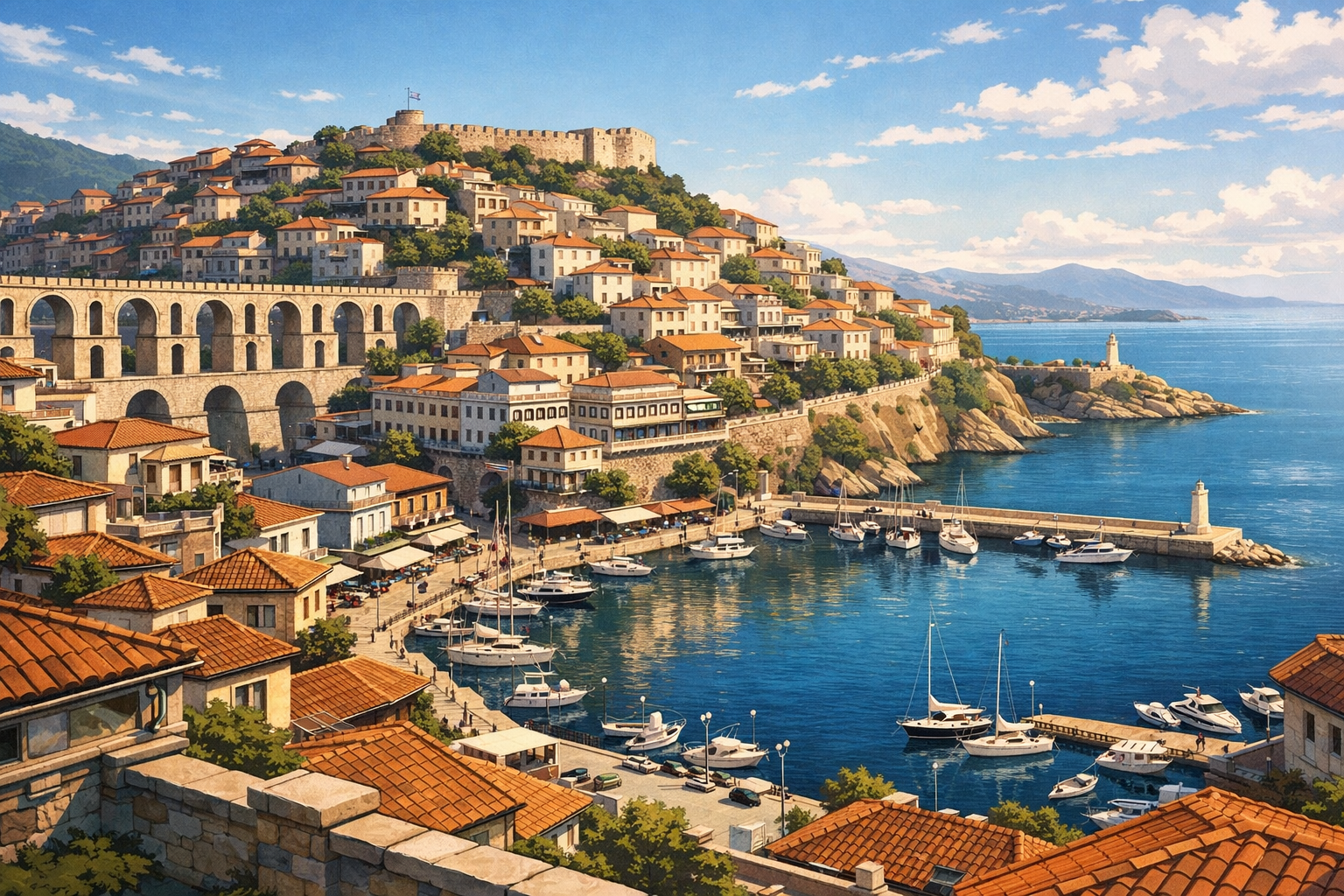
Kavala rises amphitheatrically above the sea, where the stone lanes of Panagia lead to the striking arches of the Kamares aqueduct. At the port, the city opens to the water and rewards every climb with sweeping coastal views.

🧭 DAY-BY-DAY ITINERARY

Ready-made country and city routes with daily plans, sights, transport and accommodation. Buy PDF guides for independent travel.

🧭 DAY-BY-DAY ITINERARY


Day 1 — Kavala: Panagia old town, Imaret, the House of Mohammed Ali, the fortress, and the evening port

  • 🚕 If you arrive at Kavala International Airport «Alexander the Great», allow about 35–45 minutes for the transfer into town. By KTEL bus, the journey usually takes longer because of a transfer in Chrysoupoli, so for a short two-day itinerary a taxi or pre-booked transfer is more convenient. After check-in, give yourself 30–60 minutes to rest: Kavala is built like an amphitheater, the streets here rise noticeably uphill, and it’s better to ease into the city’s rhythm without rushing.

  • 🚶 It’s best to devote the first day to what people love most about Kavala: its seafront silhouette, old town, and the views that open up at almost every turn. Start on the Panagia peninsula — the historic heart of Kavala. This is not just an “old quarter,” but a truly living labyrinth of cobbled streets, white and pastel houses, small stairways, arches, terraces, and balconies hanging over the sea. Here you can feel the city’s character especially well: Kavala is neither flat nor ceremonial, it rises in layers like the stage of an ancient theater, where instead of scenery there is the port, the bay, the rooftops, and the blue of the Aegean Sea. Panagia is quiet in the morning, and these are the best hours for wandering without a goal, turning into side streets, looking for unexpected harbor views, and photographing the city not straight on, but through the texture of stone, old doors, and descents to the water.

  • 🚶 Then head to the Imaret — one of Kavala’s most atmospheric landmarks. Founded in the early 19th century by Mohammed Ali as a religious, educational, and charitable complex, it still makes a strong impression today not through size, but through the completeness of its image: domes, inner courtyards, stone detailing, and a sense of silence and a closed world above the port. If you manage to join a tour, allow about 45 minutes. Even from the outside, the place is very photogenic: the Imaret seems to dissolve into the relief of Panagia while at the same time dominating it, reminding you how layered this city’s history has been — Greek, Byzantine, Ottoman, and maritime all at once.

  • 🚶 A few minutes away is the House-Museum of Mohammed Ali on Mohammed Ali Square. This is a rare example in Northern Greece of a well-preserved 18th-century urban Ottoman residence. It is worth including not only for the history of the ruler of Egypt who was born here, but also for the panoramas: the square in front of the house is itself one of the best spots to feel Kavala’s amphitheatrical composition. From here you can see how the city literally descends to the water, while the port and shoreline form a postcard scene you’ll want to look at for a long time.

  • 🚶 After that, climb higher — to the Fortress of Kavala. For the ascent from the old town square to the entrance, it’s best to allow 15–25 minutes at a relaxed pace, especially in the warmer season. The fortress stands on top of Panagia and historically controlled an important passage along the ancient Via Egnatia. But the main thing for a traveler today is the view. From the upper level of the tower, arguably the best panorama of Kavala opens up: the port, the promenade, modern neighborhoods, the sea, the distant curves of the coastline, and the whole logic of the city as an amphitheater become completely clear. It’s a good place to pause for 30–45 minutes, simply to sit, catch your breath, and let your eyes adjust to the scale. In clear weather it is especially beautiful closer to sunset, when the light softens and the city begins to glow in warm shades.

  • 🍽️ For a late lunch or early dinner, head back down to the lower streets of Panagia or toward the port. The descent, including photo stops, will take about 20–30 minutes. The best rhythm for this day is not to try to tick off as many places as possible, but to let Kavala reveal itself gradually: walk, eat fish or meze, have a coffee or a glass of wine with a view of the water, and feel how the old town flows into the modern port city.

  • 🚶 In the evening, be sure to walk along the promenade and the port area. Kavala’s port is not just a transport point, but an important part of the city’s identity: it is here that its maritime character is read most clearly. From the water and from the waterfront, the city looks like a cascade of houses and lights rising from the piers up the slope. An evening walk along the shore takes 40–60 minutes without rushing and is a perfect end to the day: boats, lights, salty air, the silhouette of the old town against the darkening sky, and the softly illuminated heights make Kavala one of the most beautiful port scenes in northern Greece.


Day 2 — Kavala: the Kamares aqueduct, tobacco heritage, archaeological museum, sea walk, and final views

  • 🚶 Start the second day with the symbol of Kavala — the Kamares aqueduct. It’s best to come here in the morning, while the light is soft and the surrounding space has not yet filled with city noise. This huge arched aqueduct, about 270 meters long and up to 25 meters high, is not just a beautiful backdrop for photos, but the city’s main visual landmark. In a single frame, it connects several images of Kavala at once: the old town on the heights, the urban rhythm below, and the memory of the centuries when water made life on this peninsula possible. Kamares is especially impressive because the monument is literally built into everyday life: you see not a museum set piece, but a genuine architectural giant inside a living city. Allow 30–45 minutes for seeing it and taking a calm walk around it.

  • 🚶 From Kamares, it’s convenient to continue to the neighborhoods linked to Kavala’s tobacco era. From the late 19th century through the first half of the 20th century, the city was one of the most important centers of tobacco processing and export in the Balkans, and it was precisely then that the cosmopolitan urban image still felt in the center today took shape. Walk toward Kapnergatis Square and the streets with former tobacco warehouses: here the architecture is different, more urban and bourgeois, with a European mood. If the Tobacco Museum is open, set aside 40–60 minutes for it: it is a good place to understand why Kavala was not only a beautiful seaside city, but also an important trading hub with a lively economic and social life.

  • 🏛️ The next logical stop is the Archaeological Museum of Kavala. It helps you assemble a broader historical perspective than just the old town: from ancient Neapolis to the Byzantine and later periods. The museum is especially good because after walks through streets, walls, and panoramas, it gives substance “in depth” — sculpture, architectural fragments, vessels, coins, and objects through which the city begins to be perceived not only visually, but historically as well. It’s best to allow about 45–75 minutes for the museum. This is a good option for the middle of the day, when you want a break from climbs and to spend some time indoors.

  • 🍽️ After the museum, take a lunch break in the center or by the sea. For a two-day stay in Kavala, an unhurried format is ideal: no more than one or two intensive stops in a row, followed by rest. Give yourself at least 60 minutes — the city reveals itself best precisely in the alternation of a walk, a view, coffee, a short climb, another view, and only then the next sight.

  • 🚶 In the second half of the day, return to the seafront: walk once more along the port and promenade, but this time consciously, after you have seen Kavala from above and from within. It changes perception a lot. From below, you begin to notice how the old Panagia peninsula projects into the sea, how the fortress closes the composition, how Kamares reads against the city’s relief, and how the modern districts do not destroy the historical image, but only expand it. If the weather and schedule allow, you can add a short boat trip along the coast or simply walk to a point from which a wider view of the city and harbor opens up.

  • 🌅 Dedicate the finale of the route to the views. In Kavala, this is an essential part, not a pleasant extra: here the panorama explains the meaning of the city better than any text. Return either to the upper streets of Panagia or to the viewpoints near the fortress, if you have the energy for another climb. Set aside another 45–60 minutes for this final outing to the view. Before departure, it is especially beautiful simply to stand and watch how the white houses, domes, walls, port, and sea come together into a single amphitheater. Kavala is wonderful because in two days it doesn’t have time to become tiresome — on the contrary, it is only beginning to open up.

  • 🚕 It’s best to plan the trip to the airport with extra time. The road to Kavala International Airport «Alexander the Great» usually takes about 35–45 minutes by taxi, and more time by KTEL bus because of transfers and waiting. If you have an early flight or luggage, it is wiser to book a transfer in advance.

Flight tickets

eSIM for travel

Buy PDF guide

Buy PDF guide — 4.28 USD

PDF — 4.28 USD