
Buy PDF guide

Buy PDF guide — 25.71 USD

PDF — 25.71 USD

KARELIA

KARELIA

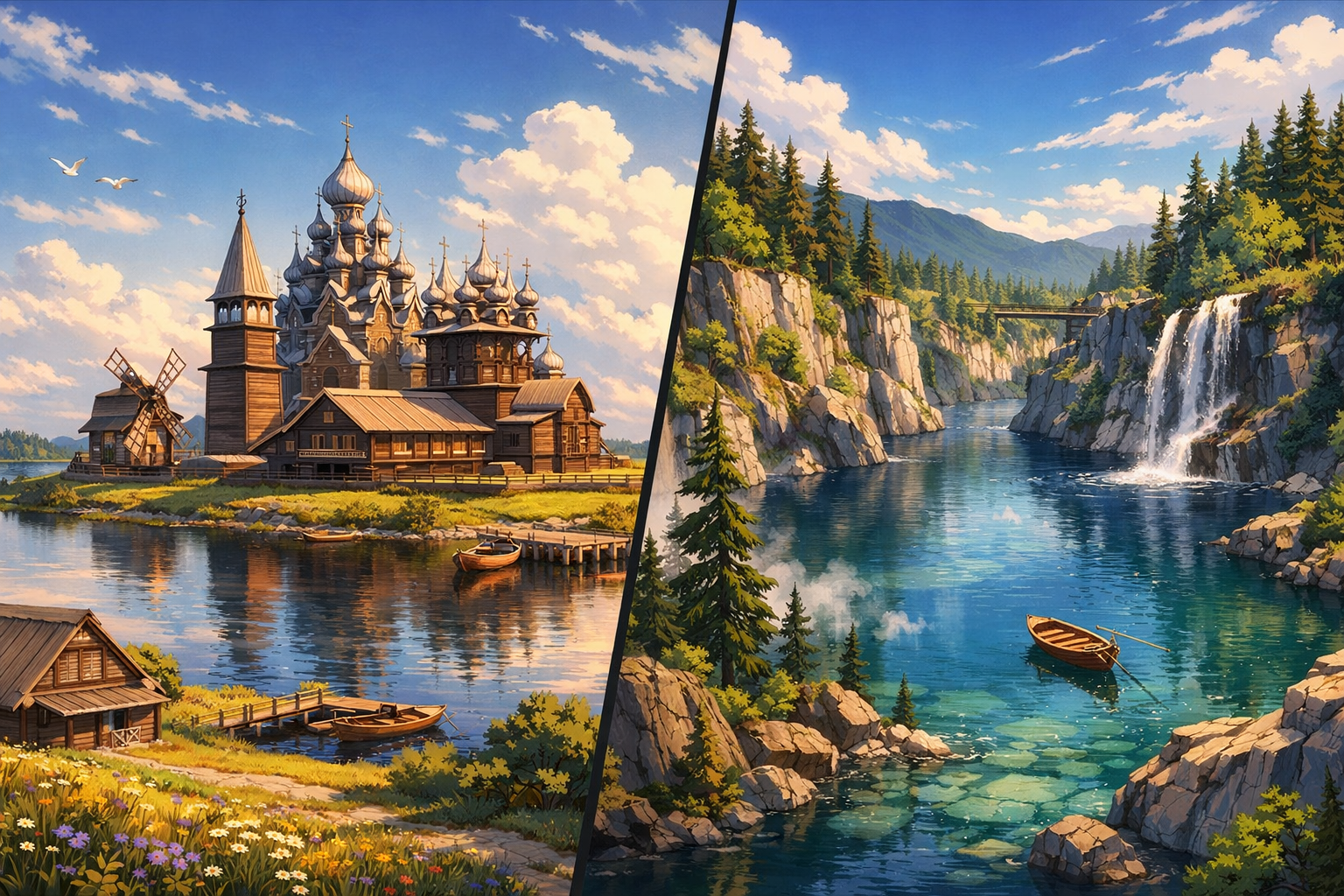
Trace Russia’s Karelian arc from lakeside Petrozavodsk and the wooden marvels of Kizhi to mineral-rich Marcial Waters and the thunder of Kivach Falls. Continue through Sortavala to Ruskeala’s marble canyon, sail to the serene monasteries of Valaam, and return across pine-fringed lakes steeped in northern light.

🧭 DAY-BY-DAY ITINERARY

Ready-made country and city routes with daily plans, sights, transport and accommodation. Buy PDF guides for independent travel.

🧭 DAY-BY-DAY ITINERARY


Day 1 — Petrozavodsk: Onega Lake embankment and an introductory stroll

  • 🚶 Arrive in the capital of Karelia and head straight to the Onega embankment: a long waterline, sculptures, and a wide horizon help you feel the scale of the northern landscape. From an architectural point of view, note Soviet Modernism and late historicist facades along Karl Marx Avenue; the city “reads” as an industrial capital of Olonets Governorate, where the Petrovsky Plant set the main planning axis.


Day 2 — Petrozavodsk: museum day (Karelian Fine Arts Museum + National Museum)

  • 🏛️ The Museum of Fine Arts of the Republic of Karelia holds a rare collection of ancient Russian icon painting from Karelia (15th–16th centuries), Russian art of the 18th–20th centuries, and “Kalevala” in graphic art. The building is the former Olonets provincial gymnasium of the late 18th century: a classical volume, tall openings, strict symmetry—an instructive lesson in “school” neoclassicism of the Russian North.

  • 🏛️ Then head to the National Museum of the Republic of Karelia on Round Square (Lenin Sq.): regional archaeology and the ethnography of Karelians, Veps, and Russian Pomors. The interiors feature calm exhibition architecture that links local history to the route: tomorrow you will see Kizhi—wooden architecture born from the same cultural layers.

Day 3 — Kizhi Island: the Kizhi Pogost ensemble (UNESCO)

  • ⛴️ A morning high-speed run across Lake Onega (during the navigation season) takes you to the key highlight of the trip—the Church of the Transfiguration (1714) and the Church of the Intercession (1764) with the bell tower. This is the peak of northern wooden architecture: twenty-two onion domes on a powerful log structure, a composition hewn without a single nail, a play of volumes against water and sky. Walk through the farmsteads of Zaonezhye: barns, granaries, mills—a “catalog” of vernacular outbuilding types that made up the everyday architecture of the North.

  • 🌅 Evening—return to Petrozavodsk and an easy walk along the embankment: in the sunset light, the silhouette of Lake Onega rhymes with the verticals of Kizhi’s domes—useful for “stitching” impressions together.

Day 4 — Petrozavodsk: “industrial archaeology” and Peter’s city

  • 🏭 The Gallery of Industrial History on Liteynaya Square is a concentrated memory of the Petrovsky Plant: from foundry technologies to the factory’s role in urban planning. Here you can clearly see the link between industry and the city’s planning logic, which will later show up in the settlements of Zaonezhye and at the piers of Lake Onega.

  • 🕍 In the second half of the day—cathedral squares and Soviet Modernism along Lenin Avenue: compare styles and materials—from stone and brick to concrete “ribbon” facades.

Day 5 — Prionezhye: Marcial Waters and Peter I’s first resort

  • 🚌 A short trip to Marcial Waters—the first Russian resort (founded under Peter I). Small museum displays, wooden buildings, chapels, and bathing huts show how imperial care for health took shape in the northern landscape. Take a pause: an unhurried rhythm will help you recover before longer transfers.

Day 6 — Prionezhye: Kivach Nature Reserve (natural context and museum)

  • 🌲 Kivach is a waterfall and the Karelia nature museum (not only “about water,” but also about geology, flora, and fauna). It’s “about nature as an architect”: reliefs, boulders, and forests—forces that local architecture has always had to negotiate with. Return to Petrozavodsk; prepare for the next transfer.

Day 7 — Transfer to Sortavala (Ladoga region) + evening in town

  • 🚗/🚌 Transfer Petrozavodsk → Sortavala (by car via the A-121 “Sortavala” highway or by intercity bus). Plan 6–7 hours with stops: the distance and radial stretches of the road require a buffer.

  • 🚶 Evening walk in Sortavala: Finnish National Romantic architecture of the early 20th century, strict volumes of granite and plaster, viewpoints to Lyappyaarvi Bay. Here, “stone and water” define silhouettes, and the town keeps the memory of the Ruskeala quarry.

Day 8 — Ruskeala: the marble canyon and mining heritage

  • ⛏️ The Ruskeala Mountain Park is a spectacle of rock and light. Old adits, drifts, sheer quarry walls, and turquoise water explain how the marble extracted here served the architecture of St. Petersburg. Walk the panoramas around the Grand Canyon and visit “Underground Ruskeala”: this is the material from which the columns, staircases, and claddings of the imperial capital grew.

Day 9 — Ruskeala Express + Sortavala’s museum context

  • 🚂 The steam-hauled heritage train “Ruskeala Express” (Sortavala ↔ Ruskeala Mountain Park): historic carriages, a dining car, and about an hour through scenic shores. After returning, visit the Kronid Gogolev Museum—carved panels about the North, wood, and people; it’s “wooden graphics” that echoes Kizhi and vernacular architecture.

Day 10 — Sortavala: Museum of the Northern Ladoga Region + architectural viewpoints

  • 🏛️ The regional Museum of the Northern Ladoga Region covers the history of the town and Lake Ladoga: from fishing cooperatives to the borders of empires. In the second half of the day—viewpoints over Lyappyaarvi, a walk along the embankment, and a hunt for Finnish modernist details in 1920s–30s houses: bay windows, pointed gables, plaster texture.

Day 11 — Valaam: monastic ensemble on the Ladoga skerries

  • ⛴️ Head to the Valaam Archipelago (during the navigation season—boats/hydrofoils from Sortavala). The Transfiguration Monastery and its sketes are “architecture of silence”: masses of stone, light walls, vertical domes against water and pines. This is the final tactile encounter with the northern sacred space, with direct threads leading back to Kizhi.

Day 12 — Return: summing up by the water

  • 🚌/🚆/✈️ Depart from Sortavala to St. Petersburg or back to Petrozavodsk (depending on your tickets). For goodbye—a short walk by Ladoga/Lake Onega: compare the “voice of stone” of Ruskeala and the “voice of wood” of Kizhi—that is Karelia.

Flight tickets

eSIM for travel

Buy PDF guide

Buy PDF guide — 25.71 USD

PDF — 25.71 USD