
Buy PDF guide

Buy PDF guide — 29.99 USD

PDF — 29.99 USD

CANBERRA

CANBERRA

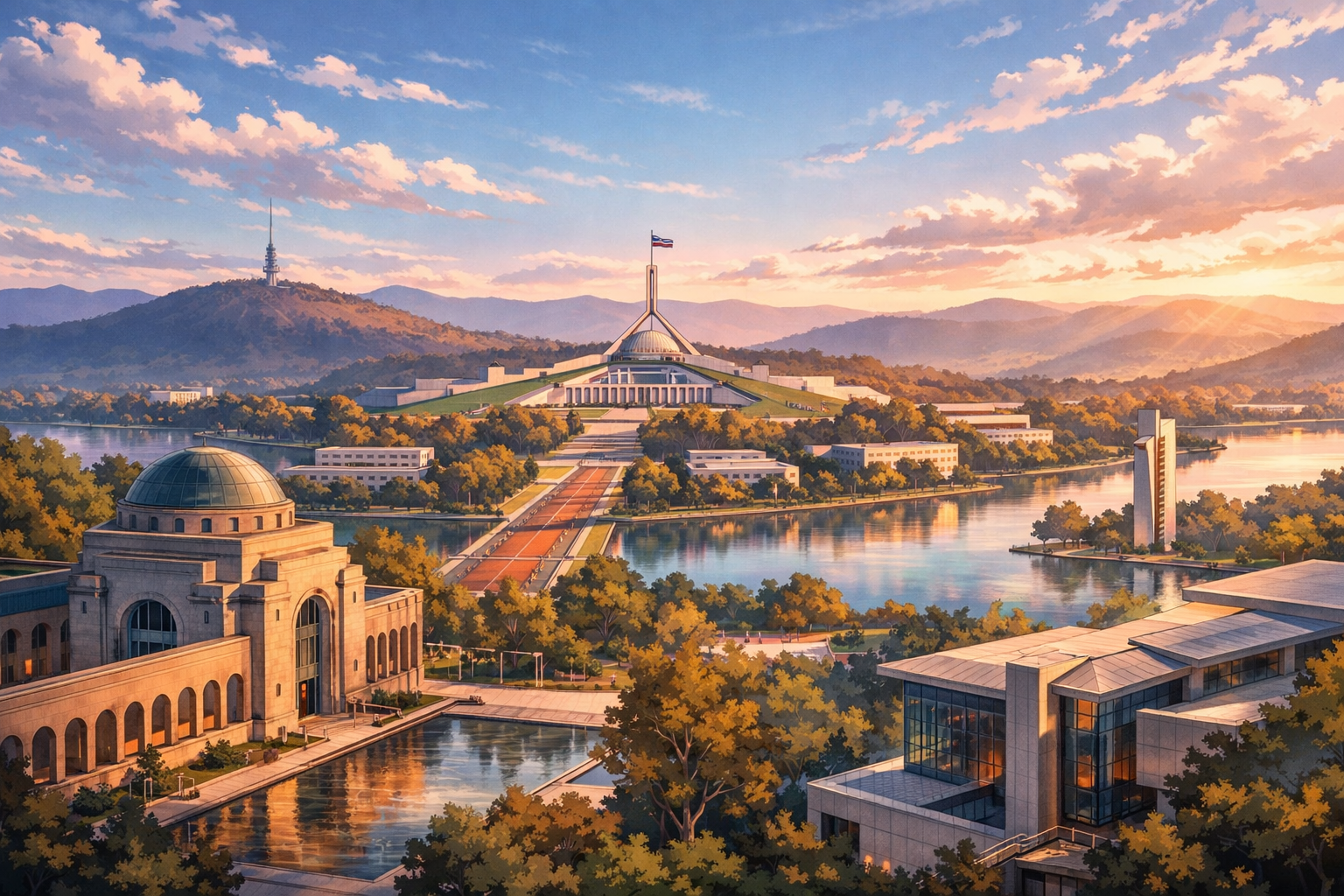
Australia’s capital balances lakeside calm and bold design, with the Parliamentary Triangle showcasing national icons amid grand lawns. Wander from Civic through Acton and Campbell to leafy Yarralumla and Barton, then finish with Braddon’s buzz and sunset on the Kingston Foreshore.

🧭 DAY-BY-DAY ITINERARY

Ready-made country and city routes with daily plans, sights, transport and accommodation. Buy PDF guides for independent travel.

🧭 DAY-BY-DAY ITINERARY


Day 1 — Parliament House and the axis of democracy

  • 🚶 Start at Parliament House (Parliament Dr, Canberra ACT 2600) — a modern building with a grass roof and the strict geometry of the chamber. Go up to the rooftop viewing platform: the panorama of the Commonwealth Avenue — Lake Burley Griffin — Anzac Parade — Australian War Memorial axis pulls Canberra “into a single line.” Then walk down Federation Mall to Old Parliament House (now the Museum of Australian Democracy, 18 King George Terrace, Parkes) through the manicured National Rose Gardens. It’s a 10–12 minute walk between the buildings; allow 1.5–2 hours to see Parliament with a tour and another 60–90 minutes for MoAD. For a break — a café in the gardens by Old Parliament House and a leisurely walk along King George Terrace to Magna Carta Place.


Day 2 — The country’s art: NGA, NPG, and the “sculpture shoreline”

  • 🚶 The Parkes Place park cluster. Start with the National Gallery of Australia (Parkes Place East, Parkes ACT 2600) — the Aboriginal art galleries here are powerful and serene. Be sure to step out into the Sculpture Garden — concrete, water, and bronze against the lake backdrop. A 3–5 minute walk away is the National Portrait Gallery (King Edward Terrace, Parkes ACT 2600): stories through faces, from explorers to musicians. Finish at the tall glass volumes of the High Court of Australia (31 Parkes Place East) — the lobby and the water view create a rare feeling of “quiet monumentality.” Transfers within the cluster take 2–10 minutes; for the museums themselves, plan 3–4 hours with breaks in shady avenues.

Day 3 — National Library and Questacon: knowledge and play

  • 🚶 By the water at Parkes Place West — the National Library of Australia (Parkes Place West, Canberra ACT 2600). Reading rooms, rare maps, and the light hush of marble. Next — an 8–10 minute walk along the waterfront to Questacon (King Edward Terrace, Parkes ACT 2600): hands-on science and lively galleries “for all ages.” Finish at Commonwealth Place with steps down to the lake — great for a breather in the wind. For this two-institution block, plan 3–4 hours plus 30–40 minutes of unhurried walks and scenic pauses.

Day 4 — National Museum of Australia and the Acton Peninsula

  • 🚶 The National Museum of Australia (Lawson Cres, Acton ACT 2601) sits on Acton Peninsula — bold “loop” architecture and wide water views. From the center (Civic) it’s a 20–25 minute walk along the West Basin or 10–12 minutes by bus/taxi; from Ovolo Nishi — a 10–12 minute walk via the pedestrian bridge. Inside — everyday objects and big narratives of Australian history. After the museum — a loop along the shore, coffee at the pier, and return to the City at sunset.

Day 5 — Australian War Memorial and ANZAC Parade

  • 🚶 The Australian War Memorial (Treloar Cres, Campbell ACT 2612) is both a museum and a place of remembrance. The Hall of Memory, vehicle collections, the Roll of Honour. Entry is via free timed tickets; a comfortable visit is 2–3 hours. Walk down ANZAC Parade to the lake (30–40 minutes downhill with stops at the memorials), reading history along the way. If you have the energy — hike up to Mount Ainslie Lookout for sunset (45–60 minutes on foot from the memorial or 10 minutes by car).

Day 6 — “Bridge to Bridge”: a loop around the center

  • 🚶 The “bridge-to-bridge” walk along the shores of Lake Burley Griffin: from Commonwealth Avenue Bridge to Kings Avenue Bridge and back. Along the way — the lawns of Commonwealth Park, mirror-like water surfaces, passing canoes. This is a gentle “reset” day with no museums: 1.5–2 hours of walking at a comfortable pace + picnic/coffee. It’s easy to stop by Magna Carta Place and the lower terraces near the National Gallery along the way.

Day 7 — Australian National Botanic Gardens and the slopes of Black Mountain

  • 🚶 The Australian National Botanic Gardens (entry from Clunies Ross St, Acton ACT 2601) are the most complete collection of Australian plants. The paths are laid out so you can walk through “botanical Australia” in 60–90 minutes, with a pause at Pollen Café. From the center it’s a 25–35 minute walk or 10–15 minutes by bus/taxi. If you still have energy — a short trail on the slopes of Black Mountain to the wild scent of eucalyptus and views over the city.

Day 8 — National Arboretum Canberra: hills and bonsai

  • 🚗 National Arboretum Canberra (Forest Dr, Molonglo Valley ACT 2611) — 250 hectares of young forests on rolling hills. Visitor centre, bonsai gallery, and a lookout with views of the lake and the parliamentary axis. It’s best reached by taxi/car-sharing: 10–15 minutes from the center without traffic. Plan 2–3 hours for panoramas, collections, and tea with a view at the Village Centre.

Day 9 — Royal Australian Mint and the Deakin/Yarralumla neighborhoods

  • 🚗 The Royal Australian Mint (62–114 Denison St, Deakin ACT 2600) — a working coin factory and a numismatics museum. Exhibits on the switch to decimal currency and coin designs. From the center it’s 12–15 minutes by taxi/car-sharing or 25–35 minutes by bus with a transfer. Afterward — a quiet walk through Yarralumla with views of the lake waters and leafy embassy districts.

Day 10 — The nation’s archives and memory

  • 🚶 The National Archives of Australia (Kings Ave, Parkes ACT 2600) — “Voices / Dhuniai” and “Connections / Mura gadi”: documents that tell how decisions are made and how a country preserves its memory. Fits into a calm day with short walks around the Parliamentary Triangle: distances between the Archives, MoAD, and Parliament are 5–15 minutes on foot. In total, 2–3 hours with breaks on the lawns.

Day 11 — Kingston Foreshore and market Saturday/Sunday

  • 🚶 Kingston Foreshore — pedestrian waterfronts, cafés, and glassy water. On weekends add the Old Bus Depot Markets (seasonally on Sundays): crafts, coffee, street food in an old warehouse setting. From the center it’s 10 minutes by taxi/car-sharing or 15–20 minutes by bus. A day about “atmosphere and water,” unhurried.

Day 12 — A “no history” day: parks, bike paths, picnic

  • 🚴 Grab a bike or e-scooter and make your own loop by the water: West Basin, Nara Peace Park, the shaded lawns of Commonwealth Park. Transfers are short (5–15 minutes), and you can make as many stops as you like. If you’re tired of museums, the “half a day on the grass, half a day in the city” mode works great.

Day 13 — Repeat your favorite: a “deep visit” to one museum

  • 🚶 Go back to the gallery where you wanted to linger—whether it’s Aboriginal art at the NGA, portraits at the NPG, or the quiet of the NLA reading rooms. Pick one place and give it 3–4 hours, unhurried. Afterwards—late lunch in Barton or Braddon, then a short evening walk by the lake.

Day 14 — Finale: Parliament Drive and sunset on the water

  • 🚶 One last lap of respect around Federation Mall and the slopes around Parliament: grass, the flagpole’s shimmering steel, the lake’s perspective receding into the water. By sunset, return to the West Basin foreshore or the steps at Commonwealth Place: Canberra says goodbye with soft light and the steady breath of wide-open space.

Flight tickets

eSIM for travel

Buy PDF guide

Buy PDF guide — 29.99 USD

PDF — 29.99 USD