
Buy PDF guide

Buy PDF guide — 8.57 USD

PDF — 8.57 USD

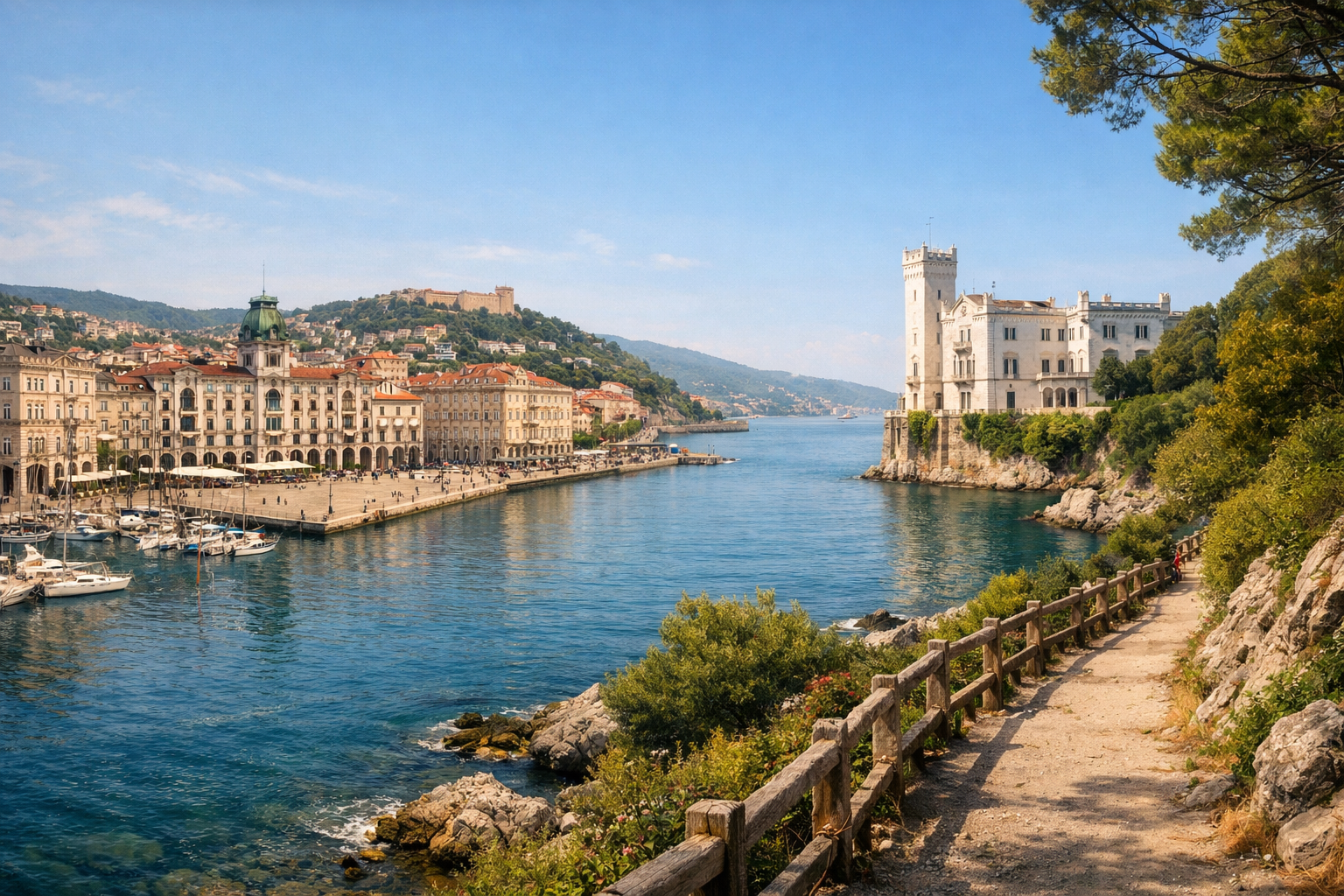
Italy, Trieste. An inexpensive trip to a port city with Austro-Hungarian architecture, a waterfront promenade, Miramare Castle, and coastal trails.

Italy, Trieste. An inexpensive trip to a port city with Austro-Hungarian architecture, a waterfront promenade, Miramare Castle, and coastal trails.

Trieste is an affordable seaside escape where Austro-Hungarian grandeur meets the Adriatic. Stroll the elegant waterfront, visit the fairy-tale Miramare Castle, then head up toward Opicina for breezy coastal trails and sweeping sea views.

🧭 DAY-BY-DAY ITINERARY

Ready-made country and city routes with daily plans, sights, transport and accommodation. Buy PDF guides for independent travel.

🧭 DAY-BY-DAY ITINERARY


Day 1 — Trieste: Piazza Unità d’Italia, the canal, and the port waterfront

  • 🚆 If you arrive via Trieste Airport, the cheapest and usually the easiest way to get into the city is the regional train to Trieste Centrale. The journey usually takes about 30–40 minutes, after which most budget hotels near the station are within a 2–10 minute walk. An alternative is the G51 bus, which also connects the airport and Trieste. Train tickets are easiest to buy in the Trenitalia app, on the carrier’s website, at machines at the airport station, or at ticket offices; city and suburban bus tickets are available in the glimble FVG and TPL FVG apps, from authorized sellers, at machines, and in some cases directly on board with a contactless bank card. For a very short 4-day trip, it makes sense to stay in one base in Trieste itself so you do not waste time and money changing accommodation.

  • 🚶 The first day is best devoted to exploring the city on foot, because Trieste’s historic center is compact, distinctive, and especially rewarding at a slow pace. Start at Piazza Unità d’Italia — a huge ceremonial square right by the water, one of the most impressive in Italy. This is where Trieste’s main charm stands out most clearly: it does not feel like a typical southern Italian city, but rather like the maritime capital of the former Austro-Hungarian Empire, where строгие фасады, просторные перспективы, кофейни и морской воздух создают атмосферу старой Центральной Европы у Адриатики. From the square, head to Molo Audace — a long pier where you will almost always want to linger longer than planned: watching the bay, ferries, seagulls, and the city’s white facades.

  • 🚶 Then continue to Canal Grande and the Borgo Teresiano district. This is one of the most photogenic corners of Trieste: the canal water, boats, 19th-century facades, the church of Sant’Antonio Nuovo aligned at the end of the view, and the calm urban rhythm create that very “postcard” image people come here for. Along the way, it is easy to stop at inexpensive bars and cafés for a quick bite: in Trieste, a budget option often means good coffee, panini, pizza al taglio, simple pasta, or a daily menu rather than a compromise on quality. For lunch, plan roughly 8–15 € per person; for a simple dinner, 12–22 €.

  • 🌆 In the evening, without spending extra, it makes sense to continue your walk along Riva del Mandracchio and Riva Nazario Sauro. The sunset light falls beautifully on the city’s seafront facade here, and by the water you can especially feel Trieste’s port character — businesslike, a little windy, noble, and far from smooth resort polish. If you still have energy, you can walk on to Arco di Riccardo and the Roman traces in the old town, but do not overload the day: a budget itinerary should not only be cheap but also realistic, so it is best to end the first day calmly and fairly early.


Day 2 — Trieste and Miramare: castle, park, and the seafront line

  • 🚌 In the morning, head to Castello di Miramare — this is Trieste’s signature postcard view and one of the most beautiful budget-accessible spots in the region. You can get there by Trieste Trasporti city bus, usually on routes running along Viale Miramare; on transport maps for the castle area, lines 6 and 36 are shown. Travel time from the center is usually about 20–35 minutes depending on your starting point and waiting time. Buy your ticket in advance in the glimble FVG or TPL FVG app, at a machine, at a tobacco shop/authorized sales point, or on board contactless if that option is available on your service. Always validate your ticket immediately after boarding if you are using a paper ticket.

  • 🏰 Miramare Castle stands on the Grignano promontory and seems almost designed for a relaxed 4-day trip: striking, historically rich, and easy to combine with a walk by the sea. Built for Archduke Maximilian of Habsburg and Charlotte of Belgium, it looks romantic and slightly theatrical — a white silhouette against the bay, a manicured park, grand interiors, and a constant sense of open sea. For a budget trip, it is especially nice that the park itself is a major attraction in its own right: even if you do not go inside the museum, a walk around the grounds already gives a full impression. If you want to visit the interiors, budget roughly around 10–20 € per adult depending on the current rate and possible combined options; the park usually remains the most cost-effective free part of the visit.

  • 🌿 After visiting the castle, do not rush back to the center. Walk through the park, go down to the water, and have a light picnic or an inexpensive snack bought in advance at a supermarket near the station or at a city delicatessen. This is one of the best ways to keep the budget under control: in Italy you can save noticeably if at least one meal a day is in the format of supermarket + water + fruit + pastries. Usually this comes to 6–12 € per person.

  • 🚶 After that, it makes sense to continue the day along the coast. In good weather and if you feel fine, you can take a long walk toward Barcola, moving along the sea and gradually returning to the city. This route is easy to navigate and very beautiful in mood: on one side the bay sparkles, on the other stretch villas, green slopes, and fragments of everyday city life without museum-like staging. If you are tired or the weather worsens, simply return by the same bus. Be sure to check the forecast, the strength of the Bora wind, and any temporary restrictions before setting out: the coast can be safe and pleasant, but conditions here change quickly.

Day 3 — Opicina and the Karst: panoramas, Strada Napoleonica, and the city tram/bus

  • 🚋 Dedicate the third day to Trieste’s upper level — the Karst plateau and the Opicina area. This is the best contrast to the city’s seafront face: in a short time you rise from the port environment to a stony edge with panoramas of the bay, red roofs, and the curve of the coast. The historic Trieste–Opicina tram is one of the city’s calling cards, but you should definitely check its operating status and any restrictions right before your trip. If the tram is unavailable or the schedule is inconvenient, use a regular city bus — for budget travel this is a completely normal and practical substitute.

  • 🥾 The main goal of the day is a walk along Strada Napoleonica, also known as Vicentina. This is one of the most beloved local panoramic trails: fairly easy, very scenic, and requiring no special gear in dry, stable weather. The trail runs along the edge of the Karst plateau and opens wide views over all of Trieste, the port, Miramare, and the sea. Here you especially understand the city’s geography: it is literally squeezed between a limestone escarpment and the Adriatic, which makes it feel at once vertical, maritime, and borderland.

  • ⚠️ Despite the route’s accessibility, treat it seriously. After rain the stones can be slippery, in summer heat and dehydration are risks, and in strong Bora winds the walk may become unpleasant or unsafe. So bring water, a cap, closed shoes with decent grip, and do not take unfamiliar side trails if you are not confident in your navigation. Before setting out, check the official weather forecast and local updates on trail conditions.

  • ☕ After the walk, take a break in Opicina or return to the center. In budget terms, this is one of the most cost-effective days: transport, viewpoints, and the trail itself cost very little, while the impressions are almost “alpine-meets-sea.” In the evening, you can add a quiet cultural touch — for example, stroll through the center once more, have coffee in a historic style, or simply dine at an inexpensive pizzeria/osteria. A rough daily estimate without museums: transport 3–10 €, food 18–35 € per person with a moderate plan.

Day 4 — Trieste museums, the old port, and departure

  • 🏛️ It is best to keep the final day flexible and inexpensive: choose 1–2 museums in the city itself so you do not depend on longer journeys before your return trip. The best option is Museo Revoltella, located not far from the sea. It is an important art museum in Trieste, associated with Baron Pasquale Revoltella, and it complements the walking days well: after squares, facades, and panoramas, you get an inner layer of the city’s culture — the taste of bourgeois Trieste, modern art collections, and the atmosphere of a wealthy 19th-century port city. An approximate ticket price is about 6–10 €.

  • 🚶 If you want to emphasize the maritime theme more strongly, a good addition is Museo del Mare in the Porto Vecchio / Porto Vivo area. This place is especially fitting in Trieste: the city cannot be understood without its harbor, shipping, trade, and maritime memory. Even a short visit helps tie together everything seen in the previous days — piers, promenades, the canal, Miramare, the winds, and port infrastructure.

  • 🧳 For departure to the airport or a long-distance train, allow extra time. If you are heading to Trieste Airport, it is usually most economical to use the regional train again from Trieste Centrale; buy tickets in advance in the Trenitalia app, on the website, at the ticket office, or at a machine. If you choose the G51 bus, check the current schedule for your exact date in advance. It is best to keep taxis as a backup option for early morning, late evening, bad weather, or heavy luggage — significantly more expensive, but sometimes justified.

  • 💡 Budget summary for a 4-day trip with an economical but comfortable plan: accommodation in an inexpensive hotel near the station is usually roughly 70–130 € per night for a double room or 55–110 € for a single/compact option depending on the season; food 20–40 € per day per person; local transport 3–10 € per day; paid entries can be limited to 1–2 sites. This format allows you to see Trieste properly without overpaying for unnecessary transfers and expensive tourist activities.

Flight tickets

eSIM for travel

Buy PDF guide

Buy PDF guide — 8.57 USD

PDF — 8.57 USD