
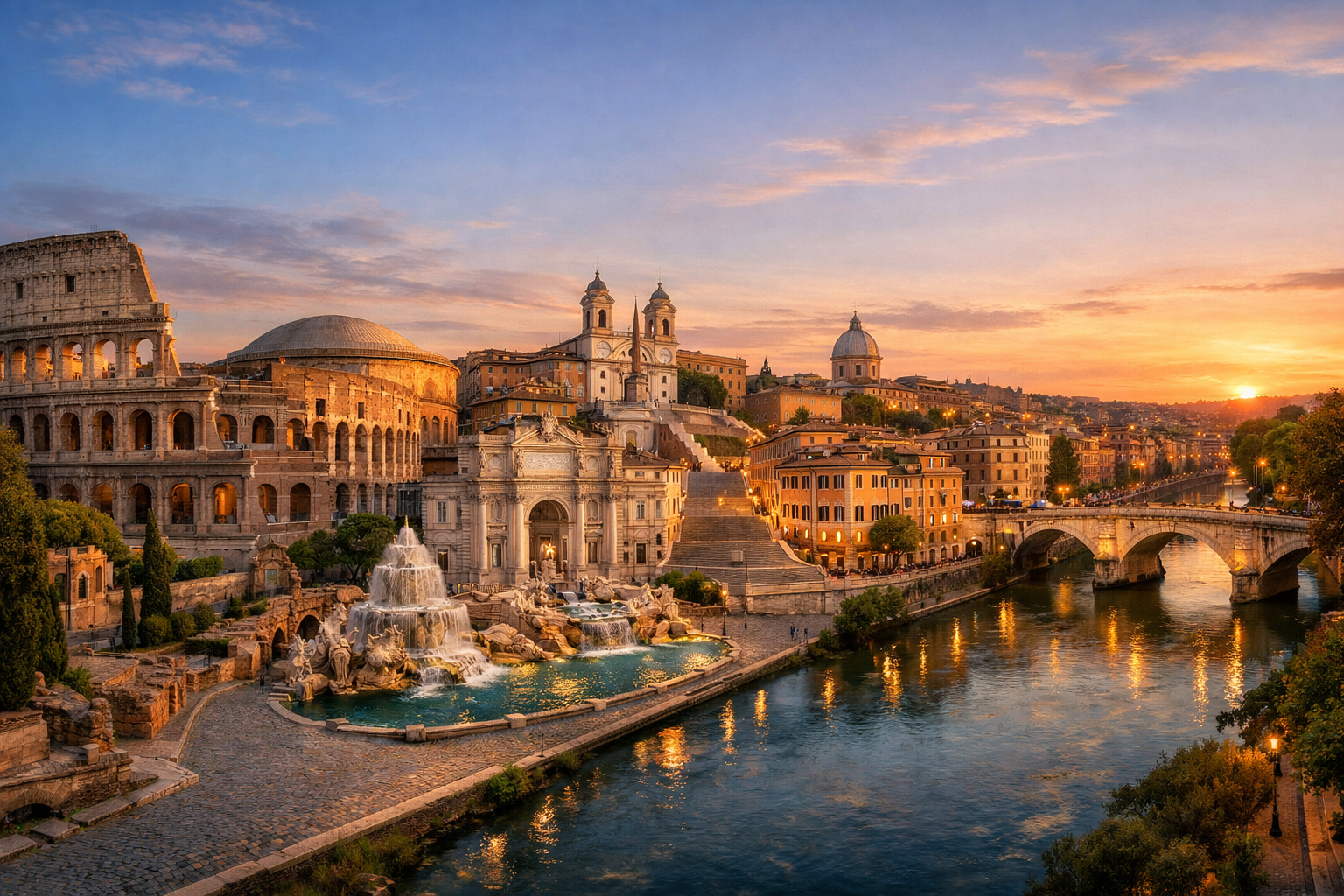
Day 1 — Ancient Rome and the evening center: Colosseum → Roman Forum/Palatine → Trevi → Spanish Steps
- 🚶 Who this day is for: weekend travelers, couples, and friends who want to see Rome’s most iconic sights without overloading themselves with transfers. Difficulty: moderate. Season: year-round. It’s best to start early, because the morning hours are more comfortable for walking through the archaeological area, and by midday the center becomes noticeably more crowded.
- 🎟️ Morning — the Colosseum, Roman Forum, and Palatine Hill. This is a single archaeological complex with several visit options, so it’s best to check tickets and time slots in advance. The Colosseum is not just a symbol of Rome, but the grand Flavian Amphitheatre, where the ancient world displayed power, engineering strength, and a love of spectacle. Even if you’ve seen it hundreds of times in photos, in person the scale of the ellipse, the stark geometry of the arches, and the feeling that this is not a ruin but a huge stone machine of history are especially impressive. After entering the Colosseum, it makes sense to continue the route through the Roman Forum and Palatine Hill: the Forum reveals the political and public heart of the ancient city, while the Palatine adds more open views, pine trees, remains of imperial palaces, and a rare sense of air and distance for central Rome. Plan at least 3–4 hours for the complex at an easy pace, with breaks for water, photos, and a short rest in the shade.
- 🚇 How to get there in the morning. If your base is around Termini, it’s convenient to take Metro Line B to Colosseo station — about 10–15 minutes, plus 3–5 minutes on foot to the entrance area. If you’re staying in the historic center, it can sometimes be faster to walk 20–30 minutes than to make transfers. On site, it’s important to arrive a little ahead of your time slot, especially in high season and on weekends.
- ☕ Break after the archaeological area. After the Colosseum and Forum, it’s better not to try to immediately “rush through everything else.” A more realistic plan is to allow 45–60 minutes for lunch or a long coffee break in Monti or on the way toward Via Nazionale / Piazza Venezia. This helps preserve energy for the evening walk and keeps the route from turning into a race.
- 🚶 Afternoon walk to the Trevi Fountain. From the Colosseum area to the Trevi Fountain, walking usually takes about 25–35 minutes depending on your pace and number of stops. Along the way, the city gradually changes mood: from ancient volumes and broad axes to the dense Baroque center, where the streets already work like theatrical wings. The Trevi Fountain is one of those Roman landmarks that has the strongest emotional impact: first you walk along narrow streets, then the space suddenly opens up, and in front of you appears a white-stone cascade with figures, movement of water, and almost stage-like lighting. Access to the area right by the basin may currently be regulated, and a separate visiting procedure applies to non-residents, so it’s worth checking current conditions before your trip. Even if you simply view the fountain from the square, the impression remains very strong, especially closer to evening.
- 🚶 The Spanish Steps and the end of the day. From Trevi to Piazza di Spagna, it’s about a 10–15 minute walk. The Spanish Steps are valuable not so much as a standalone “museum” site, but as an ideal Roman stage: steps, facades, crowds, shop windows, sunset light, and the feeling that the whole city center has come here for an aperitivo and a stroll. The climb up the steps is not difficult, but after a full day your legs will already feel the mileage — which is exactly why the route is considered moderately difficult. If you still have energy, you can walk a little toward Via del Babuino or Via del Corso, and then return to your hotel by metro from Spagna or by taxi.
- ⏱️ Day timing summary. Colosseum + Forum + Palatine: 3–4 hours. Lunch and rest: 1 hour. Walk into the center: 25–35 minutes. Trevi: 20–40 minutes including crowds and photos. Walk to the Spanish Steps: 10–15 minutes. Evening stroll: another 45–90 minutes if you wish. This pace is realistic for a weekend and leaves room for spontaneous stops.