
Buy PDF guide

Buy PDF guide — 8.57 USD

PDF — 8.57 USD

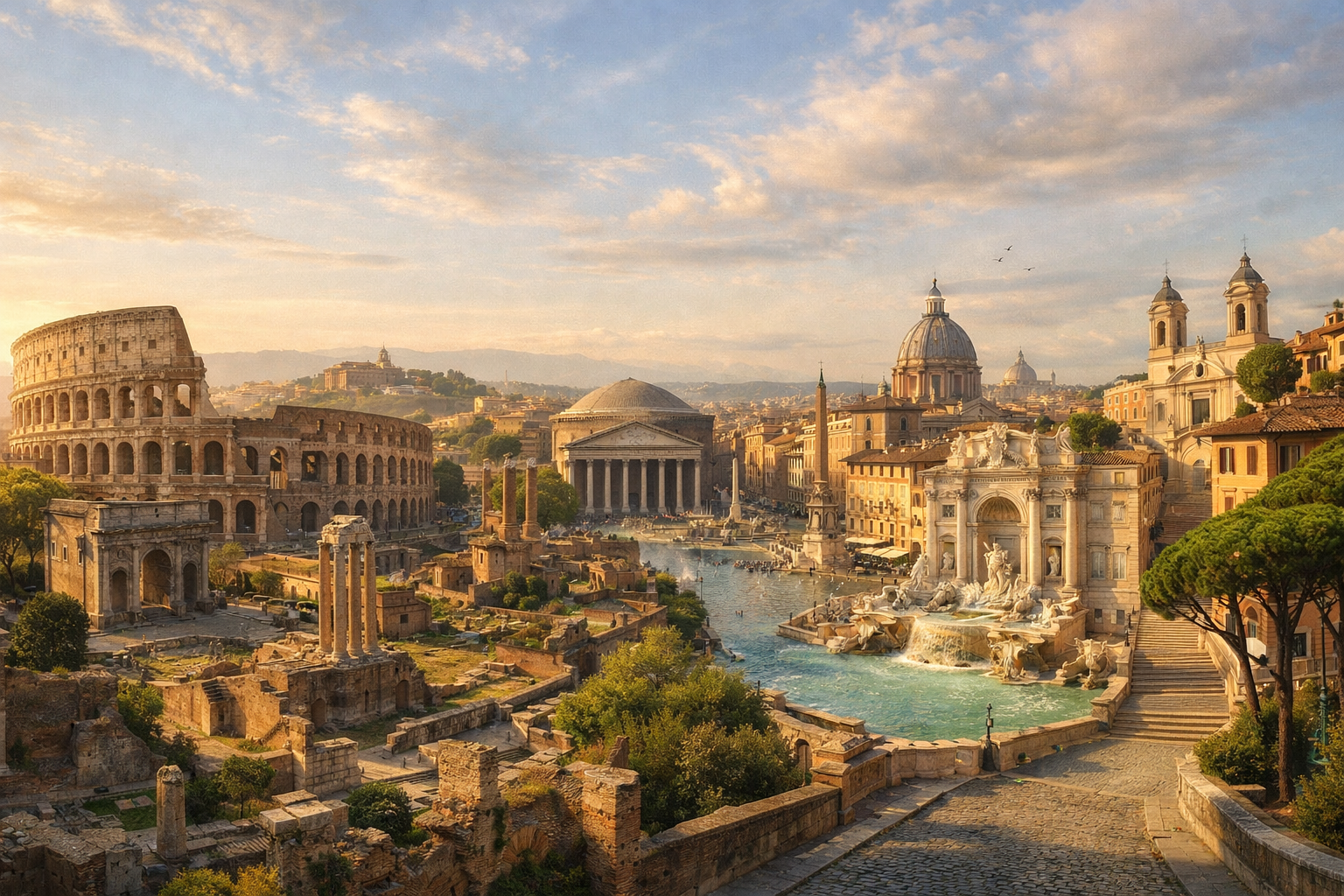
Italy, Rome. Classic Rome for the first time — the Colosseum, Roman Forum, Palatine Hill, Pantheon, Trevi Fountain, Piazza Navona, the Spanish Steps, and a walk through the historic center; the perfect first introduction to the Eternal City.

Italy, Rome. Classic Rome for the first time — the Colosseum, Roman Forum, Palatine Hill, Pantheon, Trevi Fountain, Piazza Navona, the Spanish Steps, and a walk through the historic center; the perfect first introduction to the Eternal City.

Step into Rome for the perfect first taste of the Eternal City, where ancient wonders and elegant piazzas unfold around every corner. From the Colosseum and the ruins of the Roman Forum to the Pantheon, Trevi Fountain, Piazza Navona, and the Spanish Steps, this classic route brings the city’s most iconic sights to life.

🧭 DAY-BY-DAY ROUTE

Ready-made country and city routes with daily plans, sights, transport and accommodation. Buy PDF guides for independent travel.

🧭 DAY-BY-DAY ROUTE


Day 1 — A classic start: the Colosseum, Roman Forum, and Palatine Hill

  • 🚶 It’s best to dedicate the first day to that very “ancient core” that brings many people to Rome for the first time. Start in the morning with the Colosseum, while the area is not yet overheated by the sun and the flow of visitors: even if you’ve seen it many times in photos, in person it creates a completely different effect — not like a standalone monument, but like a huge stone machine of history around which the city’s rhythm still revolves. After seeing it, it makes sense to continue to the Roman Forum and Palatine Hill: together, this is not a short stop but a substantial walk of 3–4 hours with climbs, viewpoints, and water breaks. The key here is not to rush: the Forum is best understood not as a collection of ruins, but as the former center of the ancient city’s political, religious, and everyday life, while the Palatine adds elevation, greenery, and a sense of how ancient Rome looked at itself from above. After such an intense archaeological visit, plan a late lunch and a rest in the Monti area — convenient logistically and pleasant in atmosphere. In the evening, you can make a gentle continuation of the route: walk along Via dei Fori Imperiali to Piazza Venezia, see the city in golden light, and avoid overloading the day with new museums. Time-wise, this is a realistic day: from the Colosseum to Monti it’s a 10–15 minute walk, and inside the archaeological zone, with stops, half a day easily disappears, so it’s better to keep the evening lighter.


Day 2 — Historic center: the Pantheon, Piazza Navona, and Trevi Fountain

  • 🚶 On the second day, Rome opens up not as an archaeological park, but as a living historic center where antiquity, the Baroque, and ordinary urban life are fused into one fabric. Start the morning with the Pantheon: it is one of those rare monuments that feels both monumental and almost intimate at the same time. Its dome, the light from the oculus, and the perfectly composed interior work not as an “attraction,” but as a powerful architectural experience best absorbed without rushing. Then head toward Piazza Navona — the walk takes about 10 minutes, and this is exactly the kind of stretch where it’s nice not to take shortcuts, but to walk through narrow streets, shop windows, little cafés, and squares that unexpectedly open up around the next corner. Piazza Navona is wonderful because it shows Rome in a different register: theatrical, Baroque, open, with fountains, facades, and the feeling of an urban stage. After lunch, it’s worth taking a pause, because central Rome can be exhausting from the density of impressions. Toward evening, make your way to the Trevi Fountain: from the Pantheon it’s about a 10–12 minute walk, from Navona a little longer, but at dusk this area is especially beautiful. It’s better to approach the fountain not at the height of the day, but closer to evening or early in the morning on another day for photos without the crowd. End the day with an unhurried walk through the surrounding streets — it is here that Rome first begins to feel not just like a set of famous sights, but like a cohesive, layered, and highly cinematic city.

Day 3 — The Spanish Steps, Piazza di Spagna, and the city rhythm of the center

  • 🚶 The third day is best made a little lighter on archaeology and more about the urban flavor of Rome. Start with Piazza di Spagna and the Spanish Steps: come early, before the space fills with tourist noise. In the morning, the city’s verticality is felt especially well here — the steps, the facades, the light, the color of the stone, and the gentle rise toward the church of Trinità dei Monti. This is not just a famous postcard, but one of the best places to feel the Roman habit of living among beauty as though it were the background of everyday life. After the climb and a short pause, you can walk toward Via Condotti and then to Via del Corso, and then turn into the less ceremonial streets of the center: that way, the day doesn’t remain just a “checkmark” at the steps, but becomes a full-fledged walk. From here, the Trevi Fountain is about 10–15 minutes on foot, so if you like, you can return and see it in different light, and then enjoy a long lunch. In the second half of the day, it’s good to leave time for rest or a short museum segment without overload — for example, the Capitoline Museums, if you want to add ancient sculpture and views over the Forum, or Villa Borghese if you need air and a more relaxed rhythm. This day is intentionally built more gently: after two history-packed days, it helps to let Rome work through the atmosphere of its streets, shop windows, terraces, small churches, and those unexpectedly beautiful turns in the route.

Day 4 — A final loop through the Eternal City: revisiting favorite places and a calm finish

  • 🚶 It’s best not to turn your last day in Rome into a race for extra sights. A much stronger format is “returning” — when you already understand the city’s logic a little and can walk through the center differently, more calmly, and more attentively. A good plan is to start the morning where you wanted to see the space without crowds — for example, at the Trevi Fountain or the Pantheon — then walk to Piazza Navona, have a coffee, and simply watch the center come to life. If on one of the previous days you didn’t have enough time for the Capitoline Museums, this is exactly where it is convenient to add 2–3 hours: the museum reinforces the theme of ancient Rome well while also sitting logically between the archaeological zone and the historic center. If instead you want a day without interiors, choose a walk with long pauses: from Piazza Venezia through Campidoglio to the forums, then back toward the Pantheon and the Spanish Steps. Realistically, leave time not only for walking, but also for rest: in August heat, or even in the warm season, Rome requires pauses, water, and shade. It’s best to build the end of the trip around the feeling of the city — warm stone, reflections in the squares, evening light, the sound of water by the fountains, and that rare mixture of grandeur and everyday life that makes a first meeting with Rome something you almost always want to repeat.

Flight tickets

eSIM for travel

Buy PDF guide

Buy PDF guide — 8.57 USD

PDF — 8.57 USD