
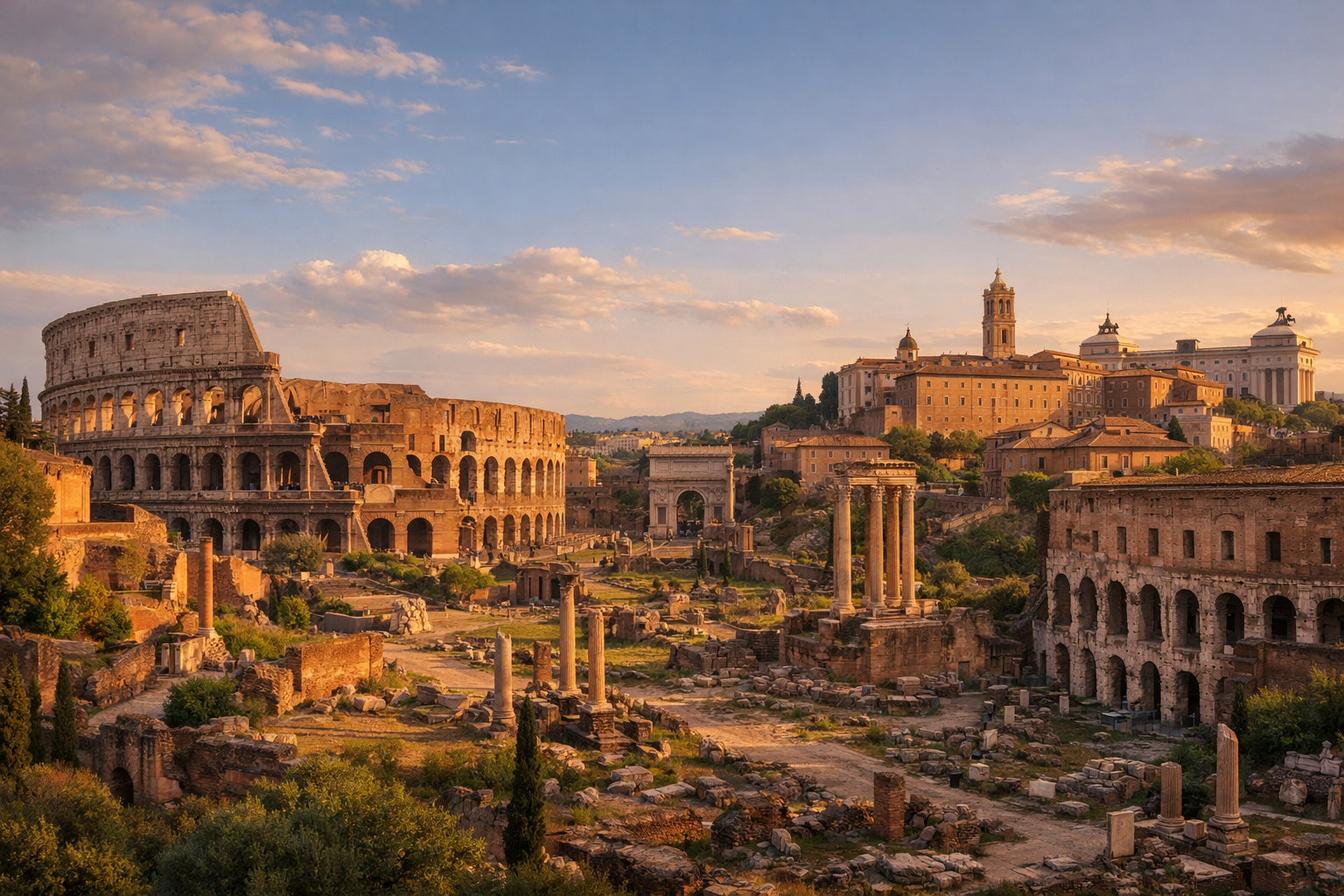
Day 1 — Colosseum, Arch of Constantine, Roman Forum, and Palatine Hill
🚶 Begin your journey with the Colosseum — the grand Flavian amphitheater that became Rome’s main stone symbol and one of the most recognizable structures of the ancient world. Here, the scale of the Roman Empire is felt especially strongly: massive arches, sophisticated engineering of entrances and tiers, traces of spectacle culture, and imperial propaganda come together in a vivid picture of a city where public space was an instrument of power. Inside, it is easy to imagine the roar of the crowd, ceremonial games, carefully organized logistics, and the way architecture worked for impact, discipline, and political prestige. For lovers of history and archaeology, this is not just a “must-see stop,” but the opening scene through which the entire further route through the ancient center is best understood.
⏱️ Practical tip for the day: for the Colosseum, Roman Forum, and Palatine, it is best to check official tickets and time slots in advance. This is a single archaeological complex with several visit options, and a full visit deserves most of the day without rushing.
🚶 Right nearby, see the Arch of Constantine — a triumphal monument that seems to sum up an entire era of the late empire. It is interesting not only as a striking monument at the foot of the Colosseum, but also as an archaeological document: its decoration uses earlier reliefs that were reinterpreted for a new imperial cult. This is a rare chance to literally see how Rome reworked its own past, turning the artistic heritage of earlier rulers into the language of new power.
🚶 Then make your way unhurriedly into the Roman Forum — the ancient heart of the city, where politics, religion, trade, and the memory of power existed side by side for centuries. Here the ruins work especially well on the imagination: basilicas, temples, rostra, the sacred road Via Sacra, arches of victors, and fragments of colonnades come together into a complex urban organism. This is not a museum hall, but a vast historical landscape where republican traditions, imperial ambitions, and the gradual transformation of the ancient capital into an archaeological palimpsest can be read in the open air. For a thoughtful visit, it helps to go slowly, pausing at key points and imagining triumphs, court proceedings, religious ceremonies, and state rituals taking place here.
🚶 Climb Palatine Hill to see Rome not only as a set of monuments, but as myth, palace topography, and strategic elevation. According to tradition, this is where the stories of Romulus and the origins of the city are connected, and later the hill became the space of imperial residences. A walk on the Palatine is especially rewarding after the forum: below, you saw Rome as a public center, and above, as a place of personal power. The remains of palaces, terraces, gardens, and viewpoints let you feel how emperors literally rose above the city. From here there are powerful panoramas of the forum, the Colosseum, and the silhouette of the center, and the archaeological walk becomes a vivid lesson in how myth, landscape, and politics merged into a single space.
🚶 If you still have energy, finish the day with a short relaxed walk through the Monti district or via Colle Oppio, with a coffee break. After several hours among ruins, it is very helpful to give yourself an hour of a lighter rhythm: ancient Rome is perceived more deeply when concentration and rest alternate.
🚇 Logistics for the day: a base near Cavour station is especially convenient for this route. Walking to the Colosseum usually takes 10–20 minutes depending on the hotel; from the Colosseum to the entrances of the archaeological complex the transfers are short, but inside the complex itself there is a lot of walking, sometimes on uneven surfaces and slopes, so the route is of moderate difficulty.