Buy PDF guide

Buy PDF guide — 12.85 USD

PDF — 12.85 USD

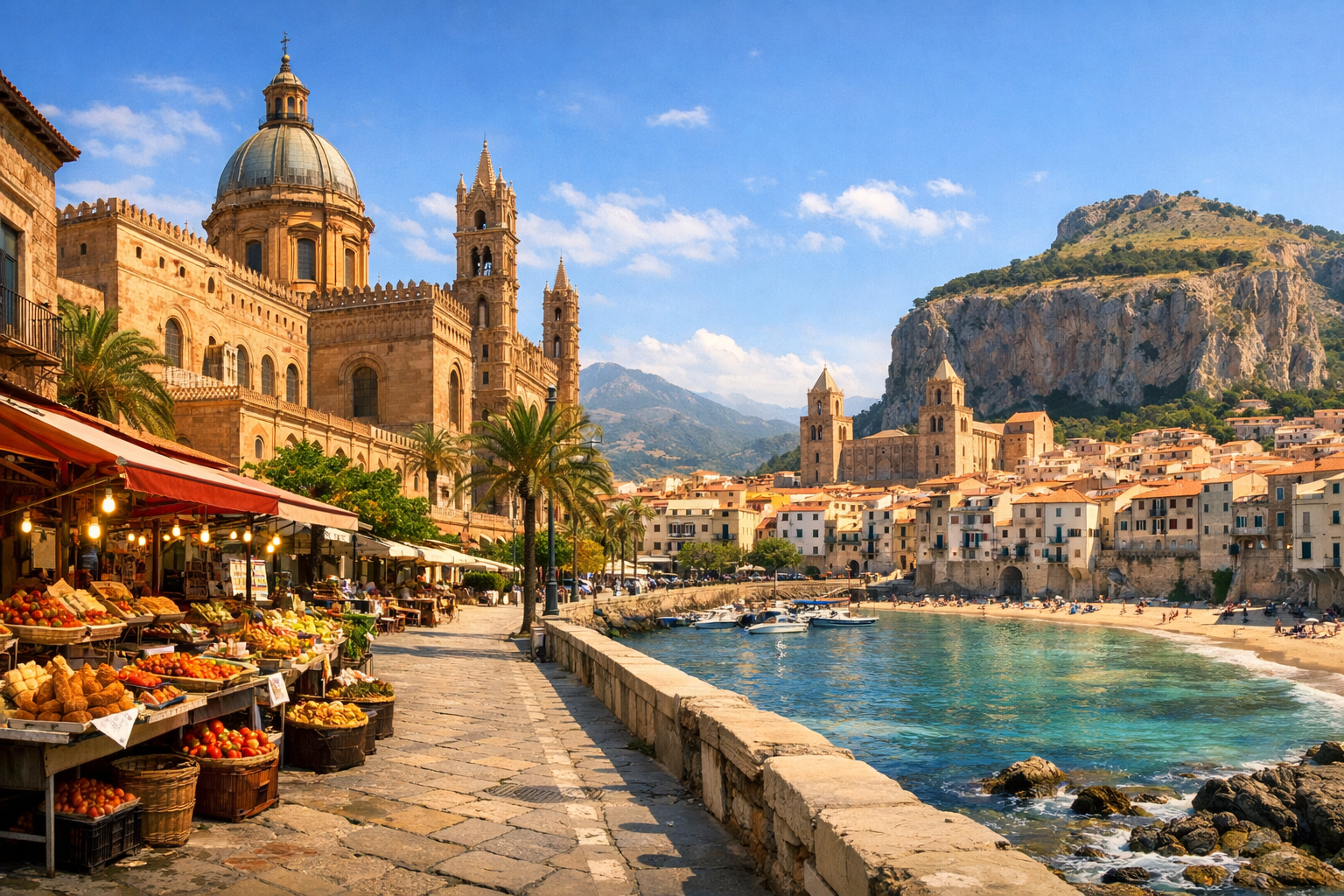
Italy, Palermo and Cefalù. A budget trip through Sicily with markets, Arab-Norman architecture, street food, and relaxation on the beach.

Italy, Palermo and Cefalù. A budget trip through Sicily with markets, Arab-Norman architecture, street food, and relaxation on the beach.

Discover Sicily on a budget with Palermo’s lively markets, Arab-Norman landmarks, and unforgettable street food. Then slow down in Cefalù, where golden beaches and a charming old town offer the perfect seaside escape before heading back to Palermo.

🧭 DAY-BY-DAY ROUTE

Ready-made country and city routes with daily plans, sights, transport and accommodation. Buy PDF guides for independent travel.

🧭 DAY-BY-DAY ROUTE


Day 1 — Palermo: arrival, Ballarò and an evening in Kalsa

  • 🚆 If you arrive at Falcone Borsellino Airport, the most convenient budget option is to go into the city by Trenitalia train to Palermo Centrale: travel time is about 45 minutes, with a price guide of around €5.90–6.80. An alternative is the Prestia e Comandè bus to the Politeama area, about 50 minutes, around €6.30, with services usually running every 30 minutes. The train is better value if you are staying near the station or close to Ballarò Market; the bus is more convenient for the Via Roma and Teatro Massimo area.

  • 🏨 After check-in, don’t overload your first day with museums. For a budget trip, it makes sense to base yourself in Palermo’s historic center and then explore almost everything on foot. The area around Palermo Centrale, Via Maqueda, Ballarò and Kalsa lets you save on transport, quickly reach markets, cathedrals and the evening seafront, and during the day feel the city’s real rhythm — with loud calls from vendors, the smell of fried panelle, and facades where Arab, Norman and Baroque layers can literally be read one over another.

  • 🚶 Start with Ballarò Market — one of the liveliest and most distinctly Sicilian places in Palermo. It’s best not to rush here: stroll past stalls with vegetables, fish, spices, candied citrus and street food, and try panelle, crocchè, arancine or sfincione in simple spots where locals eat. Ballarò is especially good as a budget food scene: instead of one expensive restaurant, you build your lunch piece by piece while also getting to know the city’s culture through the noise, accents, gestures and rhythm of the market.

  • ⛪ Then walk to Chiesa del Gesù and the Piazza Pretoria area, and continue along Via Maqueda to Quattro Canti. This part of the route requires almost no spending, yet gives you a very dense visual impression of Palermo: narrow streets suddenly open into Baroque squares, and severe stone facades sit alongside balconies, laundry, small shops and little cafés. Already on the first day it becomes clear why Palermo feels less like an “open-air museum” and more like a city where architecture lives inside everyday life.

  • 🌅 In the evening, head toward Kalsa, La Cala and Foro Italico. The waterfront here is free, spacious and very pleasant for relaxing after the journey: the sea, a long promenade, green space and golden light on the facades of the old town create a gentle end to the day. It’s also a good moment for an inexpensive dinner: pick up some street food, a slice of pizza al taglio or a simple pasta dish in the neighborhood without overpaying for tourist atmosphere.


Day 2 — Palermo: Arab-Norman heritage and the cathedral district

  • 🚶 Dedicate the second day to the main historical theme of the trip — Arab-Norman Palermo. It is here that you most vividly feel how Sicily was a bridge between the Islamic Mediterranean, the Latin West and the Byzantine East. The route is easy to do on foot and with a minimal number of paid entries: first Palazzo dei Normanni and Cappella Palatina, then San Giovanni degli Eremiti, and after that continue to Cattedrale di Palermo.

  • 👑 Palazzo dei Normanni and Cappella Palatina are the strongest paid sight on the route, so on a budget trip it makes sense to choose this as the main museum ticket of the day. The royal palace is tied to the era of the Norman Kingdom of Sicily, while the Palatine Chapel amazes not by its size but by its concentration of beauty: golden mosaics, a carved wooden ceiling with Islamic motifs, Byzantine and Latin iconography, and the solemn geometry of the space. Even if you are trying to save money, this is the place where it is best not to skip the entrance.

  • 🌴 San Giovanni degli Eremiti, with its recognizable red domes, creates a completely different impression — more intimate and quiet. Here the blending of Sicily’s artistic languages is especially easy to read: austere stone architecture, an inner courtyard, monastic silence and southern light make this place almost meditative. If your budget is tight, you can limit yourself to seeing it from outside and walking around the complex, saving your money for the chapel or for a museum on the next day.

  • ⛪ Palermo Cathedral is best understood not only as a cathedral, but as a multilayered biography of the city. Its appearance contains traces of the Norman era, Gothic, later reconstructions and Catalan motifs. You can usually enter the main part of the cathedral for free, while the paid areas — the roofs, treasury and other parts of the monumental route — are worth choosing only if you have extra budget and energy. Even without the expensive options, the square itself, the facade and the neighboring streets give a strong sense of the grandeur of old Palermo.

  • 🍋 After such a dense historical block, have an inexpensive lunch in the Capo market area or on the side streets near Via Beati Paoli and Teatro Massimo: arancine, pasta al forno, cannolo or granita cost noticeably less than a full restaurant lunch. You can end the evening around Teatro Massimo and the surrounding streets, where it is pleasant to simply walk, watch city life and avoid spending extra.

Day 3 — Palermo: markets, street food, museums by choice and the city’s free-flowing rhythm

  • 🥖 The third day is deliberately left more flexible and budget-friendly. In the morning, head to Capo or Vucciria Market — not as a “must-see attraction,” but as a continuation of getting to know the city’s gastronomic character. Capo during the day is usually more about produce and everyday life, while Vucciria feels more like one of Palermo’s urban myths: narrow streets, signs, graffiti, old exposed stone and the sense that the historic center here has not been polished up for tourists.

  • 🍤 This is the best day for unhurried street food. Focus on simple local things: pane e panelle, pane con la milza, sfincione, arancine, fritti misti, and small desserts in pastry shops. The budget format is actually organic in Palermo: food on the go and food eaten standing at the counter are part of the culture, not a compromise. If you choose places with high turnover and freshly fried food, you can eat cheaply, fillingly and quite safely.

  • 🏛️ In the second half of the day, choose one paid place based on your interests. For art — Palazzo Abatellis, with a strong Sicilian collection and the famous “Triumph of Death”; for archaeology — Museo Archeologico Regionale Antonino Salinas; for a calmer green pause — Orto Botanico di Palermo. From a budget point of view, it’s not worth trying to do everything at once: one museum per day gives you savings and a more human pace without museum fatigue.

  • 🌿 If you want an especially inexpensive and relaxed option, after the museum walk through Kalsa to Foro Italico. This is a good day to simply live in the city: have a coffee standing at bar, sit by the sea, look at the boats at Cala and give yourself a little time without a fixed agenda. For a short trip, this matters: Palermo is beautiful not only in its monuments, but also in its rough-edged, noisy, living everyday life.

  • 🛡️ It’s useful to keep safety in mind: in markets and on busy streets, keep your phone and wallet deeper inside your bag or pocket, don’t leave your bag open, and late in the evening choose well-lit routes via Via Maqueda, Via Roma, Teatro Massimo and the larger streets. No destination is ever completely safe, and before your trip it is worth checking current city warnings and transport changes once again.

Day 4 — Cefalù: train transfer, old town and beach

  • 🚆 In the morning, travel from Palermo Centrale → Cefalù on a regional Trenitalia train. The journey usually takes about 50 minutes to 1 hour 10 minutes depending on the service, and with an early purchase or the standard regional fare, it is one of the most economical and convenient transfers on the whole route. It is sensible to buy tickets in advance in the Trenitalia app, on the website, at station machines or at the ticket office. For a short trip in Sicily, the train to Cefalù is almost the ideal balance of price, comfort and predictability.

  • 🏖️ After arrival, you can walk to the historic center and the beach, so there is no need to take a taxi. After Palermo, Cefalù feels completely different in rhythm: brighter, more compact, quieter, more resort-like, but without losing historical depth. It’s a pleasant place to slow down and, for the first time on the route, give yourself proper seaside relaxation without long transfers.

  • ⛪ Start at Piazza del Duomo and Cefalù Cathedral — one of the key elements of the UNESCO World Heritage site. The cathedral makes a strong impression already from the outside: powerful towers, severe stone, the clear geometry of the square and the backdrop of the old town. Inside, the mosaics and the image of Christ Pantocrator are especially important, making the space solemn and almost Byzantine in its radiance. A basic visit to the square and cathedral fits very well with the day’s budget format.

  • 🏘️ After the cathedral, simply wander through the old town: Corso Ruggero, little inner courtyards, alleys, openings to the sea, the Lavatoio Medievale and stone houses where you feel not museum staging but old coastal life. Cefalù is very photogenic, but its charm is not in postcard prettiness — it lies in the gentle combination of sea air, medieval density and southern relaxation.

  • 🌊 In the evening, head to Spiaggia di Cefalù. This is the most budget-friendly beach scenario on the route: the town beach is easily accessible on foot, and you can do without expensive beach clubs by simply choosing a free area and spending a few hours by the water. In high season, prices for loungers and umbrellas can vary noticeably, so to save money it makes sense to bring a towel and use the free part of the beach if conditions and crowd levels allow.

Day 5 — Cefalù: morning by the sea, the Mandralisca Museum and return to Palermo

  • 🌅 Start the day early, while the town is not yet overheated and not yet filled with tour groups. The morning sea in Cefalù is one of the best moments of the whole trip: soft light, views of La Rocca, calm water and the old town behind you create exactly the Mediterranean picture people come here for. If you don’t want to overload the day, you can limit it to the beach, a light breakfast and a leisurely walk.

  • 🖼️ Then visit Museo Mandralisca — a small but very substantial museum that is perfect for a short route. Its main treasure is the famous portrait by Antonello da Messina, often called “Ignoto Marinaio.” This is not a huge half-day museum, but a compact cultural place where art, archaeology and local history are gathered on a scale that is easy to take in. For a budget trip, this format is especially convenient: the ticket is usually moderately priced, while the experience is very high quality.

  • 🍝 For lunch, it is better to choose a simple trattoria away from the most formal tables on the cathedral square, or get takeaway food. In Cefalù, prices at tourist spots by the sea are often higher than on side streets. More economical options include set menus of the day, panini, pizza slices, simple pasta dishes and granita. Here it is especially easy to accidentally “eat up” extra budget because of the location rather than the quality of the food.

  • 🚆 After lunch, return to Palermo by train. This rhythm — 2 nights in Cefalù or 1 night with a tighter budget — can be adjusted, but for a six-day route without overload it is convenient to spend one full day and part of the next in Cefalù, and then stay overnight in Palermo again before your flight. The return trip by rail once again saves money and removes the stress associated with driving and parking.

  • 🌃 In the evening in Palermo, leave some free time for last shopping at the markets, a walk along Via Roma or a light dinner. This is a good moment to try what you still haven’t had time for: cannolo, cassata, gelato, fried snacks or simple pasta in the station and historic center area, where you can eat noticeably cheaper than in the most hyped tourist quarters.

Day 6 — Palermo: a calm morning, final spots and departure

  • ☕ It’s best to keep the last day light and without strict obligations. If your flight is late, devote the morning to places you didn’t have time for: a short visit to Orto Botanico, a walk along Foro Italico, an exterior look at Palazzo Abatellis or another pass through your favorite market for gifts and food souvenirs. This kind of ending helps keep the trip from turning into a race until the very last minute.

  • 🛍️ For budget shopping, it makes more sense to look not at souvenir shops on the most touristy squares, but at grocery stores, markets and little food shops: pistachio cream, packs of pasta, local sweets, spices, capers, oregano, almond cookies and salt usually look more interesting than standard magnets and often cost less.

  • 🚆 Again, allow extra time for the trip to the airport. The most economical way is the Trenitalia train from Palermo Centrale to the airport; the Prestia e Comandè bus from the center also runs. If your flight is early or late, be sure to check the current schedule, possible strikes and temporary route changes the day before. In Sicily, transport plans are best checked right before travel, not only when building your itinerary.

  • 🎫 Buying tickets: for trains, the Trenitalia app and website, machines and ticket offices at stations are the most convenient; for Palermo city buses — AMAT sales points, the company’s online channels and the MyAMAT app, as well as authorized sellers. Before your trip, it’s worth checking exactly which ticket types are currently available: usually there are single bus/tram tickets, various passes and travel formats, and for intercity trains — standard regional tickets without mandatory seat reservations.

  • ⚠️ Important reminder: information about safety, weather, road conditions, beach accessibility, museum operations, train and bus schedules, and possible restrictions may change. Before your trip, be sure to recheck official warnings, the weather forecast, transport schedules and the current opening hours of sites. No destination can be considered completely safe.

Flight tickets

eSIM for travel

Buy PDF guide

Buy PDF guide — 12.85 USD

PDF — 12.85 USD