
Buy PDF guide

Buy PDF guide — 8.57 USD

PDF — 8.57 USD

Italy, Bologna. A budget-friendly food tour through covered arcades, the historic university district, markets, and free viewpoints.

Italy, Bologna. A budget-friendly food tour through covered arcades, the historic university district, markets, and free viewpoints.

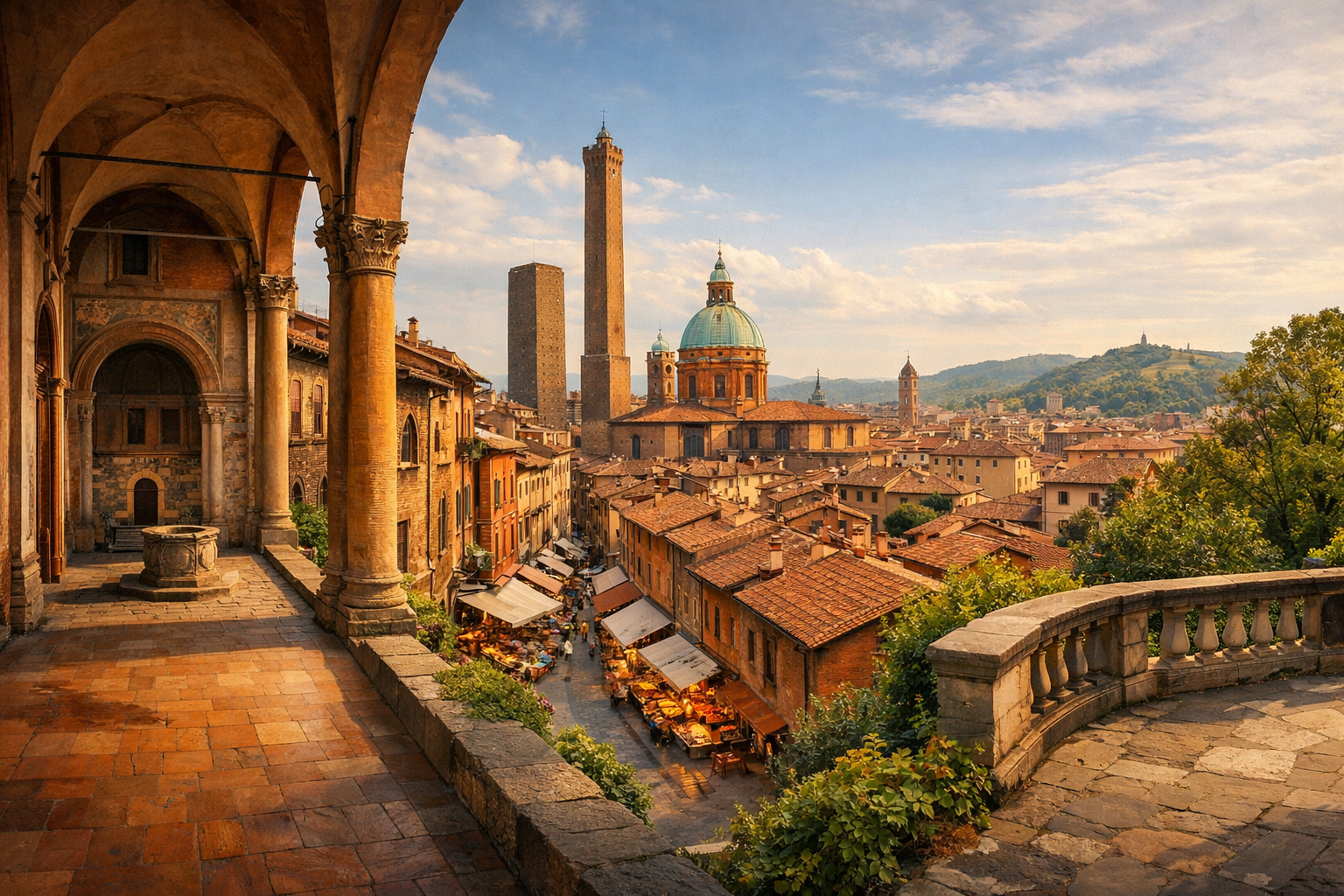
Bologna is made for a budget-friendly feast, where covered arcades lead you from old market stalls to casual trattorias and tiny bakeries. Wander through the lively university quarter, sample local flavors as you go, and end with wide city views that feel priceless.

🧭 DAY-BY-DAY ROUTE

Ready-made country and city routes with daily plans, sights, transport and accommodation. Buy PDF guides for independent travel.

🧭 DAY-BY-DAY ROUTE


Day 1 — Bologna: first impressions, covered arcades, and budget food in the center

  • 🚆 If you arrive at Guglielmo Marconi Airport, the most direct way to reach the center is the Marconi Express to Bologna Centrale: the trip usually takes about 7–8 minutes to the station, and from there most budget hotels and hostels in the university area or near the station are within a 10–20 minute walk. To save money on a short route around the historic center itself, it makes sense to walk more: Bologna is compact, and its famous porticoes are not just shelter from the sun and rain but a real urban stage, making a walk comfortable and safe even with a backpack.

  • 🚶 Start your route at Piazza Maggiore — the square where Bologna’s character is especially tangible: stern, scholarly, a little theatrical, and very lively. Medieval facades, municipal palaces, the Basilica of San Petronio, and the rhythm of everyday life all meet here. Don’t rush: in this city, the best way to save money is not to chase distant spots but to build rich walking days wisely. From the square, turn under the arcades toward Palazzo d’Accursio and then simply allow yourself to wander through the covered galleries without a strict goal. Bologna is famous for its many kilometers of porticoes, and this is exactly where the city is best understood: students hurry to class, locals stop for coffee, and the traveler gets the rare feeling that the city is not being put on display, but that they are being welcomed into it.

  • 🍝 Next, it makes sense to head to Quadrilatero and Mercato di Mezzo — the historic food fabric of the center, where Bologna smells of cheese, pasta, pastries, wine, and freshly baked focaccia. For a budget format, you don’t need to sit down for a full lunch in a tourist restaurant: it’s much smarter to assemble a tasting from several small items — a slice of mortadella, a portion of tagliatelle al ragù, a piece of pizza, a mini dessert, or a cup of coffee. A rough price guide for budget options: a quick snack usually costs about €5–12, simple pasta in an affordable place around €8–14, and coffee with something sweet another €3–6. This approach gives more impressions and fits a low-cost travel pace better.

  • 🚶 After eating, walk toward Via Rizzoli and the university core around Via Zamboni. This is a different Bologna — not market-like but intellectual and a little rougher, with bookstores, inner courtyards, old walls, and youthful energy. Along the way, look closely at the details of the porticoes: some are stern and almost palatial, others narrow, warm, and everyday. In the evening, it’s pleasant to walk here precisely because the area hasn’t been polished solely for tourists. End the day with a simple dinner in an osteria light format, a pizzeria al taglio, or by buying groceries in a supermarket and having dinner at the hostel. For the first day, this is ideal both for the budget and for your energy.


Day 2 — Bologna: the university quarter, the Archiginnasio, and a green break

  • 🚶 Dedicate the morning to the oldest university district in Europe. Bologna is especially beautiful early in the morning, when the porticoes have not yet heated up and the streets around Via Irnerio, Via Zamboni, and the blocks near the old faculties look almost cinematic. Here, you don’t need to keep buying tickets to feel the city: the main thing is to look at the facades, arches, inner courtyards, notice boards, old bookshop windows, and the lively student environment. This is one of the strongest free experiences in the city, and for a budget route it is literally ideal.

  • 🏛️ Then head to Palazzo dell’Archiginnasio, Piazza Galvani, 1. This is the former historic headquarters of the university, a place where Bologna reveals itself as a city of knowledge, memory, and ceremony. Even if you choose the most economical scenario and limit yourself to viewing it from the outside and the accessible common spaces, the place makes a strong impression: a long portico, coats of arms, a solemn courtyard, and the feeling that for centuries European intellectual energy was gathered here. If your budget allows, you can book a visit to the Anatomical Theatre in advance; this is a paid option, but it is one of the most rewarding in the city and usually better than many random museums.

  • 🥪 For lunch, it’s convenient to return to a more affordable part of the center or toward Via delle Belle Arti and Via Irnerio. In this area, it is usually easier to find student bars, inexpensive bakeries, pizza by the slice, panino, or pasta-boxes. A rough guide: a full simple lunch without alcohol is about €8–15, and if you put it together as bakery + drink, you can keep it within €5–10. In Bologna, it’s easy to overpay for “signature” cuisine in the most touristy spots, so the budget strategy is to have lunch a little away from the main postcard axes.

  • 🌿 In the second half of the day, go to Orto Botanico ed Erbario, Via Irnerio, 42. This is a pleasant green pause near the university area, especially valuable after the dense urban fabric of brick and arcades. The botanical garden does not look like a huge theme park; its strength lies elsewhere — in the silence, the academic atmosphere, the old plant collections, and the feeling that you’ve entered a calm pocket inside a university city. At the same time, it’s important to keep in mind that access to individual areas and visiting hours may change, and in bad weather or during works, access may be restricted. Dedicate the evening once again to an unhurried walk under the porticoes and an inexpensive dinner without unnecessary transfers.

Day 3 — Bologna: markets, Mercato delle Erbe, and free views from the city heights

  • 🍅 Today is the best day for a food-focused experience without overloading your wallet. Start at Mercato delle Erbe, Via Ugo Bassi, 25 — the largest covered market in the historic center. This place is excellent for a budget traveler: you don’t have to order a long restaurant lunch, but can instead put together a lively and authentic selection of several simple items — cheese, fruit, olives, pastries, local delicacies, or inexpensive ready-made dishes. The atmosphere here is very “Bolognese”: less ceremonial than the postcard-perfect Quadrilatero, and more everyday, more real. For a low-cost day, allow about €6–14 for breakfast or an early lunch.

  • 🚶 After the market, walk along Via Ugo Bassi, then head back under the porticoes toward the historic core. In Bologna there is a special joy in repeating routes: in the morning a street looks commercial, by day it feels academic, and by evening almost theatrical. Along the way, you can do some cheap “gastro-spotting” without having to buy anything: look at shops with pasta fresca, windows with tortellini and mortadella, bakeries, and small wine bars to understand where you may want to come back for dinner.

  • 🌇 The main goal of the second half of the day is a panorama without an expensive climb. At the time of planning, the famous Torre Asinelli remains closed due to works in the area around Garisenda, so for a real budget route it makes sense not to rely on it. Instead, use a more accessible and current option: the climb to Torre dell’Orologio, Piazza Maggiore, 1, if you want an inexpensive official panorama with views of red roofs and city facades. It’s not a free spot, but it is one of the most worthwhile paid panoramas in the center. If what you want is specifically a free view, it’s better to choose viewpoints during a walk on the hills or public spaces such as some terraces and sections near the ascent to San Luca that do not require a separate ticket.

  • 🌄 At sunset, make a light outing toward the southern part of the city and the initial sections of the ascent to the porticoes of San Luca, if you have the energy. Even without walking the entire long route to the sanctuary, you can still get that expansive view of roofs, hills, and evening light for which photographers love Bologna so much. The main thing is not to go too late and to consider the weather conditions, path surfaces, and your own physical shape. It’s better to plan your return to the center before dark or by Tper bus. Dinner again should be in a budget format: market food, pizza by the slice, a trattoria with a daily menu, or groceries from the supermarket.

Day 4 — Bologna: the long portico to San Luca, a final panorama, and a calm departure

  • 🚶 Dedicate the last day to the city’s most complete and beautiful free route — the walk to Santuario di Madonna di San Luca along the historic covered path. It is here that you understand especially clearly why Bologna’s porticoes are included in world heritage: they are not a separate attraction, but an entire system of urban life that shifts from everyday routine into an almost pilgrim-like rhythm. The full route requires time and moderate physical endurance, so set out in the morning, bring water, a hat in hot weather, and comfortable shoes. The climb under the porticoes itself is already the reward: the light changes in every arch, and the city gradually remains below.

  • ⛪ Even if you do not set yourself the athletic task of “absolutely reaching it at any cost,” the route to San Luca works perfectly as a budget day with panoramas and breaks. You can walk only part of the route, stop at scenic sections, and return by bus. If you do reach the sanctuary, the reward will be one of Bologna’s most recognizable images: the hill, the soft line of the city, the porticoes descending below, and the feeling that you have seen not a museum postcard, but the true relief of the place. This is one of the best final impressions of the trip, and at the same time it requires almost no spending.

  • 🥙 After returning to the center, have a farewell budget lunch: you can stop by Mercato delle Erbe again or choose an inexpensive panino and coffee near the station so as not to make unnecessary detours with luggage. For the final hours, don’t overload the program with museums: it’s better to leave time for calm packing, buying edible souvenirs in reasonable quantities, and a short walk through your favorite stretch of porticoes. For inexpensive food shopping, dry pasta, simple sweets, small packs of local deli items, and coffee work well.

  • 🚆 If you are leaving by train, from most central points it is usually realistic to walk to Bologna Centrale in 15–25 minutes. If your flight is from the airport, leave a time buffer for getting to the station and transferring to the Marconi Express. In bad weather, in the heat, or with heavy luggage, it’s better not to over-save your energy and to use a city bus or taxi. This 4-day route is designed specifically so that Bologna reveals itself through what makes it special without ruining you financially: covered arcades, a university atmosphere, markets, affordable food, and panoramas that must be earned with steps, not a big budget.

Flight tickets

eSIM for travel

Buy PDF guide

Buy PDF guide — 8.57 USD

PDF — 8.57 USD