
Buy PDF guide

Buy PDF guide — 8.57 USD

PDF — 8.57 USD

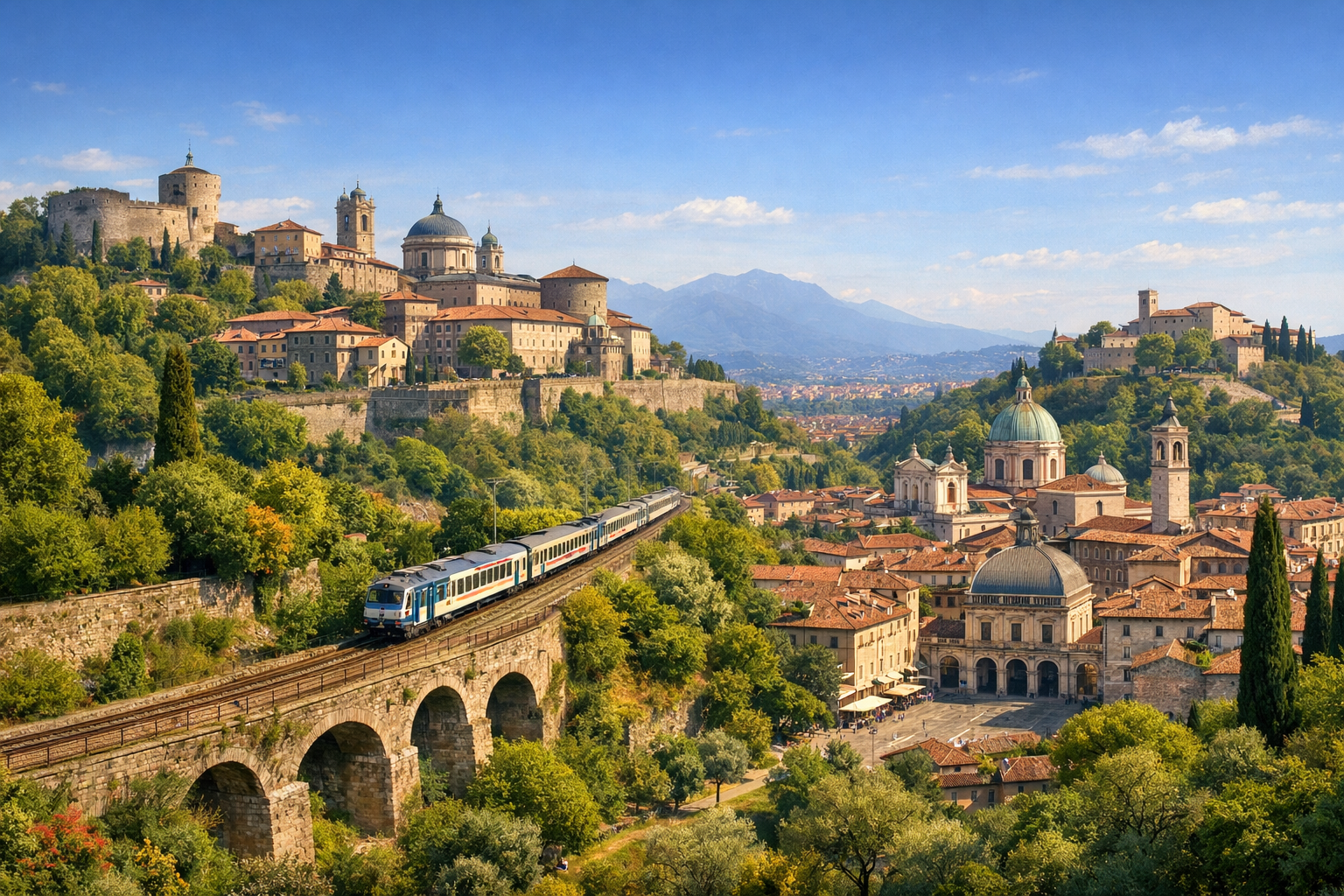
Italy, Bergamo and Brescia. An inexpensive trip through the historic cities of Lombardy with fortresses, squares, and convenient train transfers.

Italy, Bergamo and Brescia. An inexpensive trip through the historic cities of Lombardy with fortresses, squares, and convenient train transfers.

Discover Lombardy on an affordable four-day escape through Bergamo and Brescia, where hilltop fortresses, elegant piazzas, and old stone streets bring northern Italy’s history to life. With easy train connections between the two cities, it’s a relaxed way to experience culture, local flavor, and timeless urban charm.

🧭 DAY-BY-DAY ROUTE

Ready-made country and city routes with daily plans, sights, transport and accommodation. Buy PDF guides for independent travel.

🧭 DAY-BY-DAY ROUTE


Day 1 — Bergamo: Città Bassa → funicular → Città Alta

  • 🚆 If you arrive at Orio al Serio Airport, the cheapest and most sensible way to get into the city is the ATB Linea 1 bus, which goes via the train station, the center, and the lower funicular station up to Città Alta. If you arrive by train, it’s convenient to start your route on foot from Bergamo station through Città Bassa without spending money on a taxi: it’s about a 10–15 minute easy walk to the historic core of the lower town.

  • 🚶 It’s best to devote the first day to a gentle introduction to Bergamo, because this city is especially beautiful when it reveals itself gradually: from bottom to top, from a more modern urban fabric to the medieval hilltop. Start in Città Bassa, where broad avenues, cafés, and the calm rhythm of northern Italy create the feeling of a comfortable, lived-in city, then head up on the historic funicular to Città Alta — the old upper town surrounded by powerful Venetian walls included on the UNESCO list. The ride itself saves energy and becomes part of the experience: from the carriage, roofs, towers, and green slopes gradually come into view.

  • 🚶 In Città Alta, walk through the old gate to Piazza Vecchia — one of the most harmonious squares in Lombardy. There’s no need to rush here, and you don’t have to buy lots of tickets: it’s enough just to look around. The stone paving, the severe facades of the civic palaces, the Campanone tower, and the rhythm of the small streets create that very atmosphere of an “Italian fortress-city” that people come to Bergamo for. From the square, it’s easy to reach Piazza Duomo, where the city’s main historic symbols are gathered side by side: Cathedral of Sant’Alessandro, Basilica di Santa Maria Maggiore, and Cappella Colleoni. Especially nice is that part of this ensemble can be seen for free or for a symbolic donation, which is perfect for a budget route.

  • 🚶 After exploring the center, walk along sections of the Venetian walls. This is one of the best free experiences in the city: wide panoramic paths offer views over lower Bergamo, the foothills, and red roofs. In the evening, Città Alta becomes even more expressive — fewer tourists, the stone warms in the sunset light, and the narrow streets feel almost theatrically historic. For dinner, it makes sense to choose an inexpensive place in Città Bassa or get pizza al taglio/panini to take away so you don’t overpay for the most touristy tables upstairs. Budget guideline for the day: city transport and the funicular are covered by the city ticket, food is about 15–30 € per person per day with economical choices.


Day 2 — Bergamo: museums, Rocca, and a calm historical day

  • 🚶 The second day in Bergamo is best made more culturally насыщенным, but still inexpensive. In the morning, start with Palazzo del Podestà on Piazza Vecchia — it’s one of the best museums for a short route, because it lets you not just look at the old town from the outside, but literally understand how it developed from Roman times to the Venetian era. The space stands at the very historic heart of the city, next to the former center of civic and religious power, so a visit here complements yesterday’s walk well.

  • 🚶 Then head up to Rocca di Bergamo — a fortress on high ground that combines military history with one of the best panoramic views in Bergamo. This is a very “Lombard” point on the route: here you feel not a museum set, but a real strategic hill where the history of the city’s defense can literally be read in the landscape. Even if you don’t do a big museum day, the walk itself to the Rocca pays off with the views, shaded areas, and the feeling of an old frontier city between the plain and the pre-Alpine world.

  • 🚶 If you want to add one more calm stop without overload, drop into Convento di San Francesco or the Civic Museum of Natural Sciences “Enrico Caffi.” The first offers beautiful monastic architecture and quiet courtyards; the second is well suited to those who like unusual city museums and want to break up the purely “church-and-fortress” rhythm a little. For a budget trip, this day is convenient because you can choose only 1–2 paid sites and spend the rest of the time on free walks between them and the views.

  • 💤 Stay in the same hotel in Bergamo for the second night: this saves money, energy, and time on checking in again. The evening is best spent down below, around the station area or Città Bassa, where it’s easier to find more affordable dinners and supermarkets. Practical daily budget: 1–2 museum tickets at roughly 5–10 € per site or a combined ticket around 9 €, food about 15–30 €, with no need for expensive transfers.

Day 3 — Transfer to Brescia: squares, Roman heritage, and an evening in the old center

  • 🚆 Transfer: Bergamo → Brescia by direct Trenord train, about 57 minutes with no changes. This is a key argument in favor of exactly this 4-day route: the cities are close enough that you don’t have to spend your budget on intercity buses with awkward connections or on renting a car, and different enough that the trip feels like a full journey through two historic centers of Lombardy.

  • 🚶 After checking in, start getting to know Brescia from the historic center, which is often underrated compared with more promoted Italian cities, and unfairly so. Brescia makes a strong impression precisely because of its many layers: here the Roman forum, medieval squares, Venetian and later urban layers all exist side by side. Walk to Piazza della Loggia and then to the cathedral square — Piazza Paolo VI, where the juxtaposition of the Old and New Cathedrals creates one of the most expressive urban scenes in northern Italy. These spots are easy to reach on foot and require almost no spending, yet they give a strong sense of the city’s scale.

  • 🚶 The main cultural anchor of the day is the Via Musei area, where Museo di Santa Giulia and the Brixia archaeological zone are concentrated. This is one of the most valuable places on the route: not just a separate museum, but a complete urban story in which the ancient forum, monastic spaces, and archaeology come together into a picture of rare integrity. Even if you’re keeping an economical pace and visiting only one main museum, this is the best place to spend money on a ticket, because the value of the visit is genuinely high.

  • 🚶 In the evening, Brescia becomes especially pleasant for an unhurried walk: the center is not as noisy as in major metropolises, the streets are easy to navigate on foot, and the squares fill with local life rather than purely tourist activity. For dinner, choose a trattoria away from the grandest spots, or go for an aperitivo leggero, pizza, the pasta of the day, or groceries from a supermarket. Budget guideline: the Bergamo—Brescia train is usually inexpensive, food is 15–30 € per day, and a museum day is optional so the total cost doesn’t swell.

Day 4 — Brescia: Castello di Brescia, panoramas, and a final day without rushing

  • 🚶 The final day is best devoted to the fortress theme that makes Brescia especially good. Head up to Castello di Brescia on Cidneo hill — one of the most impressive yet accessible urban castle complexes in northern Italy. Entry to the castle grounds itself is free, and that alone makes it ideal for a budget trip. What matters here is not only the architectural site itself, but also the sense of space: bastions, walls, climbs, panoramas, and the constant presence of the city below.

  • 🚶 The castle is great because it allows for a full day even with almost no spending. You can simply walk around the grounds, look at the lines of the fortifications and the city roofs, or additionally visit Museo delle Armi Luigi Marzoli if you want to deepen the theme of fortifications and military history. This is especially fitting after Bergamo: in the end, the route comes together into a coherent story of Lombardy through walls, towers, fortresses, squares, and convenient rail links.

  • 🚶 After the castle, return to the center via San Faustino or Piazza Vittoria and leave time for a calm final coffee, a late lunch, and packing. This pace matters for the realism of the route: budget travel becomes more pleasant when it includes not only rushing between points, but also normal pauses for rest, water, shade, and food. If you are leaving by train, it is easy to get from the center to the station on foot or by metro/bus.

  • ⚠️ This route is designed to be affordable and convenient, but before the trip you should still make sure to recheck official warnings, the weather forecast, transport schedules, temporary restrictions at sites, and possible city works. Information about safety, weather, road conditions, and route availability may change. No destination can be considered completely safe.

Flight tickets

eSIM for travel

Buy PDF guide

Buy PDF guide — 8.57 USD

PDF — 8.57 USD