
Buy PDF guide

Buy PDF guide — 10.71 USD

PDF — 10.71 USD

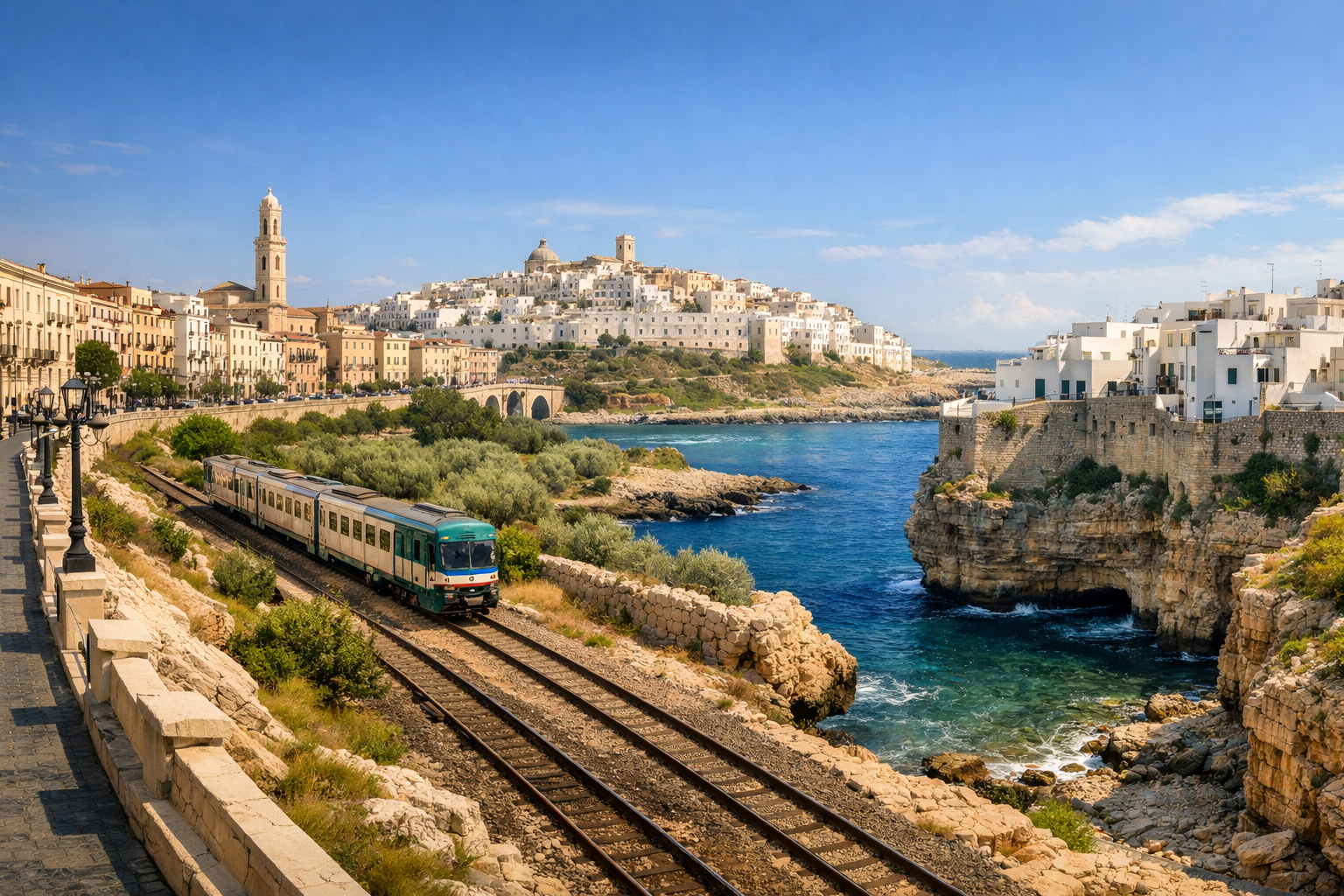
Italy, Bari and Polignano a Mare. An affordable route through Apulia with white towns, historic districts, beaches, and trips on regional trains.

Italy, Bari and Polignano a Mare. An affordable route through Apulia with white towns, historic districts, beaches, and trips on regional trains.

Discover an affordable slice of Apulia as you wander Bari’s atmospheric old town, swim beneath the cliffs of Polignano a Mare, and drift through the whitewashed lanes of Alberobello and Locorotondo. Easy regional train rides link historic streets, sunny beaches, and some of southern Italy’s most charming small towns.

🧭 DAY-BY-DAY ITINERARY

Ready-made country and city routes with daily plans, sights, transport and accommodation. Buy PDF guides for independent travel.

🧭 DAY-BY-DAY ITINERARY


Day 1 — Bari: old town, basilica, and seafront

  • 🚆 If you arrive at Bari Karol Wojtyła Airport, the cheapest and most straightforward way to get to the center is by train to Bari Centrale. The journey usually takes about 15–20 minutes, and a ticket from the airport to the center costs approximately €5–6. An alternative is the Tempesta shuttle to the central station and downtown, usually about 30 minutes depending on traffic. After check-in, don’t overload your day: this itinerary is designed specifically to be affordable and realistic, without long pushes after the journey.

  • 🚶 Start getting to know Bari from Bari Vecchia — a dense labyrinth of pale stone streets, arches, clotheslines, and tiny courtyards where life does not look like museum scenery, but continues almost as before. It is one of those old southern Italian quarters where the impression is created not by individual “checklist sights,” but by the very fabric of the city: the smell of baking, the muffled buzz of scooters, open house doors, women who still make orecchiette pasta at the entrance. It is best to wander here slowly, giving yourself time to turn into side alleys and emerge into small squares.

  • ⛪ The main historical stop of the day is Basilica di San Nicola, Largo Abate Elia, 13, 70122 Bari. This is one of the most important churches in Apulia and a rare place where Romanesque austerity, pilgrim tradition, and everyday city life are all felt at once. Even if you are not planning a deeply religious visit, it is worth coming here for the massive pale façades, heavy arches, and the atmosphere of an ancient maritime city that looked eastward for centuries. Entry to the basilica itself usually does not require a large budget, so it is an ideal sight for a low-cost itinerary.

  • 🌊 Toward evening, head out to Lungomare Nazario Sauro — Bari’s broad seafront line, where the city opens up not as a labyrinth, but as an open stage with sea, wind, and a long perspective. In the soft evening light, the limestone begins to glow, and the walk itself costs almost nothing while giving a very strong sense of southern Italy. If you still have energy, you can continue to Pane e Pomodoro — the city beach, which works better as an atmospheric stop and a place to look at the sea than as a must-do beach day.

  • 🍝 Budget food for the day: focus on focaccia barese, panzerotti, a slice of pizza al taglio, and small family trattorias in the Murat district and near the station. A realistic food budget with a frugal approach is about €20–35 per day per person if you rely on street food, inexpensive coffee bars, and one simple hot dinner.


Day 2 — Polignano a Mare: historic center and Lama Monachile beach

  • 🚆 Transfer: Bari Centrale → Polignano a Mare by Trenitalia regional train. The trip usually takes about 25–35 minutes. This is one of the most convenient and budget-friendly day trips from Bari: the ride is short, trains run regularly, and a one-way ticket usually falls in the low price range of around €3–5. It is best to leave in the morning to catch the center before the peak crowds and avoid rushing in the heat.

  • 🏘️ Polignano a Mare is not just a resort postcard, but a town where white houses literally hang above the sea from limestone cliffs. The old center here is small but very expressive: narrow lanes, arches, whitewashed façades, tiny balconies, and sudden viewpoints where the sea appears like a theatrical backdrop. The main way to experience it is simply to walk without a complicated plan, moving from quiet passages to balconies above the cliffs and small squares.

  • 🌊 The most famous spot is Lama Monachile, also known as Cala Porto. It is an iconic cove in the center of town, squeezed between high stone walls and a historic bridge. The beach here is pebbly and rocky rather than sandy, so water shoes are helpful for comfortable swimming. Visually, this is one of the strongest locations on the whole itinerary: from above you get the classic view of the gorge, bridge, and strip of sea, while below you feel as if you are inside a stone amphitheater.

  • 📸 Don’t miss the panoramic terraces of the old town and the historic bridge above Lama Monachile itself. The best budget activity here is simply to move between the free viewpoints, catch the changing colors of the water, and watch how the white town shifts from midday light to golden evening. In good weather you can add a swim; in strong heat it is wise to take a long siesta with water and shade, because the stone and cliffs heat up quickly.

  • 🍋 For food, keep to a simple format: panino, focaccia, gelato, coffee, and inexpensive takeaway seafood snacks. Polignano is noticeably more touristy than Bari, so to save money it helps either to have breakfast and dinner in Bari, or to choose small places away from the most famous terraces. In the evening, return to Bari on the same regional train for the night so you do not overpay for accommodation by the sea.

Day 3 — Alberobello: trulli and a white town without a car

  • 🚆 Transfer: Bari → Alberobello is easiest to plan through the Ferrovie del Sud Est system. Depending on the timetable, there may be a direct segment or a transfer; most often the journey takes about 1 h 30 min to 2 h 15 min. It is not the fastest outing, but it remains budget-friendly and fits well with the concept of traveling without renting a car. Before the trip, be sure to check the current timetable for your exact date, because changes are possible on regional lines.

  • 🏠 Alberobello is the most fairy-tale-like day of the itinerary and at the same time one of the most photogenic towns in all of Apulia. Its famous trulli — whitewashed houses with gray conical roofs — do not look like a museum model: this is a whole urban landscape that is especially beautiful early in the morning or closer to evening, when the crowds thin out. Here it is important not to run only along one street, but to see both the busier Rione Monti district and the calmer Aia Piccola, where the sense of a real living environment is stronger.

  • 🚶 A walk through Rione Monti gives you that classic Apulia postcard: dozens of trulli, gentle rises, white walls, stone benches, craft shops, and the feeling that the town was built out of light and limestone. But Alberobello becomes truly atmospheric in Aia Piccola — there are fewer shop windows and more quiet, so it is easier to see not only the tourist image, but also the everyday beauty of the place. This day hardly requires any paid entries: the main treasure here is the street itself.

  • 🏛️ If you want to add a museum accent without overloading the budget, stop by Museo del Territorio «Casa Pezzolla», Piazza XXVII Maggio, Alberobello. It helps explain how the trulli town developed and what these houses were in real life, not only in the tourist imagination. But even without the museum, the day will feel full: the views, the texture of the stone, the small stairways, and the panoramas of white roofs create a very complete impression.

  • 🌙 For a budget itinerary, there are two logical scenarios: either return to Bari in the evening if you found a very cheap base there and do not want to change accommodation; or stay one night in Alberobello in a simple albergo diffuso or a guesthouse in a trullo, so you can see the town almost empty early in the morning. The second option often costs a little more, but gives a special atmosphere and saves energy for the next day.

Day 4 — Locorotondo: one of the most beautiful white towns in Apulia

  • 🚆 Transfer: Alberobello → Locorotondo by FSE regional service is usually short, around 15–30 minutes, or a bus segment may be possible depending on the time of day. It is a very logical continuation of the itinerary: after the fairy-tale trulli architecture, you get another image of white Apulia — more elegant, calm, and less “postcard-noisy.”

  • 🤍 Locorotondo is often called one of the most beautiful borghi in southern Italy, and that becomes easy to understand within the first half hour of walking. The town rises on a height, its old core forms a rounded shape, and the white houses with neat façades, flowered balconies, and tidy shutters create an almost perfect rhythm. There are no dramatic Polignano cliffs here and no fairy-tale strangeness of Alberobello — instead there is purity of line, quiet, and a rare harmony of space.

  • 🚶 The best plan for the day is simply to walk through the historic center, coming out to viewpoints over the Valle d’Itria. It is from here that you especially understand why this region is loved for its “white towns”: rolling landscape, stone walls, fields, isolated trulli in the countryside, and light that makes everything soft and almost watercolor-like. This is a very budget-friendly day because the main value of Locorotondo is its free environment, not expensive museums.

  • 🍷 Although the town is also known for its wine surroundings, a budget traveler can easily skip expensive tastings: it is enough to choose a simple lunch at a local bar or tavola calda, get water, panini, focaccia, or an inexpensive pasta of the day. In the hot season, it is especially important to leave time for resting in the shade and not try to cram in too much: this town opens up best at a slow pace.

  • 🚆 In the evening, return to Bari via Alberobello or by the current regional transport connection. At this stage, the advantage of a compact itinerary is especially clear: you see several very different faces of Apulia, but without exhausting long transfers and without unnecessary car expenses.

Day 5 — Bari: museum finale, beach, and a relaxed departure

  • 🏛️ It is best to leave the last day for Bari again — a cheap and practical solution before departure. In the morning, you can visit Pinacoteca Metropolitana "Corrado Giaquinto", Via Spalato 19 / Lungomare Nazario Sauro 27, 70121 Bari. It is a good way to add art to the trip and rest a little from intensive walks in the sun. Another option for history lovers is Museo Archeologico di Santa Scolastica, in the northern part of the old town, in the complex of the former Santa Scolastica monastery.

  • 🚶 After the museum, return to Bari Vecchia again, but now without the rush of the first day. A final walk lets you notice details that often slip by on arrival: old stone staircases, tiny icons in niches, heavy wooden doors, little squares with children and neighbors. In this sense Bari is a very rewarding city: it does not require constant paid entries, yet it gives a rich sense of southern urban life.

  • 🏖️ If the weather and time before your flight allow, head to Pane e Pomodoro. This is a city beach, not an “ideal secret paradise,” but a convenient, honest, accessible location for a last look at the Adriatic. For a budget trip this is excellent: you do not need a transfer, entrance ticket, or sunbed rental if a short walk, a swim, and a rest on your own towel are enough for you.

  • 🛫 For the trip to the airport, allow extra time. The cheapest option is again the Bari Centrale ↔ Aeroporto train. If the flight is early, time is short, or you have a lot of luggage, a reasonable alternative may be the Tempesta shuttle or a taxi, but that is already a less budget-friendly scenario. Information about safety, weather, road conditions, and route availability may change. Before the trip, check official warnings, the weather forecast, transport schedules, and possible restrictions. No destination can be considered completely safe.

  • 💶 Approximate total budget without flights for 5 days in a budget style: accommodation about €45–95 per night per room in affordable options, food about €20–35 per day per person, intercity regional trips and city transport about €35–70 per person for the whole route with early planning and without unnecessary taxis. This makes the Apulia itinerary one of the most sensible options for a short budget trip in Italy.

Flight tickets

eSIM for travel

Buy PDF guide

Buy PDF guide — 10.71 USD

PDF — 10.71 USD