
Buy PDF guide

Buy PDF guide — 6.43 USD

PDF — 6.43 USD

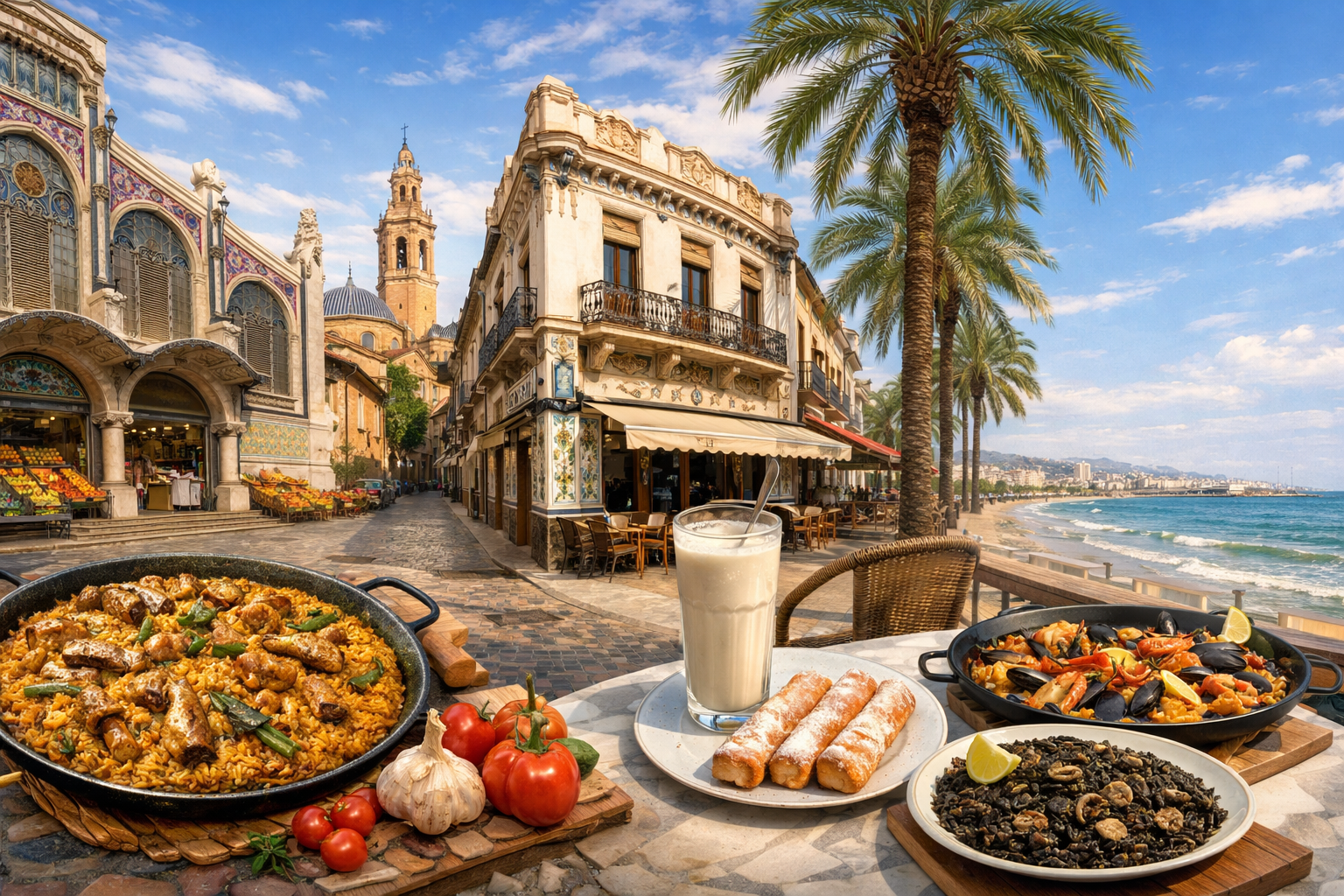
Spain, Valencia. A route to the birthplace of paella with a visit to the Central Market, Horchatería Santa Catalina, and the La Pepica restaurant by Malvarrosa Beach: Valencian paella, horchata, fartons, and rice dishes.

Spain, Valencia. A route to the birthplace of paella with a visit to the Central Market, Horchatería Santa Catalina, and the La Pepica restaurant by Malvarrosa Beach: Valencian paella, horchata, fartons, and rice dishes.

Follow the flavors of Valencia from its old-town markets to the sea. Taste authentic paella, sip refreshing horchata with soft fartons in nearby Alboraya, then end by Malvarrosa Beach at La Pepica, where the city’s love affair with rice and the Mediterranean comes fully to life.

🧭 DAY-BY-DAY ROUTE

Ready-made country and city routes with daily plans, sights, transport and accommodation. Buy PDF guides for independent travel.

🧭 DAY-BY-DAY ROUTE


Day 1 — Valencia: the historic center, the Central Market, and Horchatería Santa Catalina

  • 🚶 Start your gastronomic introduction to Valencia in the old town, where food is felt not as a separate item on the itinerary but as part of the city’s memory. The heart of this day is Mercado Central, one of the most beautiful markets in Spain, located on Plaza de la Ciudad de Brujas, right next to the Silk Exchange and the Santos Juanes church. Under its modernist vaults, it is easy to understand why Valencian cuisine is so deeply tied to produce: here in one space you find seasonal vegetables from the huerta, local citrus fruits, legumes, cured products, seafood, spices, rice, and everything from which the true cuisine of the region is born. It is best to come in the morning, when the market is lively, noisy, and at its most “working” state: you can walk between the stalls, look at garrofó, bajoqueta, saffron, local cheeses, pickles, olives, and understand the taste of Valencia through ingredients rather than through a souvenir display.

  • 🚶 After walking through the market, leave time for a slow gastronomic “warm-up”: buy small snacks or products to taste throughout the day, but do not overload your first lunch, because there will still be several important stops ahead. Valencia is especially good in the format of a long edible route: not one heavy meal, but a series of points where you can taste, compare, and notice the differences between an urban tavern, a historic horchata shop, and a rice restaurant. If the traveler does not eat meat, the market is the easiest place to put together a vegetarian selection of fruit, nuts, pastries, cheeses, and vegetable snacks; if there are gluten-free restrictions, it is more convenient to choose simple products without sauces and clarify the ingredients with vendors in advance.

  • 🏛️ While you are nearby, it makes perfect sense to add a short cultural pause: La Lonja de la Seda, Calle de la Lonja, 2, is literally opposite the market and helps you see how the city’s trading power for centuries relied on the exchange of goods, craftsmanship, and urban prosperity. And a few minutes away on foot is the Museo Nacional de Cerámica y Artes Suntuarias González Martí, c/ Poeta Querol, 2, where it is especially interesting to look at the decorative culture of the region before returning again to the topic of food: Valencian ceramics, table setting, and urban aesthetics perfectly complement the gastronomic route.

  • ☕ Closer to late morning or an early afternoon snack, head to Horchatería Santa Catalina, a historic establishment in the old center near the square and church of the same name. This is an essential point on the route not only for the drink itself, but also for the tradition: here you try tiger nut horchata, that very Valencian horchata de chufa associated with the local summer, an unhurried rhythm, and snack culture. Order the classic horchata and fartons — soft long buns that are perfect for dipping into the chilled drink. This is not just a dessert pause, but an introduction to one of the most recognizable gastronomic calling cards of the region.

  • 🍽️ For lunch or an early dinner, choose a restaurant within walking distance of the center with a focus on arroz and Mediterranean cuisine, without repeating the main paella of the route, which is planned for the seaside day. On this first day, it is better to choose dishes that are not too heavy: arroz al horno, vegetable appetizers, local tomatoes, esgarraet, seasonal fish, or light rice dishes if they are on the daytime menu. This will help preserve the structure of the tour as a gastronomic one, where each day reveals its own theme: market, horchata, huerta, then the beachside rice tradition. If there are dietary restrictions, always ask the staff to point out dishes that are sin gluten, vegetarianas, or sin marisco; in the tourist center of Valencia, staff are often used to such requests.

  • 🚶 In the evening, finish the day with a walk through Plaza de la Reina and toward the Cathedral quarter so that after a насыщенного gastronomic day you can give yourself a calm rhythm. The logistics of the first day are extremely convenient: almost all key points are within the old town and connected by 5–15 minute walks. This is a good day without rush and without taxis, with a focus on taste, architecture, and the feeling that Valencia begins not with the beach, but with the market and the old quarters.


Day 2 — Alboraya and the huerta: tiger nuts, horchata, artisanal traditions, and a cooking workshop

  • 🚆 The second day is devoted not only to food as a result, but also to the origin of the product. From the center of Valencia, it is easy to head out to Alboraya — a municipality closely connected with the cultivation of tiger nuts and the culture of horchata. This is one of the most logical gastronomic outings from the city: the trip takes little time, but offers a completely different, more agricultural and local dimension of the region. The best format for the day is to leave after breakfast in order to see the contrast between urban modernism and the huerta, the historic suburban zone that fed Valencia for centuries with vegetables, tiger nuts, and seasonal greens.

  • 🥛 The main idea of the day is to understand that horchata in Valencia is not limited to a beautiful glass in the city center. In Alboraya, the culture of horchata de chufa is felt more deeply: here the fields themselves, drying rooms, artisanal processing, and the multigenerational transmission of taste matter. As a gastronomic stop, you can choose Horchatería Daniel in Alboraya — one of the most famous names associated with artisanal horchata. Here it is especially appropriate to compare the experience with Horchatería Santa Catalina: in the center you saw the urban tradition, while in Alboraya you see its origin and a more “terroir-driven” interpretation. Order horchata and fartons, and if you like, add ice cream or a light sweet snack, but leave room for the main program of the day.

  • 🌿 If organized visits to the huerta, museum programs, or gastronomic programs about tiger nuts and horchata are available, they are worth booking in advance: such visits are especially valuable because they connect the drink with the land, seasonality, and manual labor. Tourist materials for Alboraya specifically emphasize the importance of tiger nuts and routes through the local fields. This makes the day not just tasty, but truly regional. For travelers with children or for those who do not want long journeys, Alboraya is also convenient because it remains very close to Valencia and does not require complicated planning.

  • 👩‍🍳 After a lunch break, it is ideal to add a cooking workshop on Valencian paella or rice cuisine in Valencia itself. For such an experience, it is wise to choose a reliable school or studio that works with local products and traditional technique. The workshop format is especially good on the second day: after the market and the huerta, it becomes clearer why in a true Valencian paella the rice variety, broth, fire, timing, and respect for the classic recipe are so important. In good classes, participants not only cook but also go over the basics of local gastronomy, the ingredients of paella valenciana, and the difference between dry and meloso rice dishes.

  • 🍚 During the workshop or gastronomic tasting, be sure to pay attention to the key concepts of local cuisine: socarrat, the correct thickness of the rice layer, and the distinction between paella as a specific dish and arroz as the broader world of Valencian rice techniques. If there are vegetarians in the group, it is worth clarifying in advance whether the organizer offers an alternative vegetable version; if there is a seafood or gluten allergy, it is better to mention this when booking rather than trying to solve it on the spot. For traditional paella valenciana, chicken, rabbit, bajoqueta, and garrofó are usually essential, so those who do not eat meat often need a separate option.

  • 🌇 In the evening, return to the city and finish the day with a calm walk through Jardín del Turia or around Mercado de Colón. This finale is especially successful after the workshop: you are no longer just a tourist trying paella, but a person who better understands its structure and place in the culture. If you still have energy, you can have a light dinner without heavy rice dishes: tapas, salads, grilled vegetables, a cheese plate, or seasonal fish would be more sensible than a second substantial arroz in one day.

Day 3 — Malvarrosa and rice by the sea: La Pepica, beachside Valencia, and farewell to the city

  • 🚋 The third day is built around the most symbolic Valencian ritual — a rice lunch by the sea. In the morning, do not rush: it is better to have a light breakfast at the hotel or nearby and save the main gastronomic focus for the middle of the day, because paella valenciana in Valencia is above all a lunchtime, not an evening, culture. From the center, it is convenient to reach the Malvarrosa beach area by taxi, city bus, or a combination of metro and tram-bus connections, but for exact timing it is best to allow about 25–40 minutes depending on your departure point. This is the day when a reservation is especially important.

  • 🍽️ La Pepica is a historic restaurant on the Malvarrosa seafront, one of the city’s most famous rice names. It operates by the sea and has long become part of Valencia’s gastronomic legend: artists, writers, the local public, and visitors came here, for whom rice by the beach was not just food, but a scene of Mediterranean life. The establishment has a clear service rhythm, and booking is recommended in advance, especially on weekends and in high season. For guests, it is important to keep practical rules in mind: traditional arroz dishes are not prepared instantly, the minimum cooking time for paella is around 45 minutes, sometimes longer during busy hours; paella here is usually ordered for a minimum of 2 portions, and for a small table one type of rice is generally expected for everyone.

  • 🥘 If your goal is specifically a route to the homeland of paella, then the most logical choice here is to order paella valenciana, if it is available on that particular day. In the classic version, chicken, rabbit, rosemary, bajoqueta, and garrofó are used; this is important for those who expect a seafood version “by default.” La Pepica also offers signature arroz dishes with seafood and peeled seafood in the style of senyoret/Pepica, as well as a vegetable meloso rice that may suit vegans. Based on the current menu, you should expect Valencian paella and a number of other rice dishes to be priced per portion, usually with a minimum of 2 portions, and the restaurant applies a minimum spend per person. For travelers with restrictions, this is one more reason to contact the restaurant in advance and clarify the available alternatives.

  • 🌊 The advantage of this lunch is not only the food, but also the atmosphere itself: the long stretch of beach, the light of the Mediterranean Sea, the salty air, and the feeling that rice here belongs to the landscape. After a substantial lunch, do not plan complicated museums or long transfers — it is better to leave time for a slow walk along the Paseo Marítimo, catch your breath, have a coffee, and let the day unfold naturally. This rhythm is very Valencian in the right way: first a long arroz, then the sea, then unhurried movement.

  • 🏛️ If you want to add a cultural point before or after the beach, you can connect the day with a short visit to the Marina de València area or return to the city via Jardín del Turia and Mercado de Colón. But it is more important not to overload the final day: this route is designed as a gastronomic one, not as a sightseeing marathon. The finale should feel like a beautiful farewell to the city through its most recognizable flavors — the market, horchata, the huerta, and the rice tradition by the sea.

  • ✈️ If you have a flight scheduled the same day, it is better to book lunch for an early time and choose your airport transfer with extra margin. From central Valencia to the airport, the most convenient options are often metro lines 3 or 5 or an official taxi; from the beach area, a taxi or pre-booked car is more practical. For travelers with dietary restrictions, the final advice is simple: do not rely on improvisation in rice restaurants, but agree on dish ingredients in advance, especially if there is a seafood allergy, gluten intolerance, or avoidance of meat.

Flight tickets

eSIM for travel

Buy PDF guide

Buy PDF guide — 6.43 USD

PDF — 6.43 USD