
Buy PDF guide

Buy PDF guide — 8.57 USD

PDF — 8.57 USD

Spain, Seville. A budget-friendly introduction to Andalusian architecture, squares, markets, the Triana district, and free flamenco performances.

Spain, Seville. A budget-friendly introduction to Andalusian architecture, squares, markets, the Triana district, and free flamenco performances.

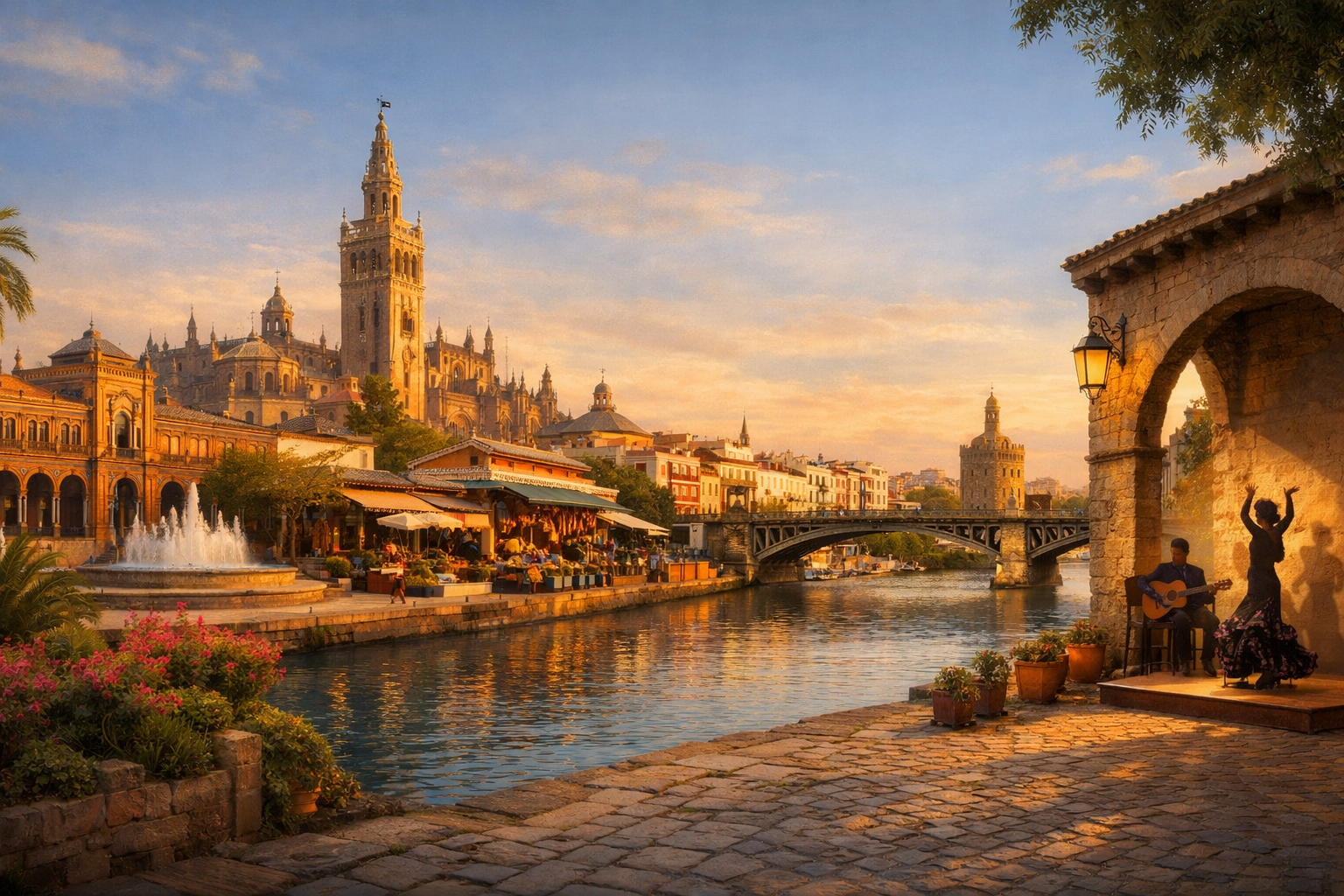
Seville is a budget-friendly gateway to Andalusia, where ornate architecture, sunlit squares, and tiled lanes make every walk feel cinematic. Wander from the historic center to María Luisa Park, then cross into Triana for lively markets, local character, and the chance to catch free flamenco in its most soulful setting.

🧭 DAY-BY-DAY ITINERARY

Ready-made country and city routes with daily plans, sights, transport and accommodation. Buy PDF guides for independent travel.

🧭 DAY-BY-DAY ITINERARY


Day 1 — Historic center: Setas, squares, and first Andalusian facades

  • 🚍 If you arrive at Seville Airport, the most budget-friendly and realistic way to get to the center is the TUSSAM EA airport bus. It goes to key central stops including Santa Justa, Prado de San Sebastián, and Plaza de Armas; the ride usually takes about 35–45 minutes depending on traffic. To save money, it’s convenient to buy a regular one-way EA ticket and then continue on foot and by city buses. Taxis are noticeably more expensive, so for a budget trip it’s better to keep them as a backup option for late evening or heavy luggage.

  • 🏨 After checking in, start getting to know the city with a compact walk through the center without expensive entrance tickets. For the first day, the Encarnación area and the surroundings of Setas de Sevilla are ideal — a huge modern wooden structure known to many as Metropol Parasol. This is a rare case in Seville where ultra-modern architecture does not clash with the old city, but seems to emphasize its layered character: below are archaeology and a market, around it are narrow streets, balconies, tiles, old signs, and warm southern light, and above it all rises an almost futuristic silhouette. Even if you don’t buy a ticket to the upper level, the square around Setas is perfect for a first unhurried evening, photos, and acclimatization.

  • 🚶 From there, it makes sense to walk through Plaza de la Encarnación to Calle Sierpes and Plaza del Salvador, then on to Plaza de San Francisco and Plaza Nueva. This is a very budget-friendly yet rich part of the route: you spend nothing on transport or entrances, but get the most valuable thing in Seville — the atmosphere of the city. In the center, the Andalusian urban fabric is especially visible: inner courtyards behind unassuming facades, wrought-iron balconies, ceramic plaques, and a palette of ochre, terracotta, and sun-faded white. Seville reveals itself not only in monuments, but also in the rhythm of its streets, where at almost every turn a new little square with orange trees and cafés appears.

  • 🍅 For a budget dinner, look for bars and taverns away from the most touristy corners near the cathedral area: in the central neighborhoods you can realistically find simple tapas bars, bakeries, sandwich bars, and menú del día options in the range of about €10–18 per person, while a very economical snack can cost around €4–8. If you want to save even more, a good option is to buy groceries at a supermarket or market and have a light picnic-style dinner in a lively but safe part of the center before late evening.

  • 🌙 On the first night, don’t overload the schedule. In the hotter months, Seville is especially pleasant after sunset: buildings hold the heat longer, the squares fill with people, and walking becomes much more comfortable. If you still have energy, you can end the day with a short evening loop to the exterior views of the Cathedral, the Giralda, and Avenida de la Constitución — without necessarily going inside, just to catch that solemn atmosphere of the old capital of Andalusia.


Day 2 — Plaza de España, María Luisa Park, and museum Andalusia without extra expense

  • 🚶 Dedicate the second day to Seville’s most striking free architecture. In the morning, head to Plaza de España — one of the city’s main stages, built for the Ibero-American Exposition of 1929. The semicircular composition of the square, brick facades, towers, bridges over the canal, painted ceramic benches representing the provinces, and the overall scale of the space create an almost theatrical impression. This is exactly the Andalusian image many people come to Seville for: a mix of regionalism, neo-Mudéjar, Renaissance motifs, water, light, and ornament. The best thing about this place for a budget traveler is that the square itself is free, while the experience feels on par with an expensive attraction.

  • 🌳 Right after the square, walk into Parque de María Luisa. It is the perfect “breather” in the route: shady avenues, fountains, birds, pavilions, and the feeling that the city temporarily dissolves into greenery. The logic of the day matters a lot here: open spaces in the morning before the strong heat, then the park where you can rest in the shade, refill your water, and sit quietly without extra expense. In summer, be sure to plan a long break around midday, because overheating in Seville is a real factor, not an abstract recommendation.

  • 🏛️ In the afternoon, it’s worth moving on to Plaza de América, where beautiful pavilions and museums are concentrated. For a budget itinerary, Museo de Artes y Costumbres Populares de Sevilla at Plaza de América 3, 41013 Sevilla is especially good. Even if you are not planning a long museum day, it is an excellent place to better understand the everyday, craft, and festive culture of Andalusia: ceramics, costume, folk traditions, decorative forms, and the visual language of southern Spain. The building itself also matters — it functions as part of the architectural ensemble and deepens the impression of the area.

  • 🥪 For lunch on this day, it makes sense to keep it simple: a bocadillo, empanada, pastries, fruit, water, and coffee. In the area between Prado de San Sebastián and the center, you can stay within about €6–12 per person if you avoid restaurants right next to the most famous photo spots. For budget travel, this is the best balance: a full day, but without a seated lunch costing €20–30.

  • 🎨 If you still have energy, on the way back you can add Museo de Bellas Artes de Sevilla, Plaza del Museo 9, 41001 Sevilla. It is one of the city’s most important art museums, especially strong in Spanish and Andalusian painting. It is a little less “postcard-perfect” than the monumental park area, but it complements the trip beautifully if you want to see how local religiosity, the Baroque, and the light of Andalusia worked not in the urban fabric, but in painting. After the museum, it’s best to end the evening with a calm walk in the center and an early rest.

Day 3 — Triana: market, ceramics, riverfront, and the search for free flamenco

  • 🌉 The third day is the most “Seville-like” in mood. Cross Puente de Isabel II into Triana, and the city immediately changes tone: there is less grandeur here and more living neighborhood energy. Triana is traditionally associated with crafts, ceramics, river life, a strong local identity, and of course flamenco. For a budget trip, the district is especially convenient because the main impressions here come not from expensive tickets, but from walking, the market, the history of the streets, and observing everyday life.

  • 🥕 Start at Mercado de Triana near Plaza del Altozano. It is not just a market, but a very useful budget stop: you can have breakfast or lunch more cheaply than in a tourist restaurant, buy fruit, pastries, ham, cheese, olives, or a simple snack set. The place is also interesting because the market is integrated into a space with archaeological layers and the history of the former Castillo de San Jorge. A morning visit is especially good: less fatigue, fresher products, and the district is already lively but not yet overheated by the daytime sun.

  • 🏺 Then visit Centro Cerámica Triana, C/ Callao 16, 41010 Sevilla. It is one of the best inexpensive places for the theme of Andalusian architecture, because it is precisely through ceramics that you understand why Seville looks the way it does. Tiles, ornament, workshop kilns, decorative traditions, and the connection between craft and facades, courtyards, and landmark urban ensembles — all this turns a walk through Triana from an ordinary “district visit” into a meaningful immersion in the material culture of Andalusia. It is cool inside, which is especially valuable in the hot season.

  • 🕯️ Nearby is the Castillo de San Jorge space, Plaza del Altozano s/n, 41010 Sevilla. Even if the main exhibition area may operate on a modified schedule, the historical context of the place itself is very important: beneath the modern market lies a heavy, layered memory of the city. After the ceramics, this point gives the route a dramatic contrast and helps you feel Triana not only as a beautiful riverside quarter, but as a place with dense history.

  • 🚶 After lunch, walk along Calle Pureza, the side streets, the river, and toward Calle Betis. This is one of those areas where there is no need to rush: look at the tiles, signs, inner patios, churches, small workshops, and life at the doorways of homes. In the evening the district is especially beautiful: the old center is visible from the other side of the river, the water catches reflections, and the walk itself costs almost nothing.

  • 💃 For the topic of free flamenco, plan a flexible evening. In Seville, free or almost-free performances sometimes take place in bars, cultural venues, hostels, and as part of city events, but these formats vary by day and season. The most realistic budget approach is to check the current city listings and venue programs in advance for your specific travel dates, and on the day itself ask at your hotel desk or at the Triana-Castillo de San Jorge tourist info point. Don’t build the whole day around one unconfirmed show: it is better to treat a free flamenco evening as a pleasant bonus rather than a guaranteed pillar of the itinerary.

Day 4 — Monumental finale: Cathedral district, Archivo de Indias, and a calm departure

  • ⛪ Dedicate the last day to the monumental heart of Seville, but in a budget format without the obligatory set of expensive tickets. Start with an exterior walk around Catedral de Sevilla, the Giralda, and Avenida de la Constitución. Even without going inside, this is one of the city’s strongest urban episodes: paved spaces, the Metrocentro tram, solemn facades, the sound of footsteps and bells, and the combination of tourist bustle with almost museum-like grandeur. For a short trip, this format is especially justified: you see the city’s main symbols without overloading your budget.

  • 📚 Be sure to stop by Archivo General de Indias, Av. de la Constitución 3 / C. Santo Tomás 5, 41071 Sevilla. This place is often underestimated, although it is here that Seville is felt especially clearly as a former global hub of trade, empire, and ocean routes. The building of the former Lonja fits beautifully into the surrounding ensemble, and the visit itself is usually perceived as a calmer and more intellectual pause compared with the noisy squares. It is also a good choice for the hottest part of the day and for those who want not only a “pretty postcard,” but also historical depth.

  • 🏰 If your budget allows for one expensive ticket, the most justified choice is Real Alcázar de Sevilla. But for a budget trip, it makes sense to leave this as an option rather than an obligation. Even without it, the route is still full: you have already seen Plaza de España, the park, Triana, the market, ceramics, the center, and the city’s monumental axis. If you want to keep spending to a minimum, it is better to invest the money not in another ticket, but in a more comfortable lunch, water, rest, or an early transfer.

  • 🍲 Before leaving, have one last simple lunch in the center: a set lunch, soup, tapas, tortilla, gazpacho, or salmorejo depending on the season. A budget guideline is about €10–16 per person for a modest but complete meal. This is better than rushing into an expensive area by the attractions or overpaying at the airport.

  • 🚌 For the return trip to the airport, the EA line is again the most convenient choice. If you are staying in the center, it is better to leave with extra time because traffic and heat can slow the city down. If your flight is very early or late and your luggage is heavy, then a taxi may be worth considering as a practical extra payment for peace of mind. Before traveling, be sure to recheck the current transport schedule, weather forecast, and any possible restrictions affecting sites: conditions in the city change, and no itinerary can be considered completely safe or unchanging.

Flight tickets

eSIM for travel

Buy PDF guide

Buy PDF guide — 8.57 USD

PDF — 8.57 USD