
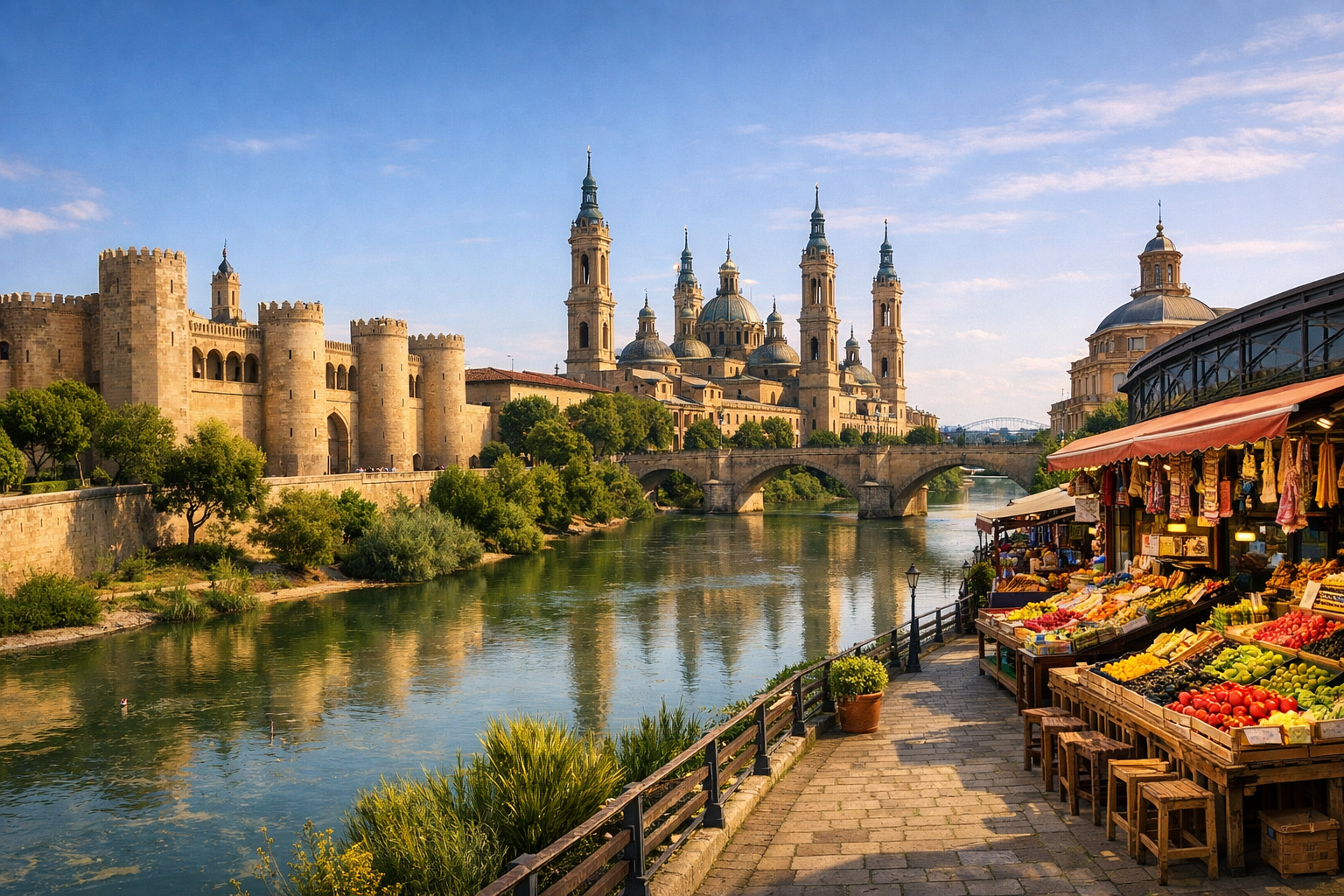
Day 1 — Zaragoza: historic center, basilica, and the Ebro riverfront
🚶 Start your route at Plaza del Pilar — the ceremonial heart of Zaragoza, where the city reveals itself from several angles at once: Baroque monumentality, river openness, and a very lively everyday atmosphere. This is where you can especially feel the scale of the city, which for centuries was an important hub between Madrid, Barcelona, Bilbao, and Valencia. In the morning, the square is especially good for a budget traveler: there is plenty of light, fewer people, and you can calmly take in the ensemble of facades, towers, arcades, and take photos without rushing. The Basílica de Nuestra Señora del Pilar — Zaragoza’s main symbol, standing on the banks of the Ebro — looks not like a separate church, but like a huge architectural stage around which the whole old city revolves. Inside, it is worth moving slowly: spacious naves, domes, religious chapels, and artistic details create the impression of a place that is not only for pilgrimage, but also deeply urban, where history is not separated from everyday life.
🚶 If your budget allows for one inexpensive paid highlight, go up to the basilica’s viewing tower: it is one of the most logical expenses in the city, because for a relatively small amount you get a panorama of old Zaragoza, the curves of the Ebro, bridges, and the roofs of the historic center. On a clear day, the view from above is especially beautiful, showing how the basilica, La Seo, Roman traces, and broad urban axes come together into one complete picture. If you do not want to spend extra, a great alternative is to walk to Puente de Piedra and look at the domes of Pilar from the bridge and the riverfront: it is a free and very striking city view.
🚶 After the basilica, take an unhurried walk along the Ebro riverfront. The river here is not just a backdrop, but an important part of the city’s character: calm water, wide walking areas, bridges, and open views make this stretch one of the best for a slow stroll without extra expenses. The best budget rhythm for the day is to alternate sightseeing with short breaks on benches in the shade and stops by the water. This pace keeps the route from becoming tiring even in summer, when midday can be hot. Along the way, it is easy to pause for coffee and simple pastries, or buy an inexpensive set from a supermarket and have a mini picnic in public spaces where appropriate.
🚶 Next, it is worth stopping by La Seo and the Museo del Foro de Caesaraugusta on Plaza de la Seo. Even if you do not buy every ticket in a row, the area itself is very important for understanding Zaragoza: here you can see that the city grew not only out of Christian monumentality, but also from its Roman past, Islamic heritage, and layered medieval history. The Forum Museum is especially good for a short visit in a budget format: it is not a giant half-day museum, but a compact stop where you can quickly and meaningfully see the archaeological layers of ancient Caesaraugusta and better understand how the Roman urban center was organized.
🍽️ For dinner, do not spread yourself across the whole city: stay in the El Tubo area and the neighboring streets of the old center. This is the most convenient option for budget travel, because you do not need to spend on extra transport, and the choice of inexpensive snacks and simple dishes here is wide. A budget evening format is 2–3 tapas or pinchos plus a drink, roughly about 10–18 € per person, if you avoid the overly touristy storefronts right on the main corners. It is best to stay overnight in this same central zone or near Avenida César Augusto: that way, most of the first and second days can be done on foot.