
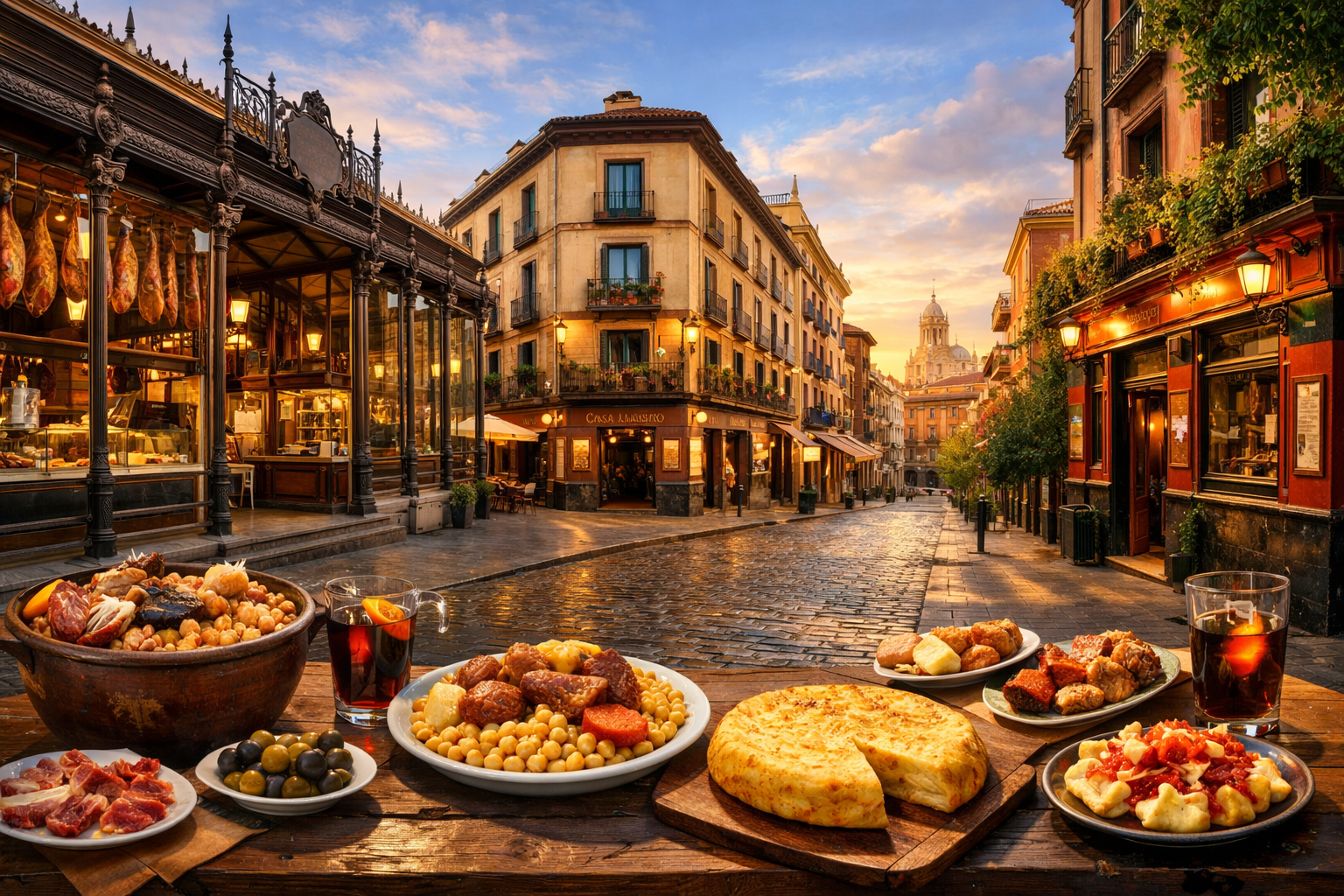
Day 1 — Austrian Madrid and La Latina: market, vermouth, and old Madrid cuisine
🚶 Start your day around Plaza Mayor and Mercado de San Miguel — this is the most convenient gateway into gastronomic Madrid for a short trip. Mercado de San Miguel is located at Plaza de San Miguel, s/n, next to Plaza Mayor, and is open daily: from Sunday to Thursday usually from 10:00 to 24:00, and on Fridays, Saturdays, and the day before public holidays until 01:00. Formally, this is not a classic market for buying groceries for the week, but rather a striking gastronomic space where it’s easy to arrange a thoughtful “tasting breakfast” and get an overview of Spanish products in one place. The idea of the day is simple: don’t fill up right away, but try a little at a time — several kinds of ham, olives, canned seafood, a glass of vermouth or wine, small pinchos, and something warm like croquettes or tortilla tapas. It’s a very touristy place, so prices are above the city average, but the logistics are ideal, the space is beautiful, and the quality of the selection is usually high. For travelers with dietary restrictions, this is the most convenient spot: you can flexibly choose individual items, look for vegetarian snacks, cheeses, vegetable toasts, and non-alcoholic drinks. If a gluten-free diet is important, it’s better to check the ingredients of each tapa on site, because breading, bread, and sauces are common.
🚶 After the market, take a 5–7 minute walk around Plaza Mayor and Calle Mayor to “walk off” the first tastings a bit and shift from the tourist food hall into a more historical context. Plaza Mayor grew out of an old market space and still feels like a stage of the old city: arcades, facades, narrow passageways, and the dense urban fabric around it perfectly explain why the culture of brief stops for wine, tapas, and unhurried meetings developed here. Along the way, you can stop by small delicatessen shops and pay attention to regional products: Manchego, canned anchovies, olive oil, turrón, paprika, jars of legumes, and beautifully displayed cured hams. This is not the museum part of the route, but rather a gastronomic warm-up, when you are not just moving between points, but learning to read the city through smells, shop windows, and historic forms of trade.
🍽️ For lunch, it makes sense to move on to Casa Ciriaco, Calle Mayor 84, about a 10–12 minute walk from Mercado de San Miguel. This is one of those old Madrid addresses where gastronomy feels not like a show for tourists, but like a continuation of the city’s memory. The establishment specializes in traditional Madrid and Castilian cuisine; signature dishes mentioned include gallina en pepitoria, callos a la madrileña, and cocido madrileño, and the average bill is approximately €40. According to published information, Casa Ciriaco accepts walk-in guests, but a reservation is recommended, especially if you want to get a comfortable lunch slot without waiting. The opening hours are usually as follows: Wednesday–Saturday 10:00–23:00, Sunday–Tuesday 10:00–16:00. For this tour, it is optimal to reserve a table for 13:30–14:00. If you want to try Madrid cuisine specifically, but not overload the day with too heavy a lunch before tomorrow’s cocido at Malacatín, a sensible choice is to order one classic hot dish per person and several shared starters for the table. For those who do not eat pork, poultry or fish dishes may work, but it is better to уточнить the ingredients in advance; vegetarians usually have a harder time in such a historic restaurant, so it’s worth checking the current menu and the availability of vegetable dishes beforehand.
☕ After lunch, set aside 1.5–2 hours for a calm walk and rest in La Latina. From Casa Ciriaco, it’s convenient to head down toward Plaza de la Villa, Calle de Segovia, and then to Cava Baja and Plaza de la Cebada. This is a very proper pause for a gastronomic tour: heavy Castilian cuisine opens up better if, after lunch, you don’t rush through sights, but give yourself time to stroll through old streets, drink coffee or mineral water, and simply observe the rhythm of the district. Along the way, you can stop by Mercado de la Cebada, Plaza de la Cebada, 17 — this is already a more everyday municipal market, not as ceremonial as San Miguel. It is useful as a contrast: here you can better feel the ordinary food life of the district, the real rhythm of shopping, meat and vegetable stalls, the gastronomic everyday life of Madrid. For a short gastronomic tour, this is a valuable stop because it balances the “postcard” experience of the first market.
🍷 Toward evening, head to Bodega de la Ardosa. In Madrid guidebooks and gastronomic routes, this is one of the most recognizable old places for vermouth, beer, and classic tortilla. Historically, the name La Ardosa is associated with the address Calle de Colón, 13 in the Malasaña/Chueca area, while current official materials from the group also mention an operating venue at Calle de Santa Engracia, 70. Before your trip, be sure to check which branch and which opening hours you need for your travel dates. For the route, allow 15–20 minutes by taxi from La Latina or about 25–35 minutes total by metro with a short walking section. The point of the stop here is not a full dinner, but an ideal Madrid aperitivo/tapeo: a glass of vermouth on tap, a portion of tortilla, perhaps croquettes, salty snacks, or preserves. This place works especially well as an evening gastronomic accent after a more substantial lunch earlier in the day. If you do not tolerate alcohol well, feel free to replace vermouth with cerveza sin alcohol or a soft drink; if you do not eat eggs, tortilla is of course off the table, so it is better to switch to other tapas and cheeses.
🌙 End the day with a light walk through Malasaña and an early return to the hotel. After a packed gastronomic day, not only the list of what you ate matters, but also the rhythm of recovery: a 20–30 minute walk after tapas will help you cope more comfortably with a late Spanish dinner or even skip a second full meal entirely. If you still have an appetite, keep it to something small — a few slices of ham, olives, or dessert, rather than another heavy set. This kind of balance is especially important before a day devoted to cocido.