
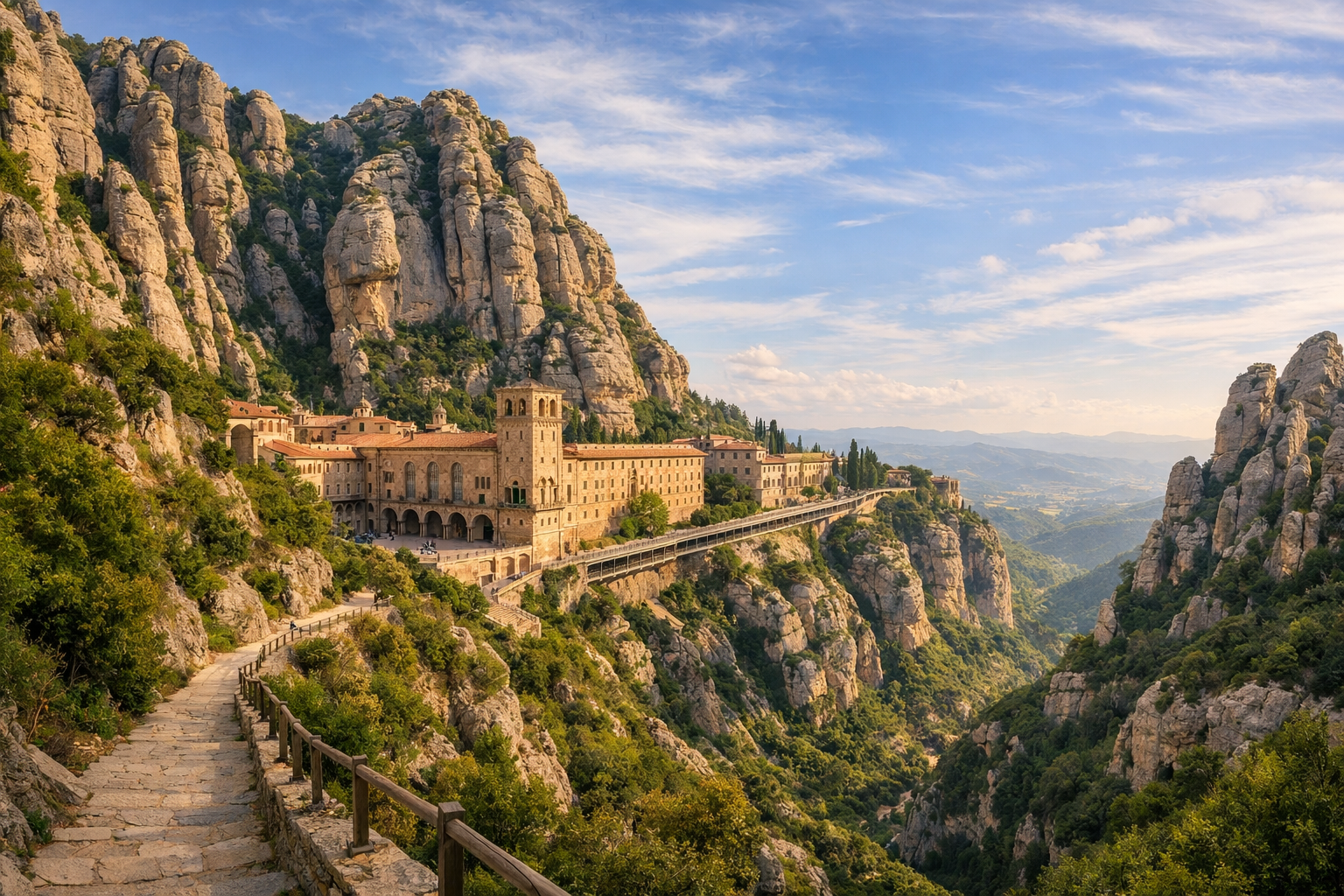
Day 1 — Arrival in Catalonia, ascent to Montserrat, and first acquaintance with the sacred mountain
🚆 Main transfer: Barcelona → Montserrat. The most convenient public option is to take the FGC R5/R50 line from Plaça Espanya to a transfer at Monistrol de Montserrat / Monistrol-Vila and then go up on the Cremallera de Montserrat. The whole journey usually takes about 1.5–2 hours depending on connections. An alternative is a car or taxi from Barcelona via the A-2, C-55, and the BP-1121/BP-1103 road.
🚶 Montserrat is one of the most recognizable and layered places in Catalonia, where geology, religious history, and modern pilgrimage merge into a single experience. Verifiable fact: this is a real mountain massif and Benedictine monastery complex located about 48 km northwest of Barcelona. The rocks of Montserrat are formed from unusual conglomerates, which makes the landscape seem almost otherworldly: rounded stone “fingers,” vertical walls, narrow saddles, and natural terraces create the atmosphere of a place that easily gathers legends around it. This geography is largely what gave rise to Montserrat’s reputation as a “place of power” — but it is important to separate cultural interpretation from fact: the natural features of the massif and the historical development of the monastery are scientifically and historically confirmed, while stories about special energy, mystical visions, and the “vibrations of the mountain” belong to the sphere of spiritual experience, pilgrimage tradition, and local folklore.
⛪ After checking in, start with the central space of Abadia de Montserrat and the basilica. This is not a museum set piece but a functioning religious complex, so a calm tone, modest clothing, and respect for services are especially important here. The main shrine is the image of Mare de Déu de Montserrat, the Black Madonna, revered as the patroness of Catalonia. The historical fact is that the cult of Our Lady of Montserrat has a centuries-old tradition and made this place one of the most important pilgrimage centers on the Iberian Peninsula. The legendary version sounds different: according to local tradition, the statue was miraculously found in a cave by shepherds after an unusual radiance and angelic singing. This story is best understood as part of the sacred narrative of the region rather than as an established historical fact.
🏛️ In the second half of the day, visit Museu de Montserrat. For an esoteric route, it matters not only as an art collection but also as a place where another layer of Montserrat becomes visible: the interaction of spirituality, symbolic art, biblical archaeology, and cultural memory. Here the journey gains intellectual depth: instead of reducing Montserrat to a “magical point on the map,” the museum helps you see how religion, the image of Mary, monastic tradition, and visual symbols have shaped the perception of the mountain for centuries. It is a good counterbalance to romanticized internet myths.
🌄 Toward evening, take a gentle walk to Creu de Sant Miquel. This trail is well suited for a first introduction: it does not require mountaineering training, yet it gives a sense of distance from the tourist core and opens one of the best views of the monastery, the rocky ridges, and the valley. For many travelers, this is where that special feeling of silence appears, the one that draws people to Montserrat. A careful way to put it is this: the place can indeed create a strong emotional and contemplative impression thanks to the relief, silence, and scale; however, any claims of proven “energy cleansing” or supernatural influence are not supported by science.
💤 It is best to spend the night either right at the monastery, to experience Montserrat early in the morning before the main daytime crowds, or in Monistrol de Montserrat at the foot of the mountain if a calmer budget and convenient rail access matter more to you.