
Buy PDF guide

Buy PDF guide — 8.57 USD

PDF — 8.57 USD

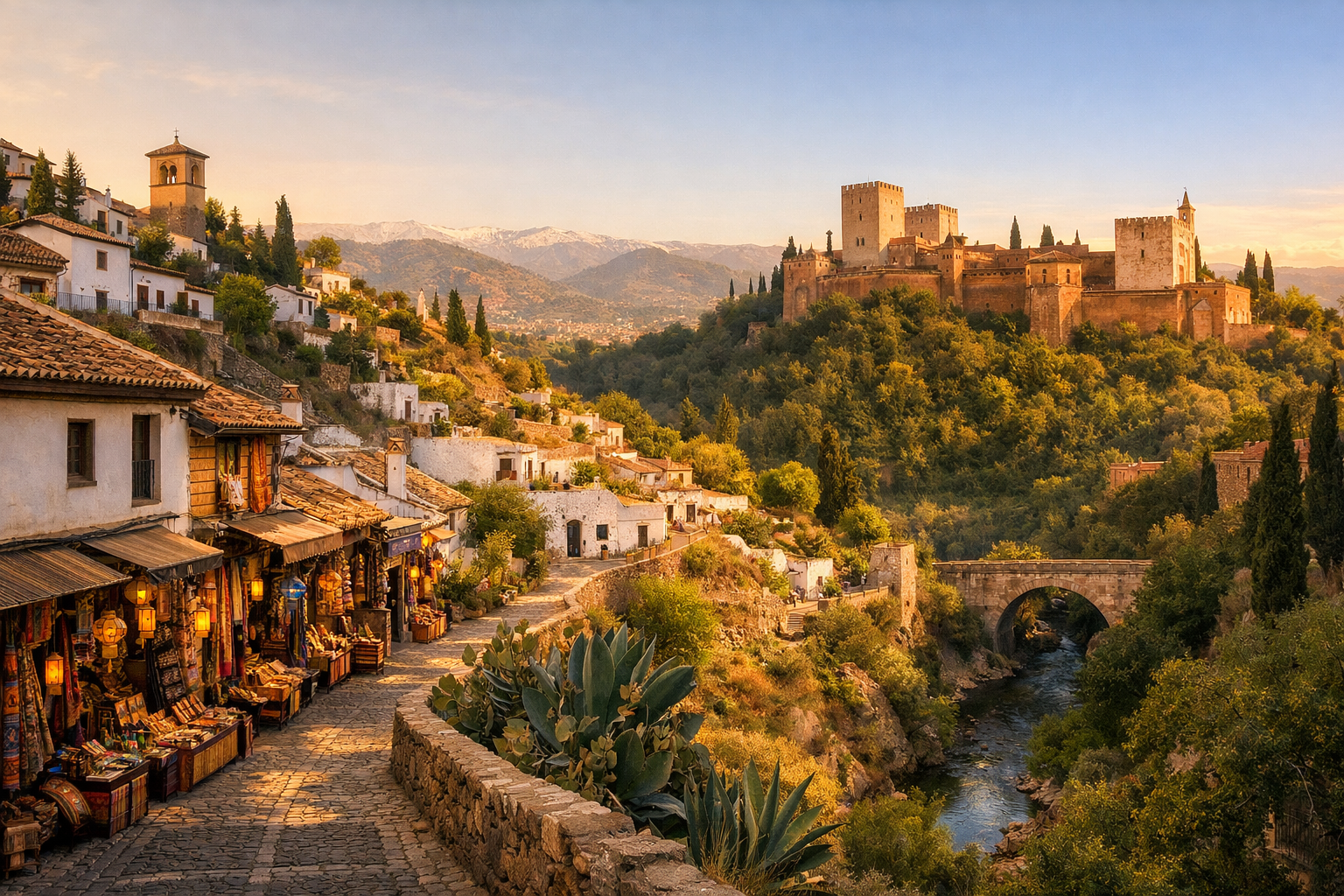
Spain, Granada. An inexpensive trip through the Albaicín quarter, the cave district of Sacromonte, the Arab markets, and the Alhambra palace complex.

Spain, Granada. An inexpensive trip through the Albaicín quarter, the cave district of Sacromonte, the Arab markets, and the Alhambra palace complex.

Lose yourself in Granada’s whitewashed Albaicín lanes, drift up to the cave homes of Sacromonte, and soak up the spice-scented energy of its Arab markets. This budget-friendly 4-day escape ends at the breathtaking Alhambra, where ornate palaces and sunset views linger long after you leave.

🧭 DAY-BY-DAY ROUTE

Ready-made country and city routes with daily plans, sights, transport and accommodation. Buy PDF guides for independent travel.

🧭 DAY-BY-DAY ROUTE


Day 1 — Granada: historic center and Arab markets

  • 🚶 It’s best to make the first day as easy and budget-friendly as possible: check into a hotel in the center or near the lower part of Albaicín, then explore the heart of Granada on foot without complicated logistics. The historic center here is very convenient for a slow introduction to the city: the streets around Gran Vía, the cathedral district, and Plaza Nueva constantly lead either to stone Renaissance facades or to narrow passages where the city’s Muslim past suddenly comes through. For a low-cost trip, this is an ideal start: many key spots are free to visit, and the experience feels rich even without paid museums.

  • 🛍️ Be sure to set aside time for the Alcaicería area — a maze of narrow shopping streets that feels like a small Arab bazaar in the center of Andalusia. Today it is not a medieval market in its full original form, but a restored shopping area with the atmosphere of an eastern quarter: carpets, ceramics, lamps, spices, textiles, tea sets, and souvenirs create that very transition from Christian Granada to its Moorish memory. It is best to come during the day or in the early evening, when the streets are lively but not yet overcrowded. Shopping is optional: even without spending money, it is a great place for a walk and photos.

  • 🏛️ After the markets, it makes sense to walk to Corral del Carbón — one of the most interesting surviving secular monuments from Granada’s Islamic era. It was once a caravanserai and trading courtyard where merchants stayed and goods were stored. Today the place is especially valuable because it helps you feel the scale of everyday, not just palatial, history of Al-Andalus: not the luxury of sultans’ halls, but the real urban fabric of the past. The route between Alcaicería, the cathedral area, and Corral del Carbón is very short, so it hardly requires any transport.

  • 🍽️ For a budget dinner, look for simple tapas bars and small menú del día options away from the most touristy corners of Plaza Nueva. A realistic range for a budget traveler is about €10–18 per person for a filling meal, and with a very modest format such as pastries, coffee, a sandwich, or ready-made supermarket food, you can manage on €6–10. At night, it is better not to head far alone through the empty uphill streets of upper Albaicín: the center itself is lively and convenient, but the steep lanes are more comfortable in daylight or by minibus.


Day 2 — Granada: Albaicín, Carrera del Darro, and sunset at San Nicolás

  • 🚶 Dedicate the second day to Albaicín — the old Moorish quarter that is best explored slowly, with frequent stops and without trying to “rush through” every point. This area is not just a set of pretty streets, but a whole hilly urban landscape of white houses, small squares, stone stairways, cypress trees behind the walls of cármenes, and unexpected views opening onto the Alhambra. It is convenient to go up by minibus C31 if you want to save energy, and then walk back down, which is especially sensible for a route that is both budget-friendly and comfortable.

  • 🌿 Start the day with Carrera del Darro and the lower part of the district: this is one of the most atmospheric streets in the city, running along the Darro River beneath the slopes of the Alhambra. Here Granada reveals itself not ceremonially, but almost theatrically: stone bridges, old facades, arches, the damp coolness from the water, and the constant feeling that the city is layered and alive. Along the way, you can look into the area of Andalusian monuments linked to the Muslim heritage, and then slowly climb toward upper Albaicín.

  • 🏰 If you still have energy and are interested in less obvious places, include Palacio de Dar al-Horra — the former residence of the mother of Granada’s last emir. It is not the loudest name on first-visit itineraries, but places like this help you understand that the city’s history is not limited to the Alhambra alone. For a budget trip, such a site is useful because it can be combined with exploring the quarter without extra transfers and with minimal time costs.

  • 🌅 The main highlight of the day is Mirador de San Nicolás, located on Plaza de San Nicolás. This is probably the most famous view of the Alhambra: the fortress and palaces lie opposite on Sabika Hill, and in clear weather Sierra Nevada is visible behind them. In the evening the square comes alive: street musicians, the soft hum of conversation, golden light on the walls of the Alhambra, and the feeling that all of Granada’s relief is gathered in one frame. It is here that you especially feel the meaning of a trip to the city — not only visiting monuments, but experiencing space itself. After sunset, it is sensible to go down by the lit streets or take the same C31 minibus back to Plaza Nueva.

Day 3 — Granada: Sacromonte, cave museum, and abbey

  • 🚶 Dedicate the third day to Sacromonte — a district that differs sharply from the center and even from Albaicín. If Albaicín is associated with whitewashed quarters and Moorish heritage, then Sacromonte means hillside paths, cave houses, and the memory of Granada’s Romani culture. It is convenient to get here by minibus C34 from the Plaza Nueva area. This is cheaper and more practical than a taxi, and it also saves you an extra uphill climb in the heat. It is best to plan the trip for the first half of the day or the later afternoon, avoiding the hottest summer hours.

  • 🕳️ The central point of the day is Museo Cuevas del Sacromonte, located in Barranco de los Negros. This is a rare place where the museum is not separated from the landscape: it is literally built into the environment, explaining how people lived in cave homes and how the district’s crafts, daily life, and musical culture developed. The complex includes an open space, a botanical area, original caves, and a viewpoint. Even if you do not usually like ethnographic museums, the experience here is very “physical”: not just text and display cases, but real volumes, light, the coolness of clay, and the feeling of the hillside under your feet.

  • ⛪ After the museum, if you wish, continue to Abadía del Sacromonte. This is a calmer, almost retreat-like part of the route where the city bustle remains below. The abbey stands higher on the slope and feels like a historical and spiritual point above all of Granada. The road here requires extra time and water, but rewards you with broad views and a different tone for the trip — not tourist noise, but silence and distance. If your budget is very tight, you can limit yourself to the free views and a walk through the district, but if you want a deeper understanding of Sacromonte, the abbey is a good addition.

  • 💃 In the evening, Sacromonte is associated with zambra flamenco and cave tablaos, but for a truly budget trip, you should not make a show a mandatory part of the plan: such programs can noticeably increase expenses. It is more economical to leave the evening for a walk to the district’s viewpoints and a return to the center by bus. A food budget guideline for the day is €12–20 in a normal budget format, and it is best to book or check the museum and transport in advance, because opening hours and certain restrictions may change by season.

Day 4 — Granada: Alhambra and Generalife

  • 🏰 It makes sense to devote the final day to the Alhambra — the main goal of the trip and the place people come to Granada from all over the world to see. But even here a budget approach is possible if you buy an official ticket in advance and do not spend money on optional tours that not every traveler needs. The full Alhambra General ticket costs about €22–23, including the Alcazaba, Generalife, Partal, and the Nasrid Palaces, and entry to the Nasrid Palaces is tied to an exact time, so being late is not an option. This is the day that needs the most careful planning.

  • 🚌 From the center, the easiest way up is by city minibus to the Alhambra, usually via line C30 or C32 depending on the current traffic scheme and any temporary changes. If you are staying relatively nearby, you can also walk, but the uphill climb in the heat before a long visit is tiring, so public transport is often the most rational and cheapest option. It is best to arrive early: the complex is large, with changes in elevation, gardens, stairways, and long walking sections.

  • 🌺 Inside, the Alhambra feels not like a single palace, but like an entire world. The Alcazaba gives you austere fortress geometry and views over the city, Partal offers a quieter and more picturesque rhythm of water and arcades, Generalife reveals the theme of gardens and the rulers’ summer retreat, and the Nasrid Palaces become the emotional center of the route: refined carving, calligraphy, inner courtyards, light playing on plasterwork, and the feeling of almost weightless architecture. It is especially important not to rush here and to leave time for resting in the shade, because the visual richness is very high.

  • 📌 It is better not to plan many additional activities for this day. After the Alhambra, it makes sense to return to the center, have a calm dinner, and finish the trip with a short walk through the lower part of the city. Budget-wise, this is the most expensive day of the route, but still quite moderate for Granada: around €25–45 per person for an independent visit, inexpensive food, and bus rides. One important practical detail: you will need the original document at the entrance, and in the hot season it is worth bringing water, comfortable closed shoes, and avoiding the hardest hours under the open sun.

Flight tickets

eSIM for travel

Buy PDF guide

Buy PDF guide — 8.57 USD

PDF — 8.57 USD