
Buy PDF guide

Buy PDF guide — 10.71 USD

PDF — 10.71 USD

Spain, Galicia. Santiago — Finisterre: the road to the ocean. Continuation of the pilgrimage route through green Galicia to the Atlantic Ocean

Spain, Galicia. Santiago — Finisterre: the road to the ocean. Continuation of the pilgrimage route through green Galicia to the Atlantic Ocean

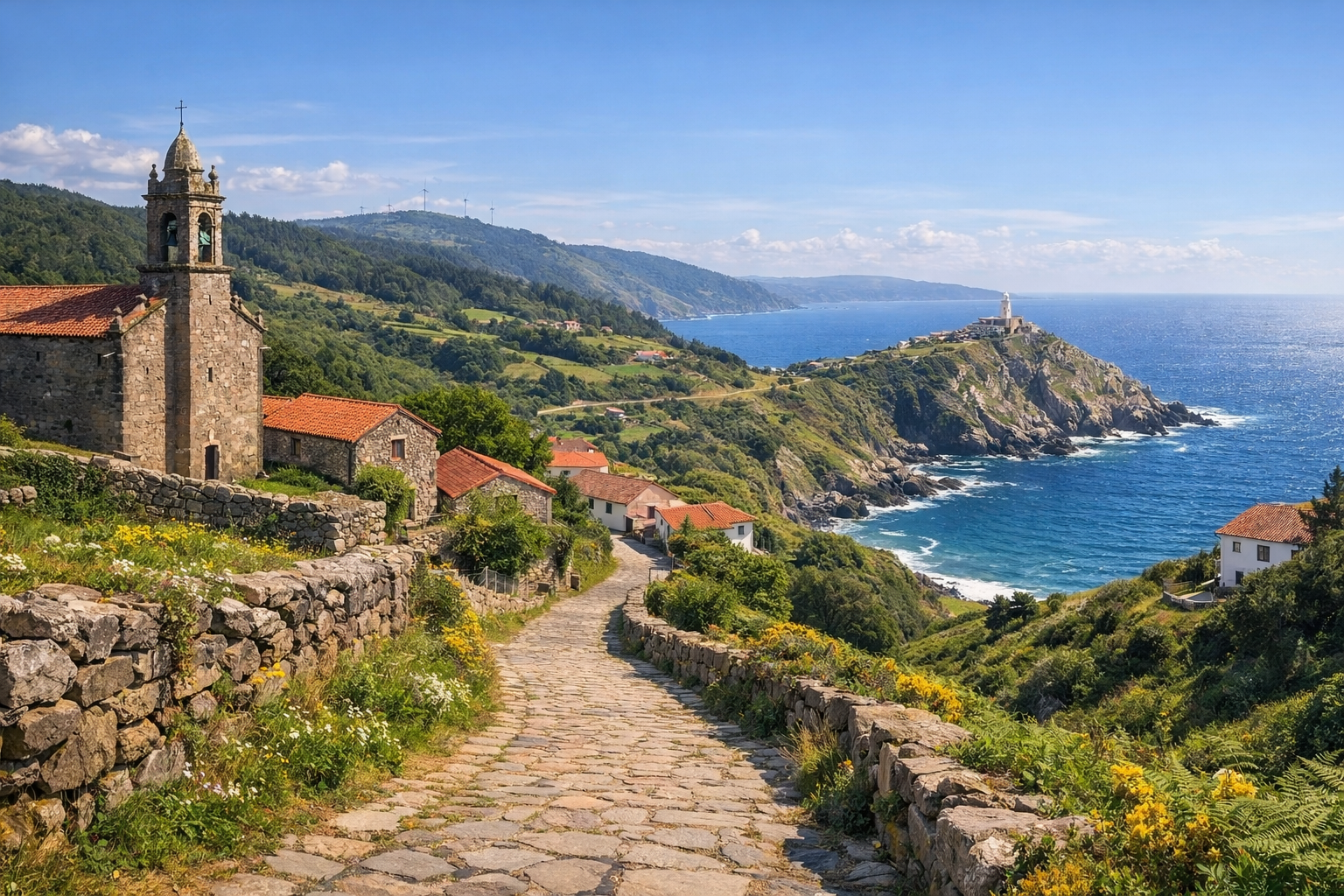
Follow the road beyond Santiago de Compostela through the lush hills of Galicia, where ancient paths lead toward the wild Atlantic. Along the way, from the Dolmen de Dombate to windswept Muxía and the far edge of Finisterre, the journey feels timeless, green, and deeply moving.

🧭 DAY-BY-DAY ROUTE

Ready-made country and city routes with daily plans, sights, transport and accommodation. Buy PDF guides for independent travel.

🧭 DAY-BY-DAY ROUTE


Day 1 — Santiago de Compostela: the sacred center of pilgrimage

  • 🚶 Begin your journey in Santiago de Compostela — the historic end point of the Camino de Santiago and one of Europe’s main sacred cities. Verifiable fact: the city grew around the cult of the Apostle James, and its cathedral has for centuries been the goal of pilgrims from across the continent. Santiago’s esoteric and mystical reputation is linked not to provable “anomalies,” but to a cultural layer of legends, symbols, and rituals: medieval Christian mysticism, the image of the road as inner purification, the sacred geography of Western Europe, and a whole language of signs intertwine here — the scallop shell, star, cross, gate, crypt, relics, incense smoke. In practice, this is felt very physically: cobbled streets, the constant ringing of bells, processions of pilgrims with staffs and backpacks, Galicia’s damp air, and the almost theatrical transition from a noisy square to the silence of side monastic courtyards.

  • 🚶 It is best to plan a calm, unhurried visit to the cathedral complex: outwardly the cathedral impresses with the baroque Obradoiro façade, but its spiritual depth is revealed through a route that passes museum spaces, the crypt, and symbolic points around the church. It is important to separate fact from tradition: the cathedral’s special importance for Western Christianity and the centuries-old practice of pilgrimage are historically confirmed; stories that the route “inevitably changes your fate” or that certain places in the cathedral possess special supernatural properties belong to personal belief and pilgrimage culture, not scientifically confirmed facts. If you want to add a subtle occult-symbolic frame to the route, pay attention to the medieval language of light, height, cardinal orientation, and ritual movement through thresholds: in European sacred architecture this is often interpreted as a transition from profane space into sacred space.

  • 🏛️ In the second half of the day, it makes sense to visit Museo das Peregrinacións e de Santiago, where the theme of the road is explored through the history of images, amulets, route markers, cult objects, and ideas of the journey as a spiritual trial. Then you can walk to the monastery of San Martiño Pinario: this is one of the largest monastic complexes in Spain, and even without mystification it makes a strong impression with its monumentality, the shadow of its interior volumes, and its almost labyrinthine atmosphere. In an esoteric key, such spaces are often perceived as places of solitude, contemplation, and discipline of the spirit, though this is precisely a cultural interpretation. The evening is best concluded with a slow walk through the old town without trying to “see everything”: for this route, the number of locations matters less than gradually entering into the theme of pilgrimage as both an inner and outer path.


Day 2 — Santiago de Compostela: symbols, traditions, and urban layers of mysticism

  • 🚶 Dedicate the second day to a less obvious but very atmospheric side of Santiago. Start with Museo do Pobo Galego and Bonaval Park: this is not an “esoteric center” in the direct sense, but a place where you better understand Galicia’s archaic layers — peasant culture, burial traditions, folk beliefs, attitudes toward death, memory, land, stone, and sea. This matters for an esoteric journey because many stories about “places of power” in Galicia grew precisely from the combination of pre-Christian ideas, Christian cults, and later romantic interpretations of Celtic heritage. Here it is especially important not to oversimplify: Galicia is often mass-branded as a “land of Celtic magic,” but the real history of the region is more complex and richer than tourist clichés.

  • 🎩 Then add Museo de la Magia de Galicia to your route. This is no ancient sanctuary, but a modern thematic space connected with the history of illusionism, stage magic, and the culture of wonder. For an esoteric tour, this stop is fitting as a reminder of the important difference between ritual, faith, folklore, and the art of creating marvels. The museum gently shows that the human desire for mystery manifests itself in very different ways: through religion, legend, stage magic, symbolic theater, and travel as a personal rite of passage.

  • 🚶 Spend the remaining time on a quiet walk through the old streets around Praza das Praterías, the arcades, small churches, and monastic façades. It is in this rhythm that Santiago begins to work as a threshold city: not as a collection of postcards, but as a space where every stone is connected with the idea of the road, repentance, the search for a sign, and meeting the end of the way. Legends about secret signs of master builders, about the special power of the western end of pilgrimage, about how here “the boundary between worlds is thinner,” belong to folklore, pilgrimage poetry, and modern esoteric interpretations. They can enrich your perception of the journey as a cultural layer, but should not be taken as proven fact.

Day 3 — Santiago → Dolmen de Dombate → Muxía

  • 🚗 It is best to travel toward Costa da Morte by car or private transfer, because that makes the route realistic and avoids being broken up by infrequent public transport connections. From Santiago to Dolmen de Dombate the road usually takes about 1.5 hours, then from Dombate to Muxía — about another 1 hour 15 minutes, depending on stops and weather. This day connects two different layers of Galicia’s sacred geography: prehistoric megalithic and later Christian-pilgrimage.

  • 🪨 Dolmen de Dombate is one of Galicia’s most important megalithic structures and one of the region’s best-known Neolithic monuments. Verifiable fact: this is a real archaeological site with an interpretation center, key to understanding the local megalithic culture. It is often called the “cathedral of Galician megalithism,” but this is a metaphor, not a historical term from the time of its construction. In esoteric circles, megaliths are often interpreted as astronomical, initiatory, or energetic places. Some such hypotheses rely on studies of spatial orientation and ritual function, but many popular claims about “portals,” “vibrations,” and a “healing field” have no scientific confirmation. What works best here is respectful contemplation: an ancient stone corridor, intimate lighting, a sense of the depth of time, and the understanding that before you is a space created for ritual or funerary use long before the written history of the region.

  • 🌊 Arrival in Muxía by evening. This town is especially important for continuing the pilgrimage logic after Santiago: for many, the road to the ocean does not end at the cathedral, but continues to the shore as a symbolic completion of an inner process. Muxía is connected with one of the strongest local traditions: according to custom, the Virgin Mary appeared here to the Apostle James in a stone boat to support him. Around the sanctuary of Virxe da Barca, Pedra de Abalar, Pedra dos Cadrís, and Pedra do Timón are linked to this tradition. It is important to distinguish clearly: the existence of the sanctuary, the stones, and their cultural significance is fact; stories about miraculous healings, testing innocence, fertility, or the stones’ special “energy” are part of religious tradition and folklore, not scientifically confirmed reality. The place is nevertheless visually powerful: granite, wind, ocean, a white church at the edge of the world, and the eternal movement of the waves create a rare feeling of the world’s outer limit.

Day 4 — Muxía: sanctuary, rocking stones, and the coast of legends

  • 🚶 This day is best spent without long transfers, focusing on the A Barca peninsula and the surroundings of Muxía. Santuario da Virxe da Barca is an active religious place, so it is important to keep quiet, dress appropriately, and not disturb services or private prayer. The sanctuary space itself is especially interesting precisely as an example of how a Christian cult became embedded in an older landscape of sacralized stones and sea. For a historian and traveler, this is an important case of syncretism; for a pilgrim, a place of consolation; for a lover of mysticism, a landscape saturated with symbols of transition, trial, and the edge of the world.

  • 🪨 Pay special attention to the stones Pedra de Abalar and Pedra dos Cadrís. Geologically, these are remarkable natural forms of the granite coast; culturally, they are among Galicia’s most famous “miraculous” stones. In tradition, they were credited with the ability to move as a sign of truth, help in rituals of purification or healing, and confirm the favor of higher powers. Today such stories are best understood as part of local religious imagination and folk culture. For safety reasons, you should not climb onto slippery stones during wind, rain, or heavy surf: the area is very beautiful, but the ocean here is harsh, and the granite becomes dangerous after moisture.

  • 🌫️ In the second half of the day, you can add a slow walk along Muxía’s waterfront and viewpoints, and in good weather — a short drive to more remote views along the Costa da Morte coastline. The region’s very name, “Coast of Death,” is connected not with some mystical deadly force, but above all with difficult navigation, reefs, storms, and numerous shipwrecks. Later romantic and esoteric interpretations intensified this image of the end of the world, where the sea is supposedly especially close to the other world. In a cultural sense, this is a very expressive myth, but it should not be taken literally. In the evening, it is useful to leave time for rest: after the windy coast and the heavy symbolic load of this route, silence here is almost essential.

Day 5 — Muxía / Finisterre: finale on the Atlantic

  • 🚗 In the morning, the transfer from Muxía to Finisterre usually takes about 35–45 minutes by car. If you drive along the coast without hurrying, the route feels very cinematic: granite villages, low skies, occasional crosses, the smell of salt, and an ever more open horizon. For centuries, Finisterre was perceived as the edge of the known world; the name itself goes back to the Latin idea of finis terrae — “end of the earth.” Historically, this is an important geographical and cultural image. Esoterically, Finisterre is often interpreted as a place of completing a cycle, the symbolic death of the old, and an encounter with the ocean as an archetype of the abyss, purification, and transition.

  • 🌅 The main point of the day is Cabo Fisterra and the lighthouse. For pilgrims, this is an unofficial but very meaningful end of the road after Santiago. In the past, there were practices of symbolically burning clothing or shoes as a sign that the journey was over; today these are treated cautiously, and there is no need to repeat them because of safety rules, fire risk, and environmental restrictions. Instead, it is better to choose a more respectful ritual of completion: a silent walk, a journal entry, a short meditation at a safe distance from the edge, gratitude to the road. Stories that “portals open” on the cape, that “karma is reset,” or that “the ocean takes away illnesses” belong to modern esoteric folklore and are not confirmed facts.

  • 🕯️ If time and interest allow, you can add a walk through the town of Finisterre itself and along the coast. Here a different rhythm is felt than in Santiago: less theology, more raw element. For some travelers, this is what becomes the true completion of pilgrimage — not the ceremonial square by the cathedral, but the wind by the lighthouse and the open Atlantic. After sunset or after your final walk, return for the night in Finisterre or Santiago depending on your flight logistics. But for this route, it is more beautiful and calmer to end the journey right by the ocean.

Flight tickets

eSIM for travel

Buy PDF guide

Buy PDF guide — 10.71 USD

PDF — 10.71 USD