
Buy PDF guide

Buy PDF guide — 15.00 USD

PDF — 15.00 USD

Ireland, west of the country. Celtic Ireland and the Atlantic. Stone monuments, monastic ruins, cliffs, and coastline come together in a journey about Celtic culture and ancient legends.

Ireland, west of the country. Celtic Ireland and the Atlantic. Stone monuments, monastic ruins, cliffs, and coastline come together in a journey about Celtic culture and ancient legends.

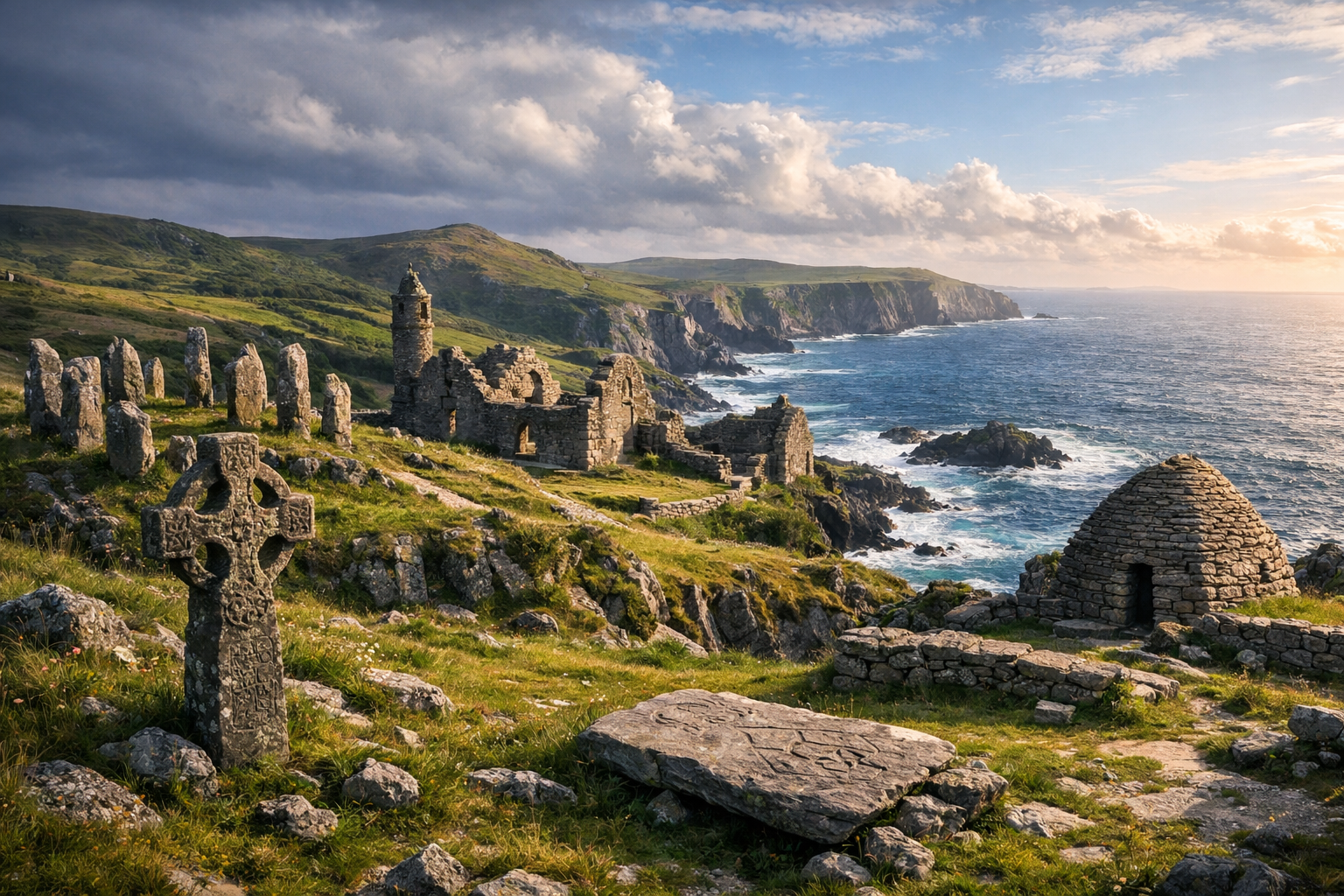
Discover Ireland’s wild west, where Atlantic light, ancient stone monuments, and monastic ruins shape a landscape steeped in Celtic spirit. From Westport through Sligo to the Burren and Ennistymon, this is a journey of dramatic cliffs, rugged coastline, and old legends that still seem close at hand.

🧭 DAY-BY-DAY ROUTE

Ready-made country and city routes with daily plans, sights, transport and accommodation. Buy PDF guides for independent travel.

🧭 DAY-BY-DAY ROUTE


Day 1 — Westport and Croagh Patrick: a sacred mountain against the backdrop of Clew Bay

  • 🚗 The recommended start of the route is via Ireland West Airport Knock. From the airport to Westport by car is about 1 hour 5 minutes to 1 hour 20 minutes, so renting a car is the most practical option here: western Ireland is very beautiful, but public transport between sacred and archaeological sites runs less frequently than in Dublin or Cork. After landing, allow time to pick up the car, make a short coffee stop, and drive calmly to your hotel by the water.

  • 🚶 Croagh Patrick above Clew Bay is one of Ireland’s most famous sacred mountains and a place where Christian memory, older ritual landscapes, and modern pilgrimage practice quite literally layer over one another. From a historical perspective, it is the key pilgrimage mountain in County Mayo, associated with the tradition of Saint Patrick, who according to church tradition fasted here for forty days. From the perspective of folklore and esoteric interpretations, Croagh Patrick is often called a “place of power” and a threshold between the earthly and other worlds, but such descriptions belong to the sphere of belief, personal experience, and local cultural mythology rather than scientifically proven effects. Even without mystical interpretations, the ascent is deeply impressive: the mountain’s pyramidal silhouette, the wind from the Atlantic, the islands scattered across the bay, and the feeling of an ancient route walked by pilgrims for centuries.

  • 🥾 If you go on foot, plan 3–4 hours for the ascent and descent at a moderate pace plus breaks. The trail is considered serious because of rocky sections, wet surfaces, and rapidly changing weather; in fog, strong wind, and rain it’s better not to push your luck. For a gentler first day, you can limit yourself to a walk at the foot of the mountain and views of it from Murrisk. Respect the pilgrimage nature of the place: do not make noise near religious sites, do not stray onto private land, and do not leave ribbons, coins, or “magical offerings” in nature.


Day 2 — North Mayo: Céide Fields and Atlantic cliffs as a prehistoric cosmos

  • 🚗 The drive Westport → Céide Fields usually takes about 1 hour 20 minutes to 1 hour 35 minutes each way along scenic but not high-speed roads. This is a day for an early departure: that way you will see the ancient landscape without rushing and still have time to return to Westport in the evening to rest.

  • 🚶 Céide Fields in County Mayo is one of the most impressive places in western Ireland for those interested in deep antiquity, ritual landscape, and the sense of the “memory of the land.” The verifiable fact here is that this is an outstanding prehistoric complex with very ancient field systems hidden beneath a layer of peat and an interpretation center by the ocean cliffs. Everything else—talk of “stone geometry,” “ancestral memory,” and the special energy of the Atlantic edge—belongs to modern esoteric readings and the personal feelings of visitors. But it is precisely the combination of archaeology, wind, empty plateau, and cliff above the ocean that makes this place almost cosmological: not a museum display, but a space where you can quite literally feel the scale of the Neolithic.

  • 🌊 Here it is especially important to take weather and seasonality into account. On the open coast, the wind can be very strong even in summer; fog rolls in quickly, and rain makes boardwalks and trails slippery. For an unhurried visit, allow 2–3 hours for the center and the walk, and then more time to contemplate the coast. If the esoteric theme of the route appeals to you, it is best to approach this place not as a “point of miracles,” but as a space of observation: ancient agricultural order, the horizon line, the ocean, and the cliffs create a meditative effect on their own without any need to assign supernatural properties to it.

Day 3 — Sligo: Carrowmore and Knocknarea, Neolithic corridors and the legend of Queen Medb

  • 🚗 The drive Westport → Sligo takes about 1 hour 45 minutes to 2 hours 10 minutes. After breakfast, leave without rushing, check into your hotel, and in the afternoon head into the ancient ritual landscape around Carrowmore. This pace makes the day realistic and does not turn it into a marathon.

  • 🚶 Carrowmore Megalithic Cemetery is one of the most important Neolithic complexes in Ireland and Europe, the largest concentration of ancient megaliths in County Sligo. Historically and archaeologically, this is a real monument of primary importance, where dozens of monuments have survived, and the modern visitor center helps explain the structure of the whole landscape. For an esoteric route, this is almost a mandatory stop: here it becomes especially clear how ancient burial and ritual places were embedded in an entire sacred geography, where other dominant features, including Knocknarea, can be read on the horizon. At the same time, any stories about “portals,” “power lines,” or contact with the otherworld should be understood as modern mythopoetic language and part of cultural imagination rather than established fact.

  • 🥾 In the second half of the day, it makes sense to hike up the Queen Maeve Trail to Knocknarea. The route is considered strenuous, the elevation gain is noticeable, and you should allow about 2.5–3 hours for the full ascent and descent. At the summit is a huge cairn traditionally associated with the legendary Queen Medb. Local folklore says that she is buried here standing upright, facing her enemies, but this is a legend, not a confirmed historical fact. A very important visiting rule: the cairn and its surroundings are considered a sacred burial place, so people do not climb on it for photos. This is one of those rare places where respect for antiquity matters more than any “perfect shot.”

Day 4 — Sligo: Carrowkeel, the Bricklieve Mountains, and cave legends of western Ireland

  • 🚗 From Sligo to the Carrowkeel area it is usually about 45–55 minutes by car, but the final road sections are rural, narrow, and require careful driving. This day is best planned only in good weather and with normal visibility: the whole point of the trip is the landscape, the silence, and the feeling of remoteness.

  • 🚶 Carrowkeel is one of Ireland’s most mesmerizing passage tomb complexes, located high in the limestone massif of the Bricklieve Mountains. This is no longer an “urban” archaeological site with convenient infrastructure, but rather a landscape experience: the approach by road, the walk in, the wind, the hills, and the stone structures that appear almost suddenly. The verifiable fact is that this is a genuine prehistoric cemetery of passage tombs. Its reputation as a place of transition, initiation, or especially strong subtle energy, however, is part of folklore and esoteric interpretation. That is the beauty of Carrowkeel: it does not impose an effect, but creates conditions in which people themselves experience an encounter with antiquity as something almost ritual.

  • 🕯️ If you still have energy, you can add views over the Keshcorran area and stories about caves associated with the Fianna, the sídhe, and other beings of Irish tradition. Here it is especially important to remember the boundary between culture and fact: the mountains, caves, and cairns are real; the tales of passages to the Otherworld, the people of the hills, and magical beings belong to Irish mythological heritage. Do not enter unmarked caves without preparation, do not climb over fences, and do not walk across private pastures. It is best to plan your return to Sligo before dark.

Day 5 — Sligo: Drumcliffe, Sligo Abbey, and the spiritual topography of monastic ruins

  • 🚗 This day is easier than the previous one and serves as balance in the route. Sligo → Drumcliffe takes about 10–15 minutes, and movements within the city are short, so there is space not only for transfers but also for contemplation, coffee, notes, and rest.

  • 🚶 Drumcliffe is a place where early Christian Ireland is almost physically visible: here there is the site of a monastic settlement traditionally founded by Saint Columcille in the 6th century, as well as a round tower and a high cross. For an esoteric journey, this point matters not because it is sensational, but because it shows the transition from pre-Christian sacred landscapes to monastic culture. Early Irish monasteries often arose in places that were already significant in local memory, and although not every such case can be strictly proven, it is here that the continuity of sacred geography is strongly felt. A later literary aura is added by the grave of W.B. Yeats: for many travelers, Sligo is a region where Celtic myth, poetry, and landscape form a single symbolic field.

  • 🏛️ In the second half of the day, head to Sligo Abbey, a 13th-century Dominican monastery in the city center. This is no longer the Neolithic and no longer a pilgrimage mountain, but the ruin of medieval spiritual discipline: stone arches, a graveyard, carved details, the silence of the former cloister. In esoteric routes, spaces like this are often romanticized as “haunted places” or “stone resonators of memory.” It is more accurate to say this: the ruins really do create a powerful atmosphere and carry a real historical trace of prayer, death, epidemics, and time, but any mystical experiences here are subjective. Keep in mind the site’s opening hours, uneven passages, and access restrictions; in the evening, it is better to end the day with a calm walk around Sligo rather than adding another long outing.

Day 6 — Burren and Ennistymon: Poulnabrone, Caherconnell, and the limestone labyrinth

  • 🚗 The drive Sligo → Ennistymon / Burren takes about 2 hours 40 minutes to 3 hours 15 minutes depending on traffic and the road you choose. This is the longest transfer of the route, so it is worth leaving early and keeping the program concentrated: after check-in, visit 2 key locations without trying to embrace all of Clare at once.

  • 🚶 Poulnabrone Dolmen is one of Ireland’s most recognizable megaliths, standing on the open limestone plateau of the Burren as if it had been placed there not by people, but by the geometry of the landscape itself. The historical fact is that this is a Neolithic portal tomb and an important archaeological monument. Everything involving “star gates,” a “stone altar of the elements,” or concentrated energy is a later esoteric and tourist interpretation. But it is precisely the minimalism of the place that makes it especially powerful in a cultural sense: one monument, gray stone, karst, sky, and almost complete absence of visual noise.

  • 🏰 Combine it with Caherconnell Stone Fort, which is very close by. Here you encounter a different layer of western Irish sacredness: a stone fort, archaeology, rural landscape, and a very clear understanding of how fortified and inhabited spaces interacted with the surrounding sacred topography. This place should not be confused with a proven “Druidic center” — archaeology does not directly confirm such claims. But as a site for reflecting on the Celtic and post-Celtic memory of the region, it is superb. When driving through the Burren, use caution: the roads are narrow, shoulders are minimal, and the weather changes quickly. On the open karst, do not leave marked trails and do not take stones.

Day 7 — Cliffs of Moher and the Clare coast: the edge of the Atlantic as the finale of a Celtic pilgrimage

  • 🚗 Ennistymon → Cliffs of Moher Experience takes about 20–25 minutes, and if you wish, the day can be supplemented with a stop in Doolin. It is a convenient finale: fewer transfers, more air and more time on the coast before a flight the next day or a further journey.

  • 🚶 The Cliffs of Moher are first and foremost a grand natural site, not an archaeological monument, but in the context of an esoteric journey they function as the culmination of the Atlantic archetype of western Ireland: the edge of land, the wind, the vertical cliffs, and the feeling of the world’s limit. Historically, geology, maritime navigation, and the cultural landscape of the coast matter more here; stories about “gates to other dimensions,” a “place of purification,” or the special magic of sunsets are folklore and modern spiritual interpretations. They may be mentioned as part of a living culture of perception, but not as fact. What is demonstrably real here is already impressive enough: a many-kilometer line of cliffs, seabirds, Atlantic panoramas, and one of Europe’s most powerful coastlines.

  • 🌬️ Allow up to 2 hours for the visit, or better yet more if you want to walk calmly along the viewing sections and sit at the edge of the day. Official safety rules apply on the site: do not climb over barriers, do not fly drones where this is prohibited, and watch children especially carefully in windy weather. If you still have time and energy, you can make a short final loop via the Burren Coast or Doolin Pier and say goodbye to the route not in the rhythm of a race, but in the rhythm of the true western shore — slow, windy, and full of ancient stories.

Flight tickets

eSIM for travel

Buy PDF guide

Buy PDF guide — 15.00 USD

PDF — 15.00 USD