
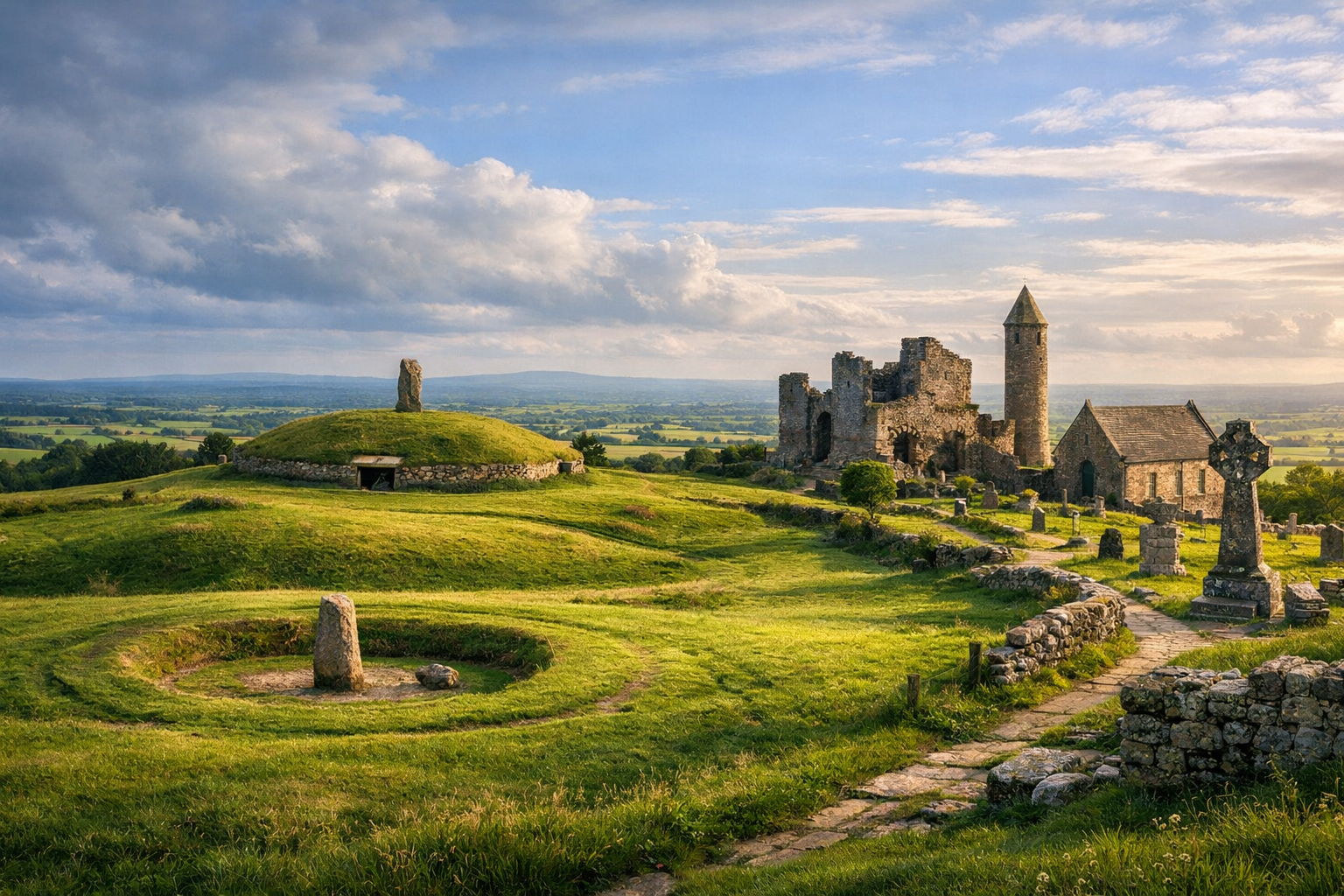
Day 1 — Hill of Tara, Trim, and an evening in the Boyne Valley
🚗 Transfer: Dublin Airport → Hill of Tara — usually about 40–50 minutes by car without serious traffic; from Dublin to County Meath, the most convenient option is a rental car, since the region’s sacred and archaeological sites are scattered across the countryside. If you don’t have a car, the logistics are possible via a bus to Navan or Trim and taxis for individual segments, but the day becomes noticeably less flexible.
🚶 The Hill of Tara is one of the most symbolically charged places in Ireland, where archaeology, early medieval politics, and folklore literally overlap. Verifiable fact: this is a real archaeological complex in County Meath, associated with the late Neolithic, the Iron Age, and the early Christian period; tradition places the residence of the High Kings of Ireland here. Today, what you mainly see on site are earthen banks and the outlines of ancient structures, not palaces or “stone temples,” so the impression works in a subtler way: this is a landscape of memory, not a museum set. Don’t miss the Mound of the Hostages — the oldest prominent monument on the hill, a passage tomb associated with very early phases of Tara’s ritual use. In clear weather, the space feels almost like a natural amphitheater of power: soft green slopes, wind, broad panoramas, and a sense of how sacred geography could serve a royal myth.
🌿 The esoteric layer of the route is presented separately from the facts here. In Irish tradition, Tara is often described as a “place of power,” a center of sacred authority and a point where the human world touched the world of sovereignty, ancestors, and gods. Legends connect the hill with Lia Fáil — the “Stone of Destiny,” which was said to respond to the touch of the true king. These stories matter as part of cultural memory and Celtic imagination, but they are not scientifically confirmed evidence of supernatural phenomena. The best way to experience the place respectfully is not to chase sensation, but to walk the route slowly, noticing how the relief, the visibility of the horizon, and the placement of the monuments create an almost ritual drama.
⚠️ Practicalities and respect: access to the hill itself is open year-round, and during the warmer season guides usually work on site. The surface is uneven, and the grass can be very slippery after rain; you need hiking shoes or at least footwear with good grip. Dogs are allowed outdoors only on a leash. Do not step onto sensitive parts of the earthworks, do not touch archaeological elements, and do not leave “offerings” — for a protected monument, this is harmful and inappropriate.
🚗 Transfer: Hill of Tara → Trim — about 25–30 minutes.
🏰 After the sacred landscape comes Trim, where the mystical tone of the journey shifts from prehistoric to medieval. Trim Castle is the largest Norman castle in Ireland, and although it is no longer a Celtic sanctuary, it works perfectly as a counterpoint: here you can see how a new system of power, fortification, and control later arrived on ancient royal land. Historically, this is a fortified center of Anglo-Norman influence, not an esoteric site. But in the context of the journey, it helps you feel how regimes of sacred and political authority changed in Meath. Walking along the outer walls and beside the River Boyne, it is easy to imagine the tense dialogue between the mythical Ireland of Tara and the more documented Ireland of castles, monasteries, and frontier defense.
🌙 In the evening, check into accommodation in Trim or a manor hotel near Navan. A night in this part of the Boyne Valley is especially good for a slow travel format: an unhurried dinner, a walk through quiet streets or around the estate grounds, and an early night before the megalithic day. For this route, it is better not to plan an intense nightlife program — the key here is not to “see everything,” but to let the places settle in your perception.