
Buy PDF guide

Buy PDF guide — 6.43 USD

PDF — 6.43 USD

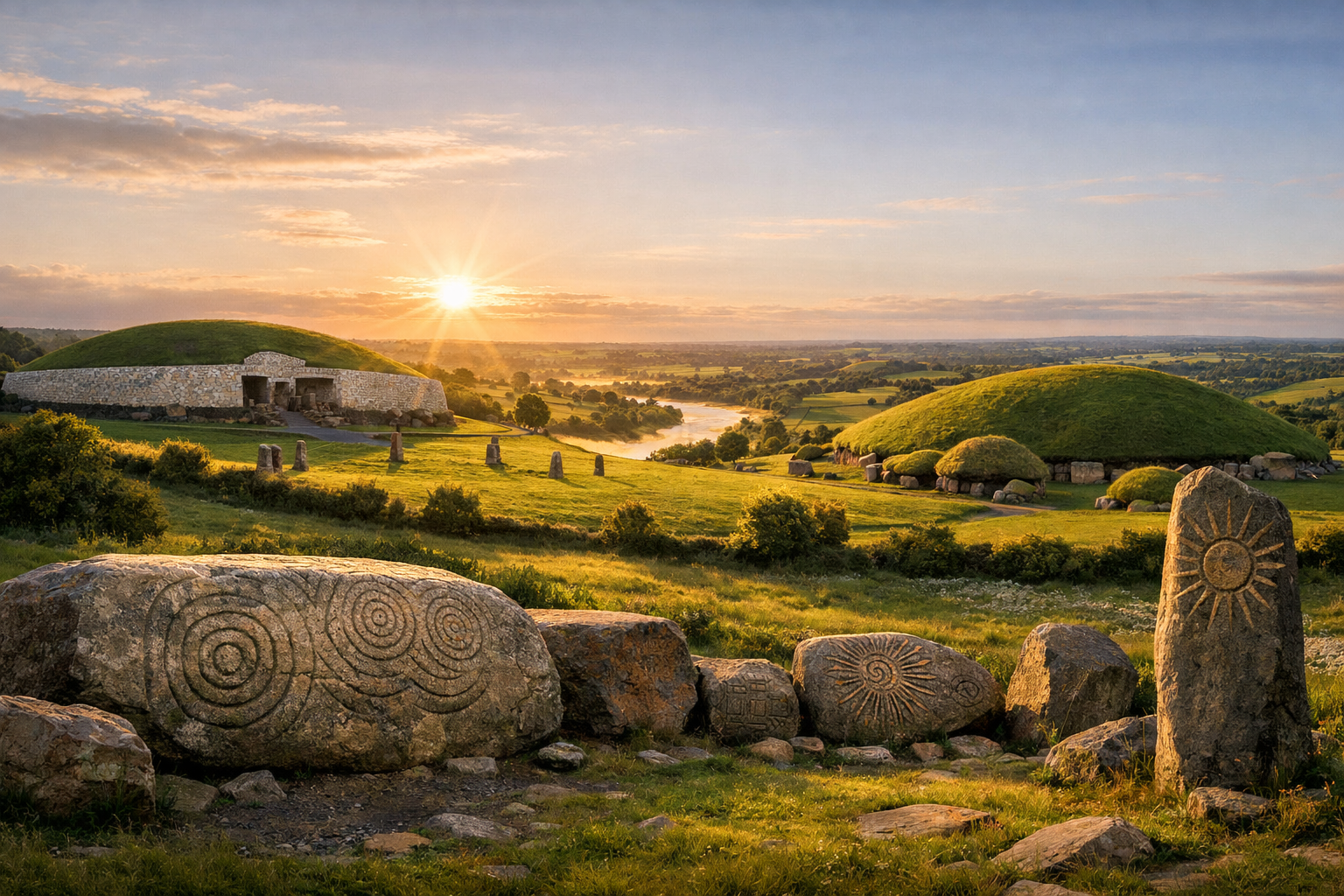
Ireland, the Boyne Valley. Newgrange and Neolithic solar symbols. Newgrange, Knowth, and the ancient landscape of the Boyne Valley for travelers interested in solstices, megalithic culture, and the symbolism of ancient Ireland.

Ireland, the Boyne Valley. Newgrange and Neolithic solar symbols. Newgrange, Knowth, and the ancient landscape of the Boyne Valley for travelers interested in solstices, megalithic culture, and the symbolism of ancient Ireland.

Step into Ireland’s Boyne Valley, where Newgrange and Knowth rise from an ancient landscape shaped by megalithic ritual, celestial alignments, and enigmatic solar symbols. Just beyond Dublin via Drogheda, this remarkable region draws travelers into the deep past at Newgrange, Dowth, Tara, and Loughcrew, where solstices and the sacred imagination of ancient Ireland still feel vividly alive.

🧭 DAY-BY-DAY ITINERARY

Ready-made country and city routes with daily plans, sights, transport and accommodation. Buy PDF guides for independent travel.

🧭 DAY-BY-DAY ITINERARY


Day 1 — Boyne Valley: Brú na Bóinne, Newgrange, and Knowth

  • 🚆/🚌 It is most convenient to plan your arrival in the region via Dublin and then travel on to Drogheda: there are direct buses from Dublin Airport to Drogheda, and from central Dublin it is also easy to take an Irish Rail train to Drogheda MacBride station. From Drogheda to Brú na Bóinne Visitor Centre, the local bus TFI Local Link Route 163 runs via the Battle of the Boyne Visitor Centre; if you have an early tour time slot, it is more practical to allow for a taxi or rental car, because access to Newgrange and Knowth is only through the official visitor centre and according to the tour schedule.

  • 🚶 The main day of the itinerary is dedicated to the sacred archaeological core of the Boyne Valley — the Brú na Bóinne complex, one of Europe’s most important Neolithic landscapes. Verifiable fact: Newgrange, Knowth, and Dowth are part of the archaeological ensemble of the bend of the River Boyne, included on the UNESCO World Heritage list; visits to Newgrange and Knowth are organized through the Brú na Bóinne Visitor Centre in Donore, from where visitors are taken by shuttle and accompanied by guides. The tour usually lasts about three hours, takes place outdoors, includes gravel paths and steps, and the entrance to the Newgrange chamber is narrow and low, so it is best to plan the day without unnecessary rushing.

  • ☀️ Newgrange is not just a famous mound, but an outstanding ritual and burial structure created more than five thousand years ago. It is especially beloved by travelers interested in solstices, because the winter solstice here is linked to a real and scientifically documented astronomical phenomenon: a ray of the rising sun penetrates through the roof-box and illuminates the inner chamber. Because of this, Newgrange holds a special place on the map of ancient sacred architecture. Esoteric interpretations often call it a “solar temple,” a “stone matrix of rebirth,” or a “place for attuning to cosmic cycles,” but these are cultural and symbolic readings, not proven properties. What is historically reliable is that the monument is connected with a highly developed Neolithic building tradition, complex ritual topography, and a carefully designed orientation toward sunlight.

  • 🌀 The stone carvings of Newgrange deserve special attention — the famous spirals, lozenges, arcs, and sun-like motifs on the kerbstones. For the modern esoteric traveler, this is one of the most compelling parts of the experience: the patterns are perceived as a visual language of meditation, a map of time cycles, or symbolism of passage between worlds. But it is important to honestly separate levels of interpretation: archaeologists recognize the exceptional artistic and ritual significance of these ornaments, yet their exact meaning remains a subject of scholarly debate. So it is best to view them through two lenses at once — as an authentic prehistoric cultural code and as a source of later mystical interpretations.

  • 🌍 Knowth complements Newgrange with a different type of impression. It is a huge mound complex with surrounding smaller tombs and one of the richest collections of megalithic art in Ireland. Unlike Newgrange, visitors are usually not taken into the chambers of Knowth, but the climb to the top and the view over the Boyne Valley provide an important sense of landscape logic: it becomes clear that before you is not a solitary monument, but an entire ritual territory where hills, river, sightlines, and the placement of monuments all worked together. In esoteric culture, Knowth is sometimes interpreted as the “lunar” or “night” pole paired with the more “solar” Newgrange, but this is a later symbolic scheme, not an established historical fact.

  • 🌿 After the main tour, it is worth leaving a calm evening for Drogheda and recovery. This is fundamentally important for this kind of itinerary: instead of overloading yourself with locations, it is better to give yourself time to reflect on what you have seen, to write down notes about symbols, the orientation of the mounds, your own associations, and the differences between science, legend, and personal experience. If you want a gentle continuation of the theme, you can take a walk along the Boyne waterfront at sunset: in local tradition the river itself is surrounded by ancient legends, but any talk of “the memory of water” and the “energy of the valley” is best understood as the poetic language of culture, not as established reality.


Day 2 — Dowth, Oldbridge, and the Hill of Tara: between archaeology, royal myth, and sacred landscape

  • 🚗/🚌 The second day is best planned more flexibly: if you are without a car, combine Route 163 bus, taxis, and short walking sections; if you have car sharing or a rental, the day becomes much more convenient. You can begin with an external visit to Dowth — the third great monument of Brú na Bóinne. It is important to take access rules and seasonality into account: Newgrange and Knowth are visited through the visitor centre with tickets and official tours, while for Dowth you should check current rules and access conditions in advance before your trip. Do not enter closed areas, climb over fences, or treat the rural landscape as “no man’s land.”

  • 🌘 Dowth often creates a quieter and even more mystical impression than its famous neighbors. It is a real archaeological monument of world significance, but without the same museum-level staging of the visitor experience as Newgrange. That is exactly why lovers of “places of power” often consider it the most contemplative part of the Boyne Valley. In folklore and esoteric retellings, Dowth is associated with themes of darkness, hidden knowledge, and cycles of diminishing light; such images fit the atmosphere of the place well, but they are not scientifically confirmed functions of the monument. The verifiable fact here is different: before you is part of a huge Neolithic ceremonial landscape, not a set for legends.

  • 🏛️ Then it makes sense to move on to the Battle of the Boyne Visitor Centre at Oldbridge Estate. This is a monument from another era, but a very useful stop for understanding the geography of the valley itself. Here there is no Neolithic mysticism, but a historically documented battlefield of 1690, a museum exhibition, and walking routes through the estate landscape. For an esoteric itinerary, this point matters not as a “magical place,” but as an opportunity to see how the same landscape accumulates layers of meaning: from Neolithic sanctuaries to Christian, military, and national-historical narratives. This helps you feel the Boyne Valley not as a set of separate sites, but as a living palimpsest territory.

  • 👑 In the second half of the day, head to the Hill of Tara — one of Ireland’s most culturally resonant sacred hills. Verifiable fact: this is a major archaeological complex important since the late Stone Age, and in the Iron Age and early Christian era it became a symbolic center associated in tradition with the High Kings of Ireland. The site is accessible year-round, and in the warm season guided tours are usually offered and a visitor point operates. From Drogheda or the Boyne Valley, it is more convenient to get here by car or taxi, because public transport takes more time and transfers.

  • 🔥 It is precisely at Tara that it is especially important to keep a double perspective — historical and mythological. On the one hand, this is a real royal and ceremonial site with embankments, earthworks, and traces of layered use. On the other hand, it is one of the most legend-saturated places in Ireland: here people tell of Lia Fáil, the “Stone of Destiny,” which supposedly responded to the coming of the true king; here too, in popular narrative, themes of druids, sacred power, the ruler’s marriage to the land, and turning points in the transition from the pagan past to Christian Ireland converge. All these narratives are extremely important as part of cultural memory, but they should not be confused with archaeologically proven details.

  • 🌬️ Tara is best experienced not through a search for miracles, but through attentive presence in the landscape. The wind, open fields, distant horizon lines, and the sense of the centrality of the space create an unusual experience in themselves. For many, this becomes the heart of an “esoteric” journey: not the promise of a supernatural effect, but the opportunity to enter a place that for centuries was considered an axis of power, myth, and memory. At sunset the hill is especially powerful visually; but if the weather is windy or wet, waterproof shoes are necessary because the ground can be slippery.

Day 3 — Loughcrew, Old Mellifont Abbey, and return: stone, light, and later spiritual history

  • 🚗 The third day is best suited for a longer trip to Loughcrew Cairns near Oldcastle in County Meath. This point makes the itinerary feel complete: if Newgrange gave you the experience of the winter sun, then Loughcrew reveals another facet of Neolithic astronomy and sacred geometry. It is easiest to get here by car or organized transfer, since public transport is too slow for a short three-day itinerary and will make the day tiring.

  • 🌄 Loughcrew is a group of ancient cairns on elevated ground where the topography itself plays a huge role. There is less of a museum-staged feeling here and more of a sense of contact with the open sky, the hills, and the ancient horizon line. The complex is especially famous because of Cairn T and its connection with the spring and autumn equinox: sunlight enters the chamber on certain days, which makes the site key for those interested in ancient astronomy. As with Newgrange, this is a real observable phenomenon, not a legend. But all talk of “portals,” “hill vibrations,” or “initiation through light” should be treated as modern spiritual interpretations, not as a proven function of the monument.

  • 🪨 Inside and around the Loughcrew monuments, the megalithic art is especially impressive: carved stones, symbols, lines, and cup-like motifs are perceived almost like an open library of prehistoric signs. For a traveler interested in the symbolism of ancient Ireland, this is no less important a stop than Newgrange. At the same time, conditions on site can be harsher: climbing, wind, wet grass, uneven ground, so allow extra time, water, and shoes with good grip. If the weather suddenly turns much worse, it is better to shorten the program than to try to “push through” the route just for a beautiful photo.

  • ⛪ On the way back toward Drogheda, it is worth making one more meaningful stop — Old Mellifont Abbey. This is no longer the Neolithic, but medieval monastic Ireland: the first major Cistercian foundation in the country, connected with a completely different spiritual discipline — prayerful, monastic, liturgical. For an esoteric itinerary, this point is valuable as a contrast: from prehistoric stone symbolism to Christian architecture of contemplation, from cairn cosmology to monastic time. No supernatural promises are needed here — the very смена spiritual eras already creates a deep impression.

  • 🕯️ The end of the journey is best made quiet and collected. In your final hours in Drogheda or on the way to the airport, you can shape your personal conclusion to the route: what in these places belongs to archaeologically established knowledge, what belongs to medieval legends and later myths, and what belongs to your own inner response to landscape, light, and ancient symbols. This approach is especially honest for esoteric tourism: you do not present poetry as science, but neither do you deny yourself the right to a profound experience.

  • ✈️ It is convenient to plan your return via Drogheda: then continue by bus to Dublin Airport or by train/bus to the capital. If you are leaving the same day, do not schedule Loughcrew too late: it is the longest section of the route and needs a real time buffer for road, weather, and rest.

Flight tickets

eSIM for travel

Buy PDF guide

Buy PDF guide — 6.43 USD

PDF — 6.43 USD